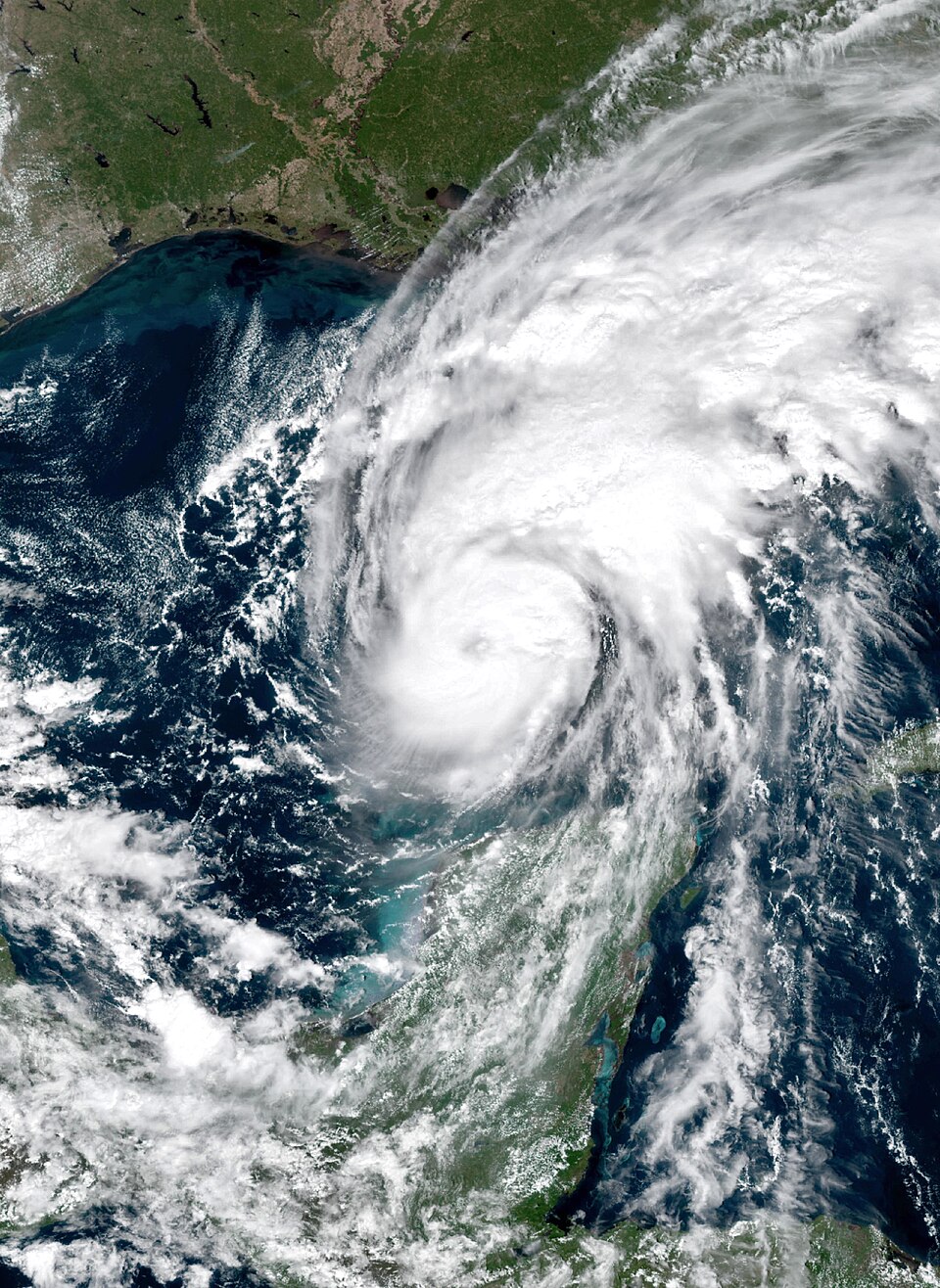
Isaias nears the Gulf Coast with 63 percent of Gulf oil shut in
The National Hurricane Center's advisory 11, at 4 a.m. CDT on Friday 9 October, put Hurricane Isaias about 200 miles south-southeast of the mouth of the Mississippi with 110 mph winds and landfall expected between Ocean Springs, Mississippi, and the Florida Panhandle on Friday night or early Saturday; the Marine Minerals Administration counted 62.89 percent of Gulf oil output and 57.35 percent of gas shut in on Thursday, up from 25.08 and 16.37 percent on Wednesday, with 121 of 371 manned platforms evacuated; Bloomberg reported Chevron's Pascagoula refinery on the western edge of the forecast path.
What happened
The National Hurricane Center's public advisory number 11, issued at 4:00 a.m. CDT on Friday 9 October, placed the eye of Hurricane Isaias about 200 miles south-southeast of the mouth of the Mississippi River, moving north-northeast at 15 mph, with maximum sustained winds near 110 mph and a minimum central pressure, the air pressure at its center, of 963 millibars. 'Isaias is likely to become a major hurricane this morning,' the center wrote, and 'on the forecast track, Isaias is expected to approach the U.S. northern Gulf Coast this afternoon and make landfall within the warning area tonight or early Saturday.' A hurricane warning, meaning hurricane conditions are expected within 24 hours, runs from Ocean Springs, Mississippi, to the Bay/Gulf County line in Florida, and a storm surge warning, for rising water pushed inland from the sea, runs from the mouth of the Mississippi River to the Suwannee River in Florida. The advisory puts the possible surge at 5 to 7 feet above ground from Dauphin Island, Alabama, to Indian Pass, Florida, and 3 to 5 feet in Mobile Bay. [1]
Isaias became a hurricane at 10:30 p.m. CDT on Wednesday 7 October, when data from an Air Force Reserve hurricane hunter aircraft showed maximum sustained winds of 75 mph, the center said in an update; Argus called it the first named hurricane of the 2026 Atlantic season, and Reuters had reported forecasters saying on Tuesday 6 October that it would be the first Atlantic hurricane of 2026. The center's forecast discussion of Friday morning calls for 'a high-end category 2 intensity at landfall', with stronger crosswinds high in the atmosphere, called shear, expected to weaken it first, and it warns that 'it would only take about a 6h delay in the onset of the shear to bring a stronger hurricane than expected onshore.' Its forecast puts the center inland near 31.0 north, 87.1 west, at 0600 UTC on Saturday 10 October, 1:00 a.m. CDT, with 75 mph winds. [3, 2, 16, 17]
Offshore, the producers had already moved. The Marine Minerals Administration, the Interior Department's offshore regulator, said on Thursday 8 October that operators had evacuated 121 production platforms, 32.61 percent of the 371 manned platforms in the Gulf, and estimated that 62.89 percent of the Gulf's current daily oil production, 1,282,879 barrels a day, and 57.35 percent of its natural gas production, 1,127 million cubic feet a day, had been shut in. Shell said it was evacuating all staff and shutting in production at its Mars, Olympus, Ursa, Vito and Appomattox assets and had moved non-essential personnel from its Stones platform, and Chevron said it had shut in production at five of its operated facilities in the region, Argus reported. [6, 16]
The record
The regulator's three releases show the pace. On Tuesday 6 October, in a release about the system it still called Invest 92L, the agency counted 9.24 percent of oil output, 185,120 barrels a day, and 3.36 percent of gas shut in, no platforms evacuated, from one company's reports. On Wednesday 7 October it counted 25.08 percent of oil, 511,619 barrels a day, and 16.37 percent of gas, eight platforms evacuated. On Thursday it was 62.89 and 57.35 percent from twelve companies' reports. Shutting in means closing safety valves below the sea floor so no oil or gas can escape, the agency explains, often done from a remote location; its percentages are estimates built from what each operator expected to produce that day. The agency's name is new: its releases say the Interior Department reunified the Bureau of Ocean Energy Management and the Bureau of Safety and Environmental Enforcement into the Marine Minerals Administration as of Friday 10 July 2026, and the releases are still posted on the safety bureau's website. [4, 5, 6]
The Energy Information Administration, EIA, the government's energy statistics agency, puts output from the federal waters of the Gulf at 2,043,000 barrels a day in July 2026, out of 13,948,000 for the whole country, in its monthly table released on Wednesday 30 September. By the desk's arithmetic that is 14.6 percent of US crude production, and the regulator's Thursday figures imply about 2.04 million barrels a day of expected Gulf output (1,282,879 over 62.89 percent), which agrees with the EIA's July figure. [7, 6]
Onshore, the Gulf Coast is where the country's crude oil is turned into fuel. The EIA counts 9,876,563 barrels a day of operable refining capacity in the Gulf Coast district, which it calls PADD 3 (Texas, Louisiana, Mississippi, Alabama, Arkansas and New Mexico), out of 18,160,493 for the United States as of 1 January 2026. By the desk's arithmetic that is 54.4 percent of the nation's capacity in one district. [8, 9]
The plants were running hard before the storm. The EIA's weekly table puts refinery use of capacity at 94.0 percent on average over the four weeks ending Friday 2 October, against 92.5 percent a year earlier; stocks of distillate, the diesel and heating oil family, stood at 105.1 million barrels against 121.6 million a year earlier, and the Strategic Petroleum Reserve, the government's emergency crude stock, held 283.0 million barrels against 407.0 million. CNN reported that the reserve is at its lowest level since 1982. [10, 19]
The ports closed in steps. The US Coast Guard set Port Condition Yankee for the Port of Mobile, meaning gale-force winds are expected within 24 hours: ships may enter only with Coast Guard permission and those leaving must arrange to depart immediately, the Alabama Port Authority said on Thursday 8 October, and that it would suspend vessel operations at its public berths at noon CDT that day and terminal operations at the close of business. The Coast Guard set the earlier condition X-ray, gale-force winds within 48 hours, for the ports of Plaquemines, New Orleans and St Bernard in Louisiana on Wednesday 7 October, and those ports remained open to commercial traffic, Argus reported. [15, 16]
Who it reaches
Chevron is reached on both sides of the shoreline. Its annual report for 2025 lists the Pascagoula refinery in Mississippi at 369,000 barrels a day of operable capacity, with crude inputs of 365,000 barrels a day in 2025, the largest of the five US refineries in its table. The plant was on the western edge of the hurricane center's projected path as of Thursday 8 October, Bloomberg reported, and Chevron said it was monitoring the storm and making 'appropriate preparations' at onshore facilities. Shell's offshore assets named above are in the Gulf, and Argus lists Shell's 231,000 barrel a day Norco refinery in Louisiana among the onshore plants in the threatened area; CNN reported that BP had also evacuated non-essential personnel from its platforms and curtailed production. [12, 18, 16, 19]
The Louisiana refiners sit west of the hurricane warning, which begins at Ocean Springs, Mississippi, in the area Reuters reported on Tuesday 6 October that the storm was speeding towards. Argus lists Marathon Petroleum's 617,000 barrel a day Garyville refinery, PBF Energy's Chalmette refinery and Valero's Meraux and St. Charles plants, and reported that the current projected track 'would likely spare most of the refineries in Louisiana from the most severe hurricane impacts.' PBF's annual report puts Chalmette at 185,000 barrels a day, and Valero's puts Meraux at 135,000 and St. Charles at 340,000. [1, 17, 16, 14, 13]
Smaller plants lie in the path itself. Vertex Energy's refinery at Mobile, Alabama, which can process 88,000 barrels of crude a day, is directly in the projected path, and Hunt Refining's 50,000 barrel a day plant at Tuscaloosa, Alabama, further inland, is also in it; neither company immediately responded to a request for comment, Bloomberg reported. Neither company is in the desk's universe. Andy Lipow of Lipow Oil Associates wrote to CNN that 'there is no slack in the system to make up for lost refinery capacity,' and Bloomberg reported AAA's national average for gasoline at 4.36 dollars a gallon on Wednesday 7 October. [18, 19]
Where the sources disagree
On the size of the refineries, the press and the filings differ. Argus and Bloomberg put Pascagoula at 356,000 barrels a day; Chevron's annual report says 369,000 of operable capacity. Argus puts Chalmette at 190,000; PBF's report says 185,000. Argus puts Valero's Meraux at 125,000 and St. Charles at 215,000; Valero's report says 135,000 and 340,000. The filings are the companies' own figures as of the end of 2025, and the desk prints them as filed. [16, 18, 12, 14, 13]
On how much refining is at risk, the measures differ in what they count. Bloomberg reported nearly 500,000 barrels a day of capacity in the projected path; CNN reported Andy Lipow's estimate that about 2.7 million barrels a day, 14 percent of the nation's capacity, lies within or near it. Reuters put the Gulf states at about 50 percent of a national capacity of 18.2 million barrels a day, while the EIA's Gulf Coast district holds 54.4 percent by the desk's arithmetic; the district includes inland Arkansas and New Mexico. On how hard plants are running, Argus said above 90 percent, CNN about 95 percent, and the EIA's four-week average is 94.0 percent. [18, 19, 17, 8, 9, 16, 10]
The regulator's own Wednesday release has two slips the desk can see: it gives two evacuated rigs as 18.8 percent of 11, where two of eleven is 18.2 percent, and it calls the 17 rigs that hold their place with thrusters and propellers 'non-dynamically positioned', where its Thursday release calls the same 17 rigs dynamically positioned. Its Thursday release is still headed 'Tropical Storm Isaias', although the hurricane center had named it a hurricane on Wednesday night. Argus placed the expected landfall along the Florida-Alabama border; the center's own words are 'within the warning area', which stretches from Mississippi to the Florida Panhandle. [5, 6, 3, 16, 1]
What settles it next
The hurricane center's next complete advisory was due at 10:00 a.m. CDT on Friday 9 October, with intermediate advisories between them, and its forecast puts landfall on Friday night or early Saturday 10 October. The regulator said it would update its evacuation and shut-in figures at 1 p.m. CDT each day as appropriate, and that once the storm passes facilities will be inspected, production from undamaged ones brought back online immediately, and damaged ones may take longer. The restart statements will come from the operators named here. [1, 6]
The EIA's next weekly petroleum report, covering the week ending Friday 9 October, is due on Thursday 15 October at 12:00 p.m. eastern time, an alternate date set because of the federal holiday on Monday 12 October; it will show refinery use and stocks for the week of the storm's approach. CNN reported that even after a category 1 hurricane it can take a week to return refining operations to normal. [11, 19]
Sources
- National Hurricane Center, Hurricane Isaias public advisory number 11, 4:00 a.m. CDT, Friday 9 October 2026, 2026-10-09
- National Hurricane Center, Hurricane Isaias forecast discussion number 11, 4:00 a.m. CDT, Friday 9 October 2026, 2026-10-09
- National Hurricane Center, tropical cyclone update 'Isaias becomes a hurricane', 10:30 p.m. CDT, Wednesday 7 October 2026, 2026-10-07
- Marine Minerals Administration, release on Gulf of America activities in response to Invest 92L, Tuesday 6 October 2026, 2026-10-06
- Marine Minerals Administration, evacuation and shut-in statistics for Isaias, Wednesday 7 October 2026, 2026-10-07
- Marine Minerals Administration, evacuation and shut-in statistics for Isaias, Thursday 8 October 2026, 2026-10-08
- EIA, crude oil production by area, monthly, through July 2026 (released 30 September 2026), 2026-09-30
- EIA, number and capacity of operable petroleum refineries, United States, as of 1 January 2026 (released 26 June 2026), 2026-06-26
- EIA, number and capacity of operable petroleum refineries, Gulf Coast (PADD 3), as of 1 January 2026 (released 26 June 2026), 2026-06-26
- EIA, Weekly Petroleum Status Report highlights, tables for the week ending 2 October 2026, 2026-10-07
- EIA, Weekly Petroleum Status Report release schedule, holiday dates for 2026, 2026-10-08
- Chevron Corporation, annual report on Form 10-K for 2025, refining operations table, filed 24 February 2026, 2026-02-24
- Valero Energy, annual report on Form 10-K for 2025, refinery list, filed 25 February 2026, 2026-02-25
- PBF Energy, annual report on Form 10-K for 2025, refinery table, filed 12 February 2026, 2026-02-12
- Alabama Port Authority, 'Hurricane Isaias: Latest updates on Port of Mobile operations', updated 9:29 a.m. CDT, Thursday 8 October 2026, 2026-10-08
- Argus, 'Hurricane heads for US Gulf coast: Update', Thursday 8 October 2026, 2026-10-08
- Reuters, 'US forecasts hurricane later this week in Gulf of Mexico', Tuesday 6 October 2026, as carried by BOE Report, 2026-10-06
- Bloomberg News, 'Hurricane Isaias poses new threat to tight U.S. fuel market', Thursday 8 October 2026, as carried by Transport Topics, 2026-10-08
- CNN Business, 'A hurricane could cripple US refining when the world can least afford it', Thursday 8 October 2026, 2026-10-08
Every stock is a company; the desk grades the company behind the stock. This article describes; it does not recommend. Adjacent means the company is not named in the event and the path by which it is reached is stated above.