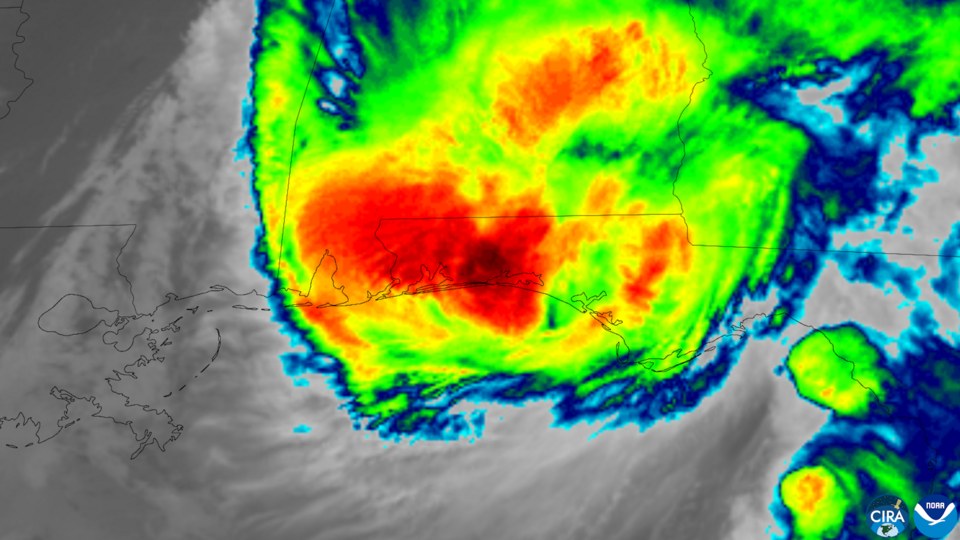
Isaias comes ashore near Destin with 72 percent of Gulf oil shut in
Hurricane Isaias made landfall near Destin, Florida, at about 8:30 p.m. CDT on Friday 9 October with 105 mph winds, a category 2, and was a post-tropical cyclone over Alabama by 4 a.m. on Saturday 10 October, the National Hurricane Center said; the Marine Minerals Administration counted 71.51 percent of Gulf oil output and 58.84 percent of gas shut in on Friday, up from 62.89 and 57.35 percent on Thursday, with 129 platforms evacuated; outage trackers counted more than 860,000 customers without power across the Southeast early on Saturday, CNN reported.
What changed since chapter one
Chapter one ended on the Marine Minerals Administration's Thursday 8 October count: 62.89 percent of the Gulf's daily oil output and 57.35 percent of its natural gas shut in, and 121 production platforms evacuated, with the storm still offshore. Since then Isaias has come ashore. The National Hurricane Center said that radar data showed Hurricane Isaias made landfall near Destin, Florida, around 8:30 p.m. CDT on Friday 9 October, 0130 UTC, with maximum sustained winds of 105 mph and an estimated minimum central pressure, the air pressure at its center, of 971 millibars. NBC News reported the landfall as a category 2 storm at 9:30 p.m. Eastern time. [9, 1, 14]
The storm peaked offshore and weakened at the coast. On Friday morning the center said an Air Force Reserve aircraft had measured winds that prompted 'an upgrade of the hurricane to major hurricane status with estimated surface winds of 105 kt', the center's measure in knots, or nautical miles an hour. By 10 p.m. CDT its advisory 14 put the center 45 miles east-northeast of Pensacola, moving north at 20 mph with 90 mph winds, and its discussion recorded that 'Isaias made landfall as a 90-kt hurricane at 0130 UTC near Destin, Florida.' At 4 a.m. CDT on Saturday 10 October, advisory 15 placed a post-tropical cyclone, one that has lost its tropical structure, about 25 miles south-southwest of Montgomery, Alabama, with 35 mph winds, and said all storm surge and tropical storm warnings had been discontinued; it was the center's last advisory on the system, with the Weather Prediction Center taking over at 10 a.m. CDT. [6, 3, 4, 5]
Offshore, the count went up one more step before landfall. The regulator said on Friday that, from operators' reports as of 11:00 a.m. CDT, personnel had been evacuated from 129 production platforms, 34.77 percent of the 371 manned platforms in the Gulf, and that about 71.51 percent of current daily oil production and 58.84 percent of natural gas production had been shut in, 1,458,814 barrels of oil a day and 1,259.2 million cubic feet of gas a day, from twelve companies' reports. By the desk's arithmetic that is 8.62 percentage points and 175,935 barrels a day more oil than on Thursday, and eight more platforms. [8, 9]
The record
Shutting in means closing safety valves below the sea floor so no oil or gas can escape, often from a remote location, the regulator explains; its percentages are estimates built from what each operator expected to produce that day. Its Friday table also counts 8 of the 11 rigs that are moored or stand on the sea floor evacuated, 72.73 percent, and 2 of the 17 dynamically positioned rigs, which hold their place with thrusters, moved off location. By the desk's arithmetic, 1,458,814 barrels over 71.51 percent implies about 2.04 million barrels a day of expected Gulf output, the same base as Thursday's figures. After the storm passes, the agency said, facilities will be inspected, production from undamaged facilities will be brought back online immediately, and damaged ones may take longer. [8, 9]
The regulator's Gulf of America region director, Bryan Domangue, told NPR on Friday that the storm was 'making a swooping turn, almost just to the east of where the most significant infrastructure is', and that it had 'swept just a little south of some of our major deepwater oil and gas facilities.' The Energy Information Administration, the government's energy statistics agency, wrote on Friday 9 October that as of Thursday 130 production platforms and rigs had been evacuated or moved, and that Isaias would be the largest storm system to make landfall in the region since Hurricane Helene in September 2024. By the desk's arithmetic the 130 matches Thursday's release: 121 platforms, 5 rigs evacuated and 4 dynamically positioned rigs moved. [19, 10, 9]
The ports closed before the storm. The Alabama Port Authority said the Coast Guard had set Port Condition Zulu for the Port of Mobile, meaning gale-force winds are expected within 12 hours: the port is closed to vessel traffic, cargo handling is suspended except as the Coast Guard authorizes, and reopening will depend on Coast Guard assessments. The Waterways Journal reported, citing the Gulf Intracoastal Canal Association, that Coast Guard Sector Mobile set Zulu at 2 a.m. on Friday 9 October for Mobile, Pascagoula, Gulfport, Pensacola and Panama City, and that Sector New Orleans expected to return to normal on Saturday 10 October. No statement from the Port of Pensacola itself, or from Colonial Pipeline, was found by the time of writing. [12, 18]
The outages are counted by trackers, and the counts climbed through the night. NBC News reported about 668,000 customers without power in Alabama, Florida and Georgia at around 11 p.m. local time on Friday, according to poweroutage.us: about 409,000 in Florida, 234,000 in Alabama and 26,000 in Georgia. CNN reported more than 770,000 across the Southeast in a post stamped shortly after 3 a.m. Eastern on Saturday, with about 425,000 in Florida and 304,000 in Alabama according to PowerOutage.us, and in a post stamped shortly before 5 a.m. Eastern that the total topped 860,000, with 442,305 in Florida, 313,755 in Alabama and 76,194 in Georgia according to PowerOutage.com. None of these is a utility's own count. [14, 15]
Who it reaches
Chevron's Pascagoula refinery in Mississippi lay west of the landfall. Bloomberg reported on Friday that three fuel-making plants were in or near the projected path, including Chevron's 356,000 barrel a day Pascagoula refinery, and the hurricane center's 10 p.m. advisory discontinued the hurricane warning west of the Mississippi/Alabama border. Debnil Chowdhury of S&P Global Energy told NPR that Pascagoula is 'very important to supplying airports throughout the southeast', and Chevron spokesman Ross Allen told NPR that refineries generally prepare for storms by trying to reduce flood risk. No statement from Chevron on the plant after landfall was found by the time of writing. [17, 3, 19]
Offshore, Chevron, BP and Shell were among the companies that reported evacuating personnel and shutting platforms, the AP reported, and NPR reported that Chevron planned to redeploy its evacuated drilling rigs once the storm passed. The Louisiana refiners of chapter one, Marathon Petroleum, Valero and PBF Energy, sit west of the landfall: the AP reported that the storm was forecast to miss the oil industry's biggest hubs, and the center's 10 p.m. advisory lifted the tropical storm warning west of Ocean Springs, Mississippi, and the storm surge warning west of Dauphin Island, Alabama. [16, 19, 3]
Onshore, the power companies are reached. Southern Company's annual report says it owns all the common stock of Alabama Power, Georgia Power and Mississippi Power. Alabama Power said more than 5,000 additional crews were coming in from nearly 25 states, WBRC reported on Friday. Florida Power and Light, a subsidiary of NextEra Energy, said on Friday that a restoration workforce of approximately 14,000, with support from crews across 17 states, was in place and that command centers were active in Pensacola and Juno Beach. Neither company had published its own outage count on the pages read for this piece; the counts above are the trackers'. [13, 20, 11]
Where the sources disagree
On the winds just after landfall, the record contradicts itself. The hurricane center's 9 p.m. CDT update gives maximum sustained winds of '85 mph (160 km/h)', but 160 kilometers an hour is about 100 mph by the desk's arithmetic; NBC News reported that the center said the earlier figure was wrong and the winds were 100 mph, while the archived update still reads 85. The trackers also disagree with each other: CNN cited PowerOutage.us for its count of more than 770,000 and PowerOutage.com for its count of more than 860,000, two trackers whose figures need not match. [2, 14, 15]
On the refineries at risk, AP reported the analyst Andrew Lipow's figure that Pascagoula and Vertex Energy's Mobile refinery make up 2.4 percent of the nation's refining capacity, and NPR reported S&P Global Energy's figure of about 2.5 percent of the nation's capacity and about 5 percent of the Gulf Coast's. Bloomberg's Friday story gave gas shut-ins as 59 percent of regional output in one paragraph and about 57 percent, Thursday's figure, in another. The EIA's note gives Thursday's gas shut-ins as '1.1 billion million cubic feet per day', a unit slip for 1.1 billion cubic feet. The Alabama Port Authority's update is headed 'Last updated: Thursday, October 9', a date that fell on a Friday. [16, 19, 17, 10, 12]
What settles it next
The regulator said it would keep updating evacuation and shut-in statistics at 1 p.m. CDT each day as appropriate; no release dated Saturday 10 October had been posted when this was written early that morning. The restart statements will come from the operators, after the inspections the agency describes. The ports reopen on Coast Guard assessment and authorization, the Alabama Port Authority said, and the Waterways Journal reported that the Army Corps of Engineers was coordinating post-storm channel surveys with NOAA. The Weather Prediction Center's advisories follow the remnant, which the hurricane center forecast to dissipate on Sunday 11 October. [8, 12, 18, 5]
The EIA's next weekly petroleum report, for the week ending Friday 9 October, is due on Thursday 15 October at 12:00 p.m. eastern time, an alternate date because of Columbus Day; it will carry refinery use and fuel stocks for the week of landfall. The restoration figures will come from the utilities themselves, and FPL directs customers to its PowerTracker for outage and restoration information. [7, 11]
Sources
- National Hurricane Center, Hurricane Isaias tropical cyclone update, 'Isaias makes landfall near Destin Florida', 8:30 p.m. CDT, Friday 9 October 2026, 2026-10-09
- National Hurricane Center, Hurricane Isaias tropical cyclone update, 9:00 p.m. CDT, Friday 9 October 2026, 2026-10-09
- National Hurricane Center, Hurricane Isaias public advisory number 14, 10:00 p.m. CDT, Friday 9 October 2026, 2026-10-09
- National Hurricane Center, Hurricane Isaias forecast discussion number 14, 10:00 p.m. CDT, Friday 9 October 2026, 2026-10-09
- National Hurricane Center, Post-Tropical Cyclone Isaias public advisory number 15, 4:00 a.m. CDT, Saturday 10 October 2026, 2026-10-10
- National Hurricane Center, Hurricane Isaias forecast discussion number 12, 10:00 a.m. CDT, Friday 9 October 2026, 2026-10-09
- EIA, Weekly Petroleum Status Report release schedule, holiday dates for 2026, 2026-10-10
- Marine Minerals Administration, 'MMA Monitors Gulf of America Oil and Gas Activities in Response to Hurricane Isaias', evacuation and shut-in statistics, Friday, 2026-10-09
- Marine Minerals Administration, evacuation and shut-in statistics for Isaias, Thursday 8 October 2026, 2026-10-08
- EIA, Today in Energy, 'Hurricane Isaias nears landfall, leading to production shut-ins', Friday 9 October 2026, 2026-10-09
- Florida Power and Light, 'FPL is ready to respond as Hurricane Isaias nears the Florida Panhandle', Friday 9 October 2026, 2026-10-09
- Alabama Port Authority, Hurricane Isaias update on the Port of Mobile, Port Condition Zulu, headed 'Last updated: Thursday, October 9, at 8:31 a.m. CDT', 2026-10-09
- Southern Company, annual report on Form 10-K for 2025, Item 1 Business, filed 19 February 2026, 2026-02-19
- NBC News, live coverage, 'Isaias weakens to a post-tropical cyclone after making landfall near Destin, Florida', 9 and 10 October 2026, 2026-10-10
- CNN, live updates, 'Isaias pushes into Southeast after smashing into Gulf Coast as a powerful hurricane', 9 and 10 October 2026, 2026-10-10
- Associated Press (Matthew Brown and Josh Kelety), 'Hurricane Isaias could nudge fuel prices higher if Gulf of Mexico refineries lose power', Friday 9 October 20, 2026-10-09
- Bloomberg News, 'Hurricane Isaias reaches Category 3 as it nears Florida', Friday 9 October 2026, as carried by Energy Connects, 2026-10-09
- The Waterways Journal, 'Isaias nears major hurricane strength as Sector Mobile ports close', Friday 9 October 2026, 2026-10-09
- NPR, 'How the oil industry is preparing for Hurricane Isaias', Friday 9 October 2026, 2026-10-09
- WBRC, 'Alabama Power ready for outages as state braces for Hurricane Isaias', Friday 9 October 2026, as carried by WDAM, 2026-10-09
Every stock is a company; the desk grades the company behind the stock. This article describes; it does not recommend. Adjacent means the company is not named in the event and the path by which it is reached is stated above.