Drones shut the Saudi pipeline that bypasses Hormuz
The line carried 4 to 5 percent of the world's oil to the Red Sea while the strait stayed closed. The ministry's two statements, the IEA's September figures and the buyers' delayed cargoes show what the stoppage costs and who pays it, and the repair clock Bloomberg's source gave runs to late October.
What happened
On the morning of Thursday 10 September, drones hit Saudi Arabia's East-West pipeline in the Riyadh and Madinah regions. The Saudi Press Agency carried the energy ministry's statement the next day: the line was shut down as a precautionary measure, a number of people were injured and given medical care, and emergency and technical teams were securing the pipeline and assessing its safety, with further developments to be announced in due course. On 12 September the foreign ministry said several drones launched from Iraq had caused injuries and some damage, and that the Kingdom had chosen not to respond at this stage, at the request of Iraq's prime minister, while reserving the right to take all necessary measures. Al Jazeera reported that the office of Iraq's prime minister traced the launch to Maysan province in the southeast of Iraq. [1, 2, 3]
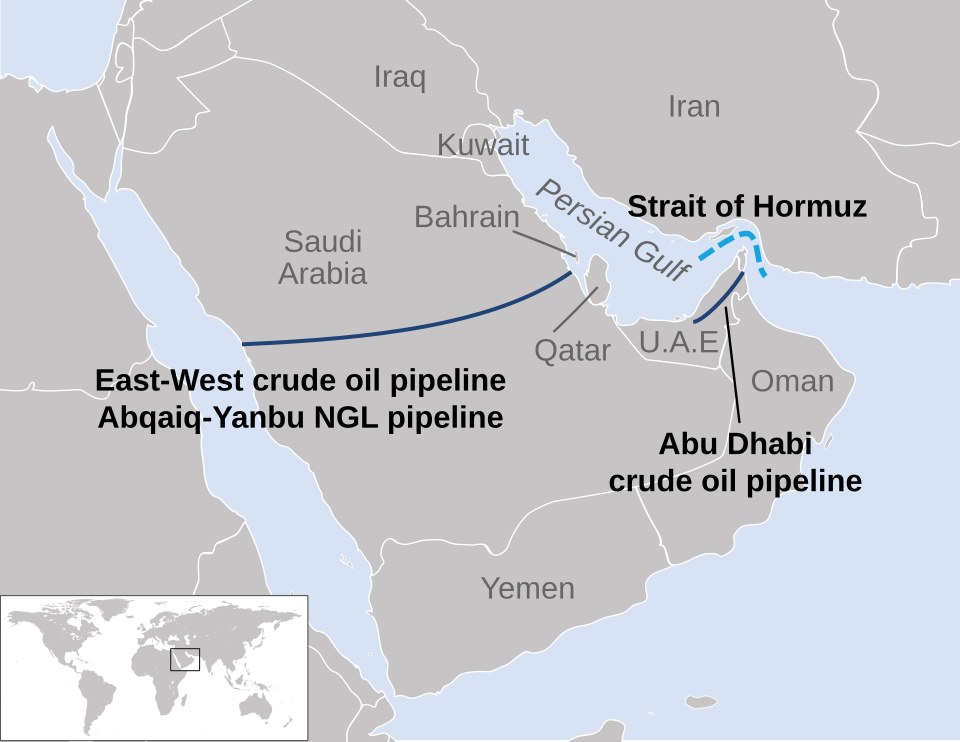
The pipeline is the Kingdom's way around the Strait of Hormuz. Built in 1981 and known as the Petroline, it runs about 1,200 kilometres from the Abqaiq processing centre in the east to the port of Yanbu on the Red Sea, with a capacity of up to 7 million barrels a day, of which about 2 million feed Saudi refineries along the way. Since the strait closed in March it has been the main route for Saudi crude to reach a ship: Al Jazeera put the flow at 4 to 5 million barrels a day in recent months, about 4 to 5 percent of the world's supply. Fortune reported in March that the Kingdom switched to the line within hours of the first American and Israeli strikes on Iran. [3, 4, 16]
For the buyers, the shutdown showed up as silence and then delay. Reuters reported on 14 September that two Suezmax tankers, Lahore and Aspen, were due to load at Yanbu that Monday and a very large crude carrier, Kenya B, within days; one refiner had been told its loading would be delayed with no new date, and three others had heard nothing. By 15 September Oilprice.com reported that Aramco had confirmed loadings from Yanbu were suspended and had cancelled some late-September cargoes for European term buyers. The Maritime Executive reported satellite imagery from Soar Atlas showing significant damage at three pumping stations. [6, 10, 11]
On Wednesday 16 September, Bloomberg reported, citing a person familiar with the matter, that Aramco was working to bypass the damaged section and aimed to restore roughly half the line's capacity within days and its full capability in about six weeks; Aramco and the energy ministry did not respond to its request for comment. The same report said Aramco had sold about 20 million barrels to Asian refiners for pickup in September and October, and that Poland's Orlen had bought replacement cargoes elsewhere. Anadolu Agency reported the United States energy secretary, Chris Wright, saying the line was expected to resume operations within days and calling the disruption temporary, and reported Brent falling 3.8 percent to $104.80 a barrel on the day. [7, 8, 9]
The record
What the two statements say, and what they do not. The energy ministry's statement gives the day and the morning, the two regions, the injuries and the precaution; it gives no figure for the damage, no restart date and no estimate of the crude held back. The foreign ministry's statement adds the origin of the drones, the words injuries and some damage that is currently being addressed, and the decision to let the Iraqi government act first. Neither names Aramco's plan, the bypass or the six weeks; those come from Bloomberg's unnamed source and from the trade press, and this study keeps them apart from the record. [1, 2]
The International Energy Agency's monthly report came out on 11 September, the day of the shutdown announcement, and does not mention the pipeline; it describes the market the line was holding up. World supply is put at 100.7 million barrels a day for 2026, down 5.7 million on the year, and the agency expects demand to fall by 2.5 million barrels a day, a steeper drop than it saw a month earlier. The Gulf's oil exports averaged about 13 million barrels a day in August, nearly half their pre-war level. Stocks have been drawn down by 507 million barrels since February. North Sea Dated crude averaged $91.00 a barrel in August and reached $113.48 on 9 September, and diesel in the United States passed $200 a barrel in early September, 94 percent above its pre-war level, all as the agency reported. [13]
The agency's June commentary measured the bypass at work: flows through the East-West line to Yanbu rose from about 2 million barrels a day before the war to more than 5 million by early June, the United Arab Emirates' Habshan to Fujairah line carried 1.8 million a day, and member countries released 400 million barrels from emergency stocks while global stocks fell at a record pace. The United States Energy Information Administration's chokepoint analysis from June 2025 gives the scale of what the strait carried: about 20 million barrels a day of oil in 2024, a fifth of the world's use, Saudi crude alone 5.5 million barrels a day of it, and 84 percent of the crude going to Asia. The same analysis puts the East-West line's nominal capacity at 5 million barrels a day, expanded temporarily to 7.0 million in 2019. [14, 15]
The line has been hit before and repaired fast. Global Energy Monitor's entry describes two parallel pipes of 48 and 56 inches with eleven pumping stations, a capacity of 5 million barrels a day since 1992, a plan announced in 2016 to reach 7 million, and drone strikes attributed to Yemen's Houthis in May 2019. MEES reported that an Iranian strike on 8 April this year took out one pumping station, cut throughput by 700,000 barrels a day, and was repaired by 12 April. Al Jazeera reported that a March strike near the Saudi Aramco and ExxonMobil refinery at Yanbu disrupted crude loading for days before shipments recovered. [17, 18, 4]
The summer had already cut the flow. Reuters reported that loadings at Yanbu fell to 500,000 to 1 million barrels a day in July, from about 6 million in June, after the Houthi blockade of Red Sea shipping began in July, and that Chinese refiners stopped loading in the Red Sea in August. Kpler's count for August, as Al Jazeera carried it, was about 2 million barrels a day through the line, the lowest month since January, and Al Jazeera reported the IEA counting Saudi supply in August at its lowest in more than thirty years. Traders told Reuters that Yanbu held five to seven days of export stocks when the line stopped, with a few more days available from Egyptian storage at Ain Sukhna and Sidi Kerir. [4, 6, 7]
Who it reaches
The buyers first. The EIA's figures show where Gulf crude goes: 84 percent of it to Asia, with China, India, Japan and South Korea taking 69 percent between them. Reuters reported an Asian refiner saying that getting sour crude is a challenge and that all would be chasing limited supplies from Iraq, the UAE and others at higher prices. Bloomberg reported Aramco's sale of about 20 million barrels to Asian refiners for September and October and Orlen's replacement purchases in Europe. None of those buyers is listed in the United States; the company on this site with a stake at Yanbu is ExxonMobil, Aramco's partner in the refinery there. [15, 6, 8, 4]
Producers and refiners next, through the prices the sources report. Anadolu reported Brent at $104.80 and WTI at $101.59 on 16 September after the restart reports, down about 4 percent on the day; NBC News reported Brent above $109 and diesel at a record $6.23 a gallon on AAA's count on 14 September, up 75 percent this year; the IEA reported United States diesel above $200 a barrel in early September. Exxon Mobil, Chevron, Occidental and ConocoPhillips sell crude at prices that move with those benchmarks; Valero, Marathon Petroleum and Phillips 66 sell the diesel and gasoline those figures describe. This site prints none of those prices as its own; each is the named outlet's report on the named day. [9, 12, 13]
Ships and planes. Oilprice.com reported that chartering a very large crude carrier in the Gulf costs $30 to $32 a barrel with war-risk premiums on top, and the Maritime Executive reported tanker transport costs at levels previously unimaginable, especially through Hormuz. Frontline, DHT, Scorpio Tankers and International Seaways own the ships those rates are paid for. In the air, Oilprice.com reported in August that jet fuel rose to $215.32 a barrel at the end of March before easing to just over $130, that Southwest's fuel expense was almost $900 million higher in the second quarter than a year earlier, and that United expects nearly $6 billion of additional fuel expense for 2026; Delta and American buy the same fuel. [10, 11, 19]
Where the sources disagree
On the day itself. The energy ministry dates the attacks to the morning of Thursday 10 September. Al Jazeera's reports give 11 September, once as a Friday and once as last Thursday; the Associated Press placed the attack on Thursday; Bloomberg wrote of a 10 September shutdown. This study follows the ministry's statement for the attack and the agency's date line, 11 September, for the announcement. [1, 3, 4, 5, 8]
On the repair clock. Two regional officials told the Associated Press that repairs, including at a major pumping facility, could take three to five weeks, and one said the line might work partially meanwhile. Reuters' sources, as Al Jazeera carried them, said five to six weeks, with one expecting a sooner restart. Bloomberg's source gave half the capacity within days and full capability in about six weeks. The United States energy secretary said days. Analysts quoted by Anadolu said several weeks. The Maritime Executive cited satellite imagery of damage at three pumping stations. None of these is Aramco speaking; Aramco had not answered Bloomberg's questions by the time of its report. [4, 5, 7, 9, 11]
On the numbers. The line's capacity is 7 million barrels a day in the Associated Press and Al Jazeera, and 5 million with a temporary 7.0 million in 2019 in the EIA's analysis; the difference is between what was built and what was sustained. The flow before the attack is 4 to 5 million barrels a day in Reuters' figures, about 4 million on average in the Maritime Executive's, and about 2 million for August in Kpler's count. The loss is 4 to 5 percent of world supply in the Reuters figure that Bloomberg and Al Jazeera both carry. The study prints the figures side by side rather than choosing one. [4, 5, 7, 11, 15]
What settles it next
The dated records to read. The Saudi Press Agency, where the ministry said further developments will be announced; Aramco's loading notices to its buyers, which Reuters and Bloomberg have been carrying; the days Bloomberg's source gave for half the capacity and the six weeks for all of it, which from 16 September run to the end of October; the Energy Information Administration's weekly inventory report each Wednesday, the one Anadolu cited for the week ending 11 September; and the IEA's next monthly report in October. And the companies' own filings: the refiners, producers, tanker owners and airlines named above file their third-quarter reports on EDGAR from late October, with the fuel and crude costs of these weeks in them; Exxon Mobil's filing index is the example linked here. Each of these is a document with a date, not a forecast of this site. When the next study in this series is written, it opens with what those documents changed. [1, 7, 9, 13, 20]
Sources
- Saudi Press Agency, statement by an official source at the Ministry of Energy: East-West Pipeline shut down as a precaution following multiple attacks, 2026-09-11
- Saudi Ministry of Foreign Affairs statement condemning the drone attack on the East-West Pipeline by drones launched from Iraq, as carried by GlobalSecurity.org, 2026-09-12
- Al Jazeera, Saudi Arabia shuts critical oil pipeline after drone attack: what it means, 2026-09-12
- Al Jazeera, Why Saudi Arabia's East-West pipeline matters for global oil, 2026-09-14
- Associated Press via PBS NewsHour, Saudi oil pipeline hit in strikes will be mostly out of service for several weeks, 2026-09-14
- Reuters via Business Recorder, Asian refiners, awaiting word on Saudi shipments, expect tighter supply, 2026-09-14
- Bloomberg via Yahoo Finance, Saudi Aramco targets half East-West pipeline capacity within days, 2026-09-16
- Bloomberg via Transport Topics, Saudis seek to resume half of key oil pipeline within days, 2026-09-16
- Anadolu Agency, Oil prices fall around 4 percent as US seeks to ease Saudi supply concerns, 2026-09-16
- Oilprice.com via Yahoo Finance, Saudi oil crisis deepens as Aramco suspends Yanbu loadings, 2026-09-15
- The Maritime Executive, Oil prices jump at news of pause in Saudi loadings at Red Sea terminal, 2026-09-15
- NBC News, 10-year Treasury yield tops 5 percent as oil surges and diesel hits all-time high, 2026-09-14
- International Energy Agency, Oil Market Report, September 2026, 2026-09-11
- International Energy Agency, commentary: How global oil supplies have readjusted to help fill the huge gap left by the Strait of Hormuz shock, 2026-06-22
- U.S. Energy Information Administration, Today in Energy: Amid regional conflict, the Strait of Hormuz remains critical oil chokepoint, 2025-06-16
- Fortune, Saudi Arabia's East-West oil pipeline, the 7 million barrel bypass around the Strait of Hormuz to Yanbu on the Red Sea, 2026-03-28
- MEES, Saudi repairs East-West pipeline after Iran strike (issue 69/16; the summary is public, the full article is paywalled), 2026-04-17
- Global Energy Monitor, East-West Crude Oil Pipeline (reference entry)
- Oilprice.com, Airlines scramble for jet fuel as Hormuz disruption drags on, 2026-08-08
- SEC EDGAR, Exxon Mobil Corporation, filing index of quarterly reports on Form 10-Q
Every stock is a company; the desk grades the company behind the stock. This article describes; it does not recommend. Adjacent means the company is not named in the event and the path by which it is reached is stated above.