Four Saudi airports struck in three days; a tanker is hit off Qatar
What changed since 5 October: Saudi Arabia's aviation authority confirmed attacks on the airports of Jazan and Najran on Monday 5 October, Abha on Tuesday and Riyadh on Wednesday, three people killed and 39 injured by the desk's count of its figures, the Abha and Riyadh strikes claimed by the Houthis; the energy minister put the East-West line at 5.8 million barrels, read as a daily capacity by one report and as barrels pumped by another; maritime security sources counted at least 12 tanker attacks around Hormuz in the week to 5 October, the most of the war, and on Wednesday a tanker was struck north of Qatar, the first attack in the Gulf away from the strait since 9 September; the EIA now forecasts a higher Brent average for the quarter, citing the pipeline attacks.
What changed since chapter three
Chapter three closed on Monday 5 October with a source in Saudi Arabia's energy sector telling AFP that a strike on a pumping station at Khurais, east of Riyadh, had stopped the East-West line again, and with no comment from the Saudi authorities or Aramco. The kingdom's government has now spoken on the line, though not on Khurais. On Tuesday 6 October the energy minister, Prince Abdulaziz bin Salman, told a panel at the Made in GCC forum in Manama that the kingdom had restored the pipeline's operational capacity to 5.8 million barrels per day as of Tuesday morning, Saudi Gazette reported; Asharq Al-Awsat reported the same remarks as oil pumped through the line having 'reached 5.8 million barrels as of Tuesday morning'. The line runs from the producing areas in the east to the export terminals on the Red Sea coast, the bypass this series follows. [11, 4, 18]
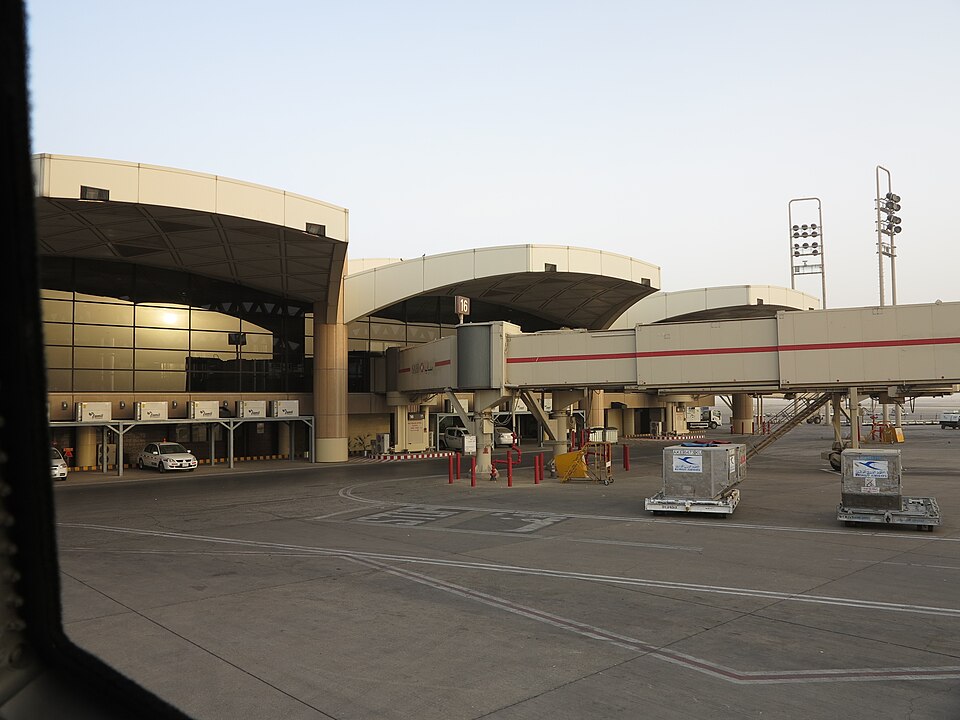
The Houthis' claims on Saudi airports, unconfirmed in chapter three, now have the kingdom's own record beside them. The General Authority of Civil Aviation, GACA, said on Tuesday that King Abdullah bin Abdulaziz International Airport in Jazan and Najran International Airport were attacked on Monday evening, leaving three people with minor injuries and property damage at both. On Wednesday it said, in a statement carried by the Saudi Press Agency, that two women, a Moroccan and an Algerian resident, were killed and 28 people injured in an attack on Abha International Airport on Tuesday, and that a Sudanese resident was killed and eight people injured, five Saudi citizens, two Egyptian residents and one Pakistani resident, in an attack on King Khalid International Airport in Riyadh on Wednesday. By the desk's arithmetic on GACA's figures, that is three dead and 39 injured at four airports in three days. [2, 1]
The Saudi-led coalition said early on Wednesday that it had intercepted and destroyed a Houthi ballistic missile north of Riyadh and, earlier, another launched toward Khamis Mushait, a city in the kingdom's south-west. 'We are tracking the launch platform through the coalition's intelligence system in the skies over Sanaa, and we will destroy it,' its spokesman, Maj. Gen. Turki Al-Maliki, said. The Houthis' military spokesman, Yahya Saree, said the group had targeted King Khalid airport with several drones, and in a separate statement claimed attacks on Abha airport and an air base in Khamis Mushait; Reuters reported no immediate Saudi confirmation of either airport attack. The same Wednesday, Yemen's Transport Ministry said, a Houthi missile landed near the runway at Aden's international airport minutes before a flight from Cairo was due, and the plane was diverted to Jeddah. [3, 13, 1]
At sea the count rose, and on Wednesday it left the strait. Three maritime security sources told Reuters there were at least 12 attacks on oil, liquefied natural gas and liquefied petroleum gas tankers around the Strait of Hormuz in the week of 28 September to 5 October, the most in any week since the war began on 28 February; India's foreign ministry said 12 crew members were injured when a projectile struck the tanker On Peace in the strait. On Wednesday Yahoo Finance reported that UK officials had counted at least nine attacks in the strait so far in October. That evening, at 19:00 UTC, the UK Maritime Trade Operations centre, UKMTO, a British government agency that monitors maritime security in the region, reported a tanker struck by multiple projectiles about 51 nautical miles north of Madinat ash Shamal, Qatar, with casualties, Ship & Bunker reported. 'For the first time since 9 September, Iran has struck a ship in the Gulf, away from the Strait of Hormuz,' said Martin Kelly, head of advisory at EOS Risk Group. The report as quoted did not name the ship. [12, 17, 14]
Brent crude futures, the world benchmark, settled down 38 cents at 100.20 dollars a barrel on Wednesday after a choppy session, Reuters reported, and US crude settled at 88.28 dollars; earlier that morning Yahoo Finance had reported Brent trading back above 101 dollars on the attacks and on a storm nearing the US Gulf coast. The desk repeats each figure as reported and measures none. [15, 17]
The record
The International Energy Agency's member governments agreed on Wednesday to speed up the oil stock releases they launched in March. 'Member governments expressed support for accelerating the oil stock releases announced in the Collective Action of March 2026 with a view to completing them as soon as possible,' the agency's executive director, Fatih Birol, said in its statement, and 'IEA members also supported the prioritisation of the release of diesel stocks, to the extent possible, given the current tightness in diesel markets.' The IEA said about 100 million barrels pledged under the March plan have yet to reach the market, and that member governments still hold publicly held emergency stocks equivalent to around 1.1 billion barrels, including over 200 million barrels of diesel; it did not say how much of the release would be diesel and how much crude. A European Commission spokesperson said the releases must stay within the amount approved in March, and the members review the plans at a board meeting next week, Reuters reported. [16]
The US Energy Information Administration's Short-Term Energy Outlook, released on Tuesday 6 October, now forecasts that the Brent spot price will average 105 dollars a barrel in the last three months of 2026, 14 dollars more than in its September outlook, and 84 dollars next year. 'The attacks on the East-West pipeline in Saudi Arabia highlight the potential for continued volatility in physical oil flows and oil prices amid ongoing withdrawals of oil inventories globally,' the agency wrote. It assumes that Middle East flows stay constrained through the quarter, while estimating that the region's shut-in production in September was the lowest since the fighting began. These are the EIA's forecasts, not the desk's; the agency finished its inputs on 1 October, so the outlook does not count the stocks the Group of Seven pledged on 2 October. [5]
The EIA's weekly report of Wednesday 7 October, for the week ending Friday 2 October, counts commercial crude oil stocks in the United States, outside the strategic reserve, down 3.2 million barrels to 424.1 million, 1 percent above the five-year average. Distillate stocks, the diesel and heating oil that the IEA's members want released first, were unchanged at 12 percent below the five-year average, and total commercial petroleum stocks were down 6.9 million barrels for the week. Crude imports were up 1.1 million barrels a day to 6.8 million. [6]
Fewer ships crossed the strait. Kpler, a commodity-tracking firm, counted only seven commodity carriers through the strait on Tuesday 6 October, the lowest since late July, Oilprice.com reported. Two of its analysts wrote that crude crossing the strait was down 27 percent from a wartime high the week before, at no less than 10.1 million barrels a day, which they put at 74 percent of its pre-war level; the sharpest drop was among the tankers that move cargo from ship to ship in the Gulf of Oman, the method Saudi Arabia has used to raise its exports. [19]
Who it reaches
Every path is adjacent: no company listed in the United States is named in the attacks. The tanker owners carry the cargoes the strait and the bypass move. Frontline's report for April to June says that 'risk levels across the Strait of Hormuz, the Red Sea and the Black Sea are rapidly changing with little warning, leading to more waiting time, disrupted flows and a greater need for fleet repositioning', and that a significant number of vessels have stayed committed to trades in the Arabian Gulf. SFL Corporation said on Wednesday that it had agreed to sell four LR2 product tankers built in 2014 and 2015 and three Suezmax tankers built in 2019 to Trafigura, the trading house that charters them, with delivery in the fourth quarter of 2026 and the first of 2027; it estimates net cash proceeds of about 275 million dollars after profit share and debt repayment, and a book gain of about 175 million dollars. Bloomberg called the deal the latest example of trading houses and state energy companies buying tankers, as disruption in Hormuz drew in scores of ships and growing risks in the Red Sea lengthened voyages. [10, 9, 20]
Where the sources disagree
On the pipeline. The energy minister's 5.8 million is a daily capacity restored in Saudi Gazette's report and a count of barrels pumped in Asharq Al-Awsat's, two readings of one remark that cannot both be right. Neither report carries a word on Khurais, no statement from Aramco was found, and the minister's figure does not answer the AFP source's account of a stoppage after the strike of Sunday 4 October. [4, 18, 11]
On the attacks. The coalition says it intercepted and destroyed a ballistic missile north of Riyadh; the Houthis' spokesman says they sent several drones at the airport; GACA reports a death, injuries and damage there without naming the weapon or the attacker. The count at sea differs by counter and by week: at least 12 attacks in the week to 5 October from three maritime security sources, and nine incidents for the same week in data from the UN's International Maritime Organization, which maritime sources say tends to take longer to verify, both as Reuters reported; at least nine in the strait in October from UK officials, as Yahoo Finance reported; and Oilprice.com attributes at least 12 attacks between 28 September and 2 October to the US Navy-led Joint Maritime Information Center, a different window and source from the ones Reuters named. [3, 13, 1, 12, 17, 19]
On the flows. Reuters reported on Monday 5 October that Gulf oil exporters had topped pre-war levels for about half of September; Kpler's analysts now put crude crossing the strait at 74 percent of its pre-war level, with Tuesday's traffic the thinnest since late July. The first counts the region's exports through every outlet and the second counts crossings of the strait alone, and the second came after the week with the most attacks of the war. The price moved both ways on Wednesday: above 101 dollars in the morning by Yahoo Finance's report, a settlement at 100.20 by Reuters'. [12, 19, 17, 15]
What settles it next
The dated records still to come. The IEA's board meeting next week, where members review the release plans. The EIA's next weekly petroleum report, moved by the Columbus Day holiday to Thursday 15 October at 12:00 p.m. Eastern time, for the week ending Friday 9 October. The next meeting of the seven OPEC+ countries that on 4 October kept their November production at September's required level, on Sunday 1 November. The EIA's next Short-Term Energy Outlook on Tuesday 10 November. And the records that have no date yet: UKMTO's identification of the tanker struck off Qatar, a word from Aramco on Khurais, and a loading count for the Red Sea terminals in October. The next chapter opens with what those documents changed. [16, 7, 8, 5, 14, 11]
Sources
- Saudi General Authority of Civil Aviation, statement on the attacks on Abha and King Khalid international airports, carried by the Saudi Press Agency, as report, 2026-10-07
- Saudi General Authority of Civil Aviation, statement on the attacks on Jazan and Najran airports, as reported by Saudi Gazette, 6 October 2026, 2026-10-06
- Coalition to Support Legitimacy in Yemen (spokesman Maj. Gen. Turki Al-Maliki), statement on the missile intercepted north of Riyadh, as reported by Saudi Gazet, 2026-10-07
- Saudi Minister of Energy Prince Abdulaziz bin Salman, remarks at the Made in GCC 2026 forum in Manama on the East-West Pipeline, as reported by Saudi Gazette, 6, 2026-10-06
- US Energy Information Administration, Short-Term Energy Outlook, released 6 October 2026 (forecast completed 1 October; next release 10 November), 2026-10-06
- US Energy Information Administration, Weekly Petroleum Status Report summary for the week ending 2 October 2026, released 7 October 2026, 2026-10-07
- US Energy Information Administration, Weekly Petroleum Status Report release schedule (holiday dates), 2026-10-07
- OPEC, press release: Saudi Arabia, Russia, Iraq, Kuwait, Kazakhstan, Algeria, and Oman reaffirm commitment to market stability, 4 October 2026, 2026-10-04
- SFL Corporation Ltd., report on Form 6-K, sale of four LR2 and three Suezmax tankers and termination of charters, 7 October 2026, 2026-10-07
- Frontline plc, report on Form 6-K for the quarter and six months ended 30 June 2026, filed 16 September 2026, 2026-09-16
- AFP via The Business Standard, Saudi Arabia's East-West oil pipeline halted again after fresh attack, 5 October 2026, 2026-10-05
- Reuters (Jonathan Saul) via gCaptain, Attacks on tankers in Hormuz hit highest of any week since start of Iran war, sources say, 7 October 2026, 2026-10-07
- Reuters via gCaptain, Houthis attack Aden airport as fighting intensifies in Yemen, 7 October 2026, 2026-10-07
- Ship & Bunker, Tanker hit by multiple projectiles off the coast of Qatar (UKMTO's report), 8 October 2026, 2026-10-08
- Reuters (Georgina McCartney) via Central Oregon Daily, Oil prices settle down as IEA agrees to accelerate oil stock release, 7 October 2026, 2026-10-07
- Reuters via Euronext, IEA to accelerate oil reserve release, says 100 million barrels still to come (with the IEA's statement), 7 October 2026, 2026-10-07
- Yahoo Finance (Ines Ferre), Oil prices climb above $100 on Strait of Hormuz attacks, Gulf storm threat, 7 October 2026, 2026-10-07
- Asharq Al-Awsat, Saudi Energy Minister: Oil pumped through East-West Pipeline reached 5.8 million barrels, 6 October 2026, 2026-10-06
- Oilprice.com (Irina Slav), Hormuz tanker traffic hits two-month low as attacks surge (Kpler's count), 8 October 2026, 2026-10-08
- Bloomberg via gCaptain, Trafigura buys seven oil tankers from SFL as shipping costs rise, 7 October 2026, 2026-10-07
Every stock is a company; the desk grades the company behind the stock. This article describes; it does not recommend. Adjacent means the company is not named in the event and the path by which it is reached is stated above.