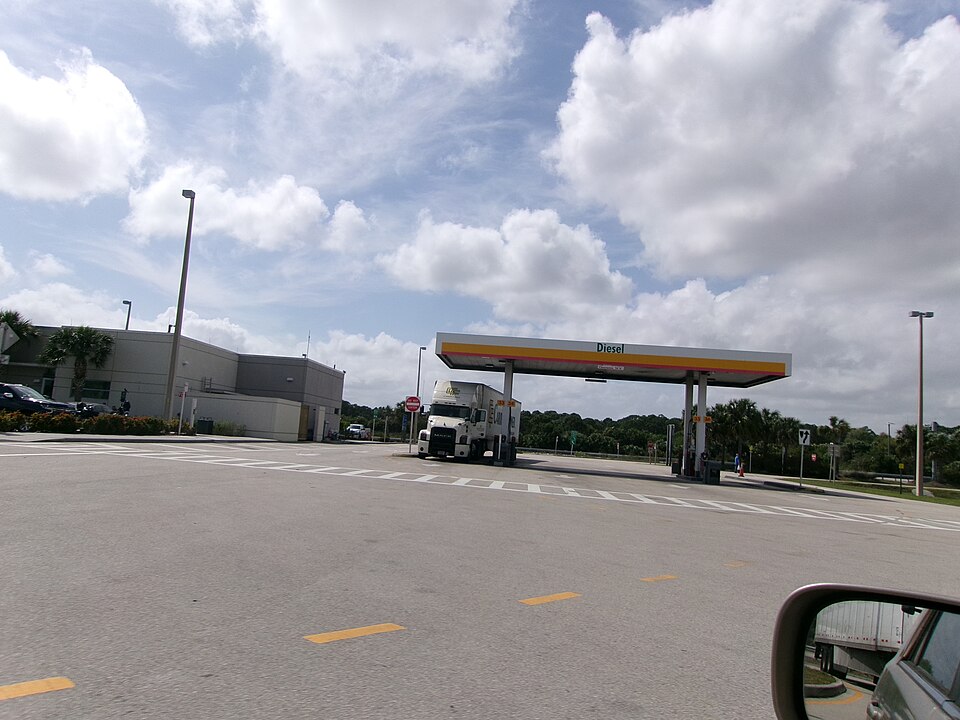
Diesel slips from its record as the White House weighs a tax break
The Energy Information Administration's Monday survey puts diesel at 6.382 dollars a gallon, 14.7 cents under the record of a week earlier and 2.63 dollars above a year ago; its Wednesday report shows distillate stocks down 2.3 million barrels to 105.2 million, refineries at 92.5 percent and exports back up; the President said on Sunday he may still ban exports, and Reuters reports the alternatives on the table: red-dyed diesel for wider sale, a suspended excise tax, voluntary restraint by refiners.
What changed since chapter one
Chapter one closed on five statements and no document. The sixth came on Sunday 27 September, at the Presidents Cup golf tournament in Illinois, where the President told a Fox News reporter that he is 'very seriously' weighing a ban on diesel exports. Reuters quoted him: 'That can oftentimes lead to a little bit of an increase in gasoline for cars, so we're looking at it very seriously. We may do it.' Yahoo Finance called it more cautious language than the week before, when he had said he had 'called for' a ban, and quoted a White House official on Monday: 'No policy decision has been made at this time', the president 'is evaluating all the options on the table'. [1, 2]
The options have names now. Reuters reported on Monday, from two people familiar with the discussions, that the White House is considering 'regulatory relief that would allow broader sales of red-dyed diesel', the untaxed fuel reserved for farms and other off-road uses, as 'one of the leading alternatives to a diesel export ban'. Highway diesel carries a federal tax of 24.4 cents a gallon; dyed diesel is exempt but for a 0.1 cent charge for a tank clean-up fund. The administration is also 'seeking voluntary commitments from major refiners to limit diesel exports', and an official said 'no final decisions have been made'. Yahoo Finance listed three options short of a ban: a voluntary limit, suspending the federal diesel excise tax, and bringing in the states. [1, 2]
The Energy Secretary, Chris Wright, put the administration's preference this way at the United Nations, as Yahoo Finance reported: 'We're trying to avoid a blunt hammer of a government policy, understanding the complexity of refining.' The American Petroleum Institute said a blanket ban 'would only compound the problem' and that 'the answer is more supply and more flexibility'. Senator Chuck Grassley of Iowa, who had called for a ban, suggested the President 'tell Big Oil 2reduce their prices 4 Americans', in the senator's own spelling. Representative Ashley Hinson of Iowa asked the House to return before the election to pause diesel exports and suspend the federal gas tax, Reuters reported. [2, 1]
The price turned. The agency's weekly survey, taken on Monday 28 September, puts the national average for diesel at 6.382 dollars a gallon, said the agency's update: 14.7 cents under the record 6.529 of 21 September, the first weekly fall in four weeks on the series, and 2.628 dollars above the same week a year earlier. Regular gasoline was 4.465, down 1.3 cents. AAA's daily average was 6.45 on Monday, Yahoo Finance reported, against its record 6.52. [3, 4, 2]
The barrels came Wednesday. The agency's weekly report for the week ending 25 September shows distillate stocks, which include diesel and heating oil, at 105.2 million barrels, down 2.3 million on the week and 18.4 million, or 14.9 percent, below the same week a year earlier, when they were 123.6 million. Refineries ran at 92.5 percent of capacity, from 94.0 the week before and 98.0 at the end of August. Distillate production was 5.003 million barrels a day, product supplied to the domestic market 3.948 million, and exports 1.529 million, up from 1.331 million the week before and above the 1.378 million of a year earlier. Reuters reported that analysts had expected a draw of 190,000 barrels, and that diesel futures 'extended gains following the report'. [5, 6, 7, 8, 9, 10]
The record
Still no order, rule or letter. The standing law chapter one found, the Commerce Department's licence requirement for products from the Naval Petroleum Reserves, is unchanged, and none of the week's statements names a statute. What has been added to the record is the arithmetic of a tax: 24.4 cents a gallon on highway diesel against a price of 6.382 dollars is 3.8 percent of the pump price, by the desk's division. Reuters noted that any saving to consumers 'would depend on how the relief is structured and how much of the savings is passed through by fuel sellers', and Yahoo Finance that a suspension of the tax is unclear without Congress, 'which is unlikely with most lawmakers already at home for the campaign season'. [11, 1, 2, 3]
The agency's own figures speak to the ban's premise. In the week to 25 September the country made 5.003 million barrels of distillate a day, used 3.948 million and sent 1.529 million abroad, so exports were about 31 percent of output. Stocks are 14.9 percent below a year ago. Yahoo Finance reported a new analysis by Oxford Economics: a ban could bring 'immediate price relief in at least some regions of the US', with prices 'dropping roughly 30% within weeks', unevenly, while raising prices elsewhere, including 'a possible 40%-50% jump in European wholesale prices'; other experts warned that refineries would cut output and make any relief short. [8, 9, 7, 5, 2]
The objection to the leading alternative is in the same report that carried it. 'I can't think that this would have any impact at all,' Patrick De Haan of GasBuddy told Reuters. 'It's simply diesel with red dye added that's not taxed. It does nothing to improve supply or impact price.' Farmers already use the untaxed fuel, he noted; letting truckers use it would save them the tax without adding a barrel. [1]
The refiners have filed nothing about restraint. The five that Reuters named in chapter one, Marathon Petroleum, Valero, Phillips 66, ExxonMobil and Chevron, have no current report on EDGAR since then that touches exports; Delek's report of 29 September is the closing of a convertible notes offering, and Par Pacific's of 28 September an officer change. Their third-quarter results, in late October and November, are the next place their own words would appear. [12, 11]
The rest of the week's oil record is in the same report: crude stocks excluding the strategic reserve rose 922,000 barrels to 427.3 million, against an expected draw, and gasoline stocks fell 1.7 million to 204.4 million, Reuters reported from the agency's tables. Utilization has come down five and a half points in four weeks, from 98.0 percent at the end of August to 92.5; neither the agency's table nor the reporting read here gives a cause. [13, 14, 10, 6]
Who it reaches
The same seventeen filers as chapter one. The five refiners Reuters named are direct, as the companies the Energy Secretary asked for voluntary restraint; five more refiners are adjacent, as exporters any restraint would cover; on the other side of the pump, three trucking companies buy the diesel the agency surveys, two railroads burn it, and two airlines buy the jet fuel the industry says a ban would make dearer. The farmers the red-dye proposal is aimed at are not on this site's record; they already buy the untaxed fuel, and the change would reach the truckers instead. This chapter prints no share price. [11, 1, 3]
Where the sources disagree
On what the President wants. He 'called for' a ban the week before, said 'we may do it' on Sunday with a caveat about gasoline, and his official said on Monday that no decision has been made, while his Energy Secretary works on voluntary limits and calls a ban a blunt hammer. The desk records them in order and picks none. On the remedy: the people Reuters spoke to call red-dyed diesel the leading alternative, and the analyst Reuters quoted says it 'does nothing to improve supply or impact price'. [2, 1]
On the price: the agency's 6.382 is a Monday survey of retail stations; AAA's 6.45 is a daily average of the same Monday; each fell from its own record, by 14.7 cents and 7 cents, and the two are different measures of one thing, as chapter one said. On the week's stocks: the reporting says distillate is 14 percent below the five-year average, a comparison the desk did not compute; the agency's own series, read here, gives 14.9 percent below a year ago. [3, 2, 10, 5, 15]
What settles it next
An order, a rule or a notice on red-dyed diesel or the excise tax, none of which exists at this writing. The agency's next weekly price, from the survey of Monday 5 October, and its next weekly report on Wednesday 7 October. Anything the refiners say about voluntary restraint, which would appear on EDGAR or in their third-quarter results in late October and November. And the heating-oil season, which the Northeast will meet with distillate stocks 14.9 percent below last year's. Chapter three opens on the first of these to carry a date. [3, 5, 11]
Sources
- Reuters via BOE Report, White House weighs red-dyed diesel tax relief to lower fuel prices, 2026-09-28
- Yahoo Finance, Trump sounds less than sold on a diesel export embargo as his team weighs 3 options short of a ban, 2026-09-28
- U.S. Energy Information Administration, Gasoline and Diesel Fuel Update, week of 28 September 2026 (released 29 September), 2026-09-29
- U.S. Energy Information Administration, Weekly U.S. No 2 Diesel Retail Prices, dollars per gallon (the series since March 1994), 2026-09-29
- U.S. Energy Information Administration, Weekly U.S. Ending Stocks of Distillate Fuel Oil (released 30 September), 2026-09-30
- U.S. Energy Information Administration, Weekly U.S. Percent Utilization of Refinery Operable Capacity, 2026-09-30
- U.S. Energy Information Administration, Weekly U.S. Exports of Total Distillate, 2026-09-30
- U.S. Energy Information Administration, Weekly U.S. Refiner and Blender Net Production of Distillate Fuel Oil, 2026-09-30
- U.S. Energy Information Administration, Weekly U.S. Product Supplied of Distillate Fuel Oil, 2026-09-30
- Reuters via BOE Report, US crude stocks rise, gasoline and distillate inventories fall, EIA, 2026-09-30
- CrossAssetData, The diesel export ban, chapter one (the letter, the statements, the law and the record price, with the filers it named), 2026-09-24
- Delek US Holdings, current report on Form 8-K (a convertible notes offering closed 29 September 2026), 2026-09-29
- U.S. Energy Information Administration, Weekly U.S. Ending Stocks excluding SPR of Crude Oil, 2026-09-30
- U.S. Energy Information Administration, Weekly U.S. Ending Stocks of Total Gasoline, 2026-09-30
- OilPrice.com, EIA Reports Crude Build as Diesel Stocks Fall 14% Below Average, 2026-09-30
Every stock is a company; the desk grades the company behind the stock. This article describes; it does not recommend. Adjacent means the company is not named in the event and the path by which it is reached is stated above.