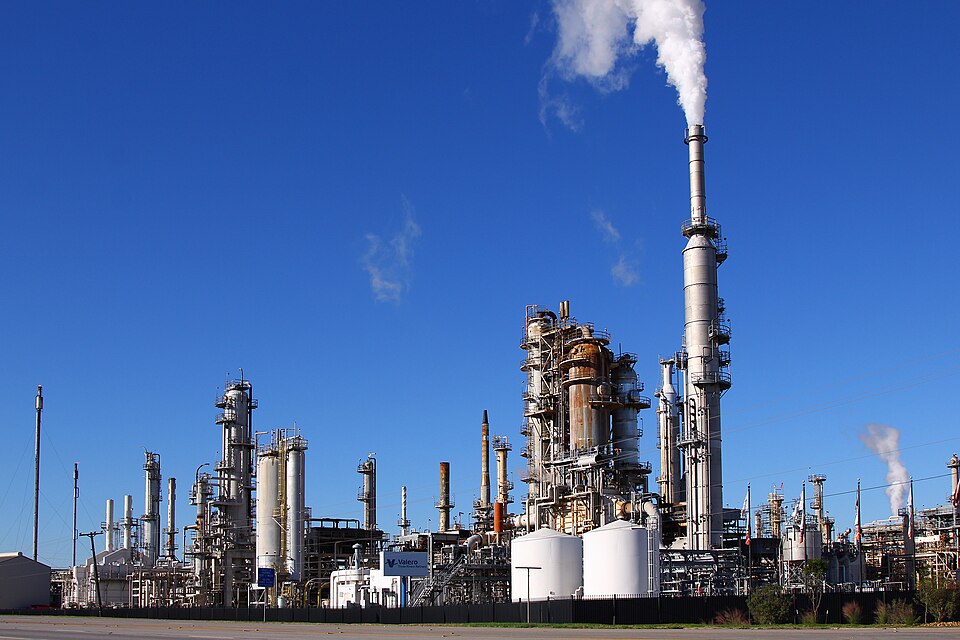
Diesel at a record 6.53 dollars, and a fight over an export ban
The letter of 23 September, signed from the Chamber of Commerce to the Texas Oil and Gas Association, says a ban 'would require refineries to throttle utilization'; the Energy Secretary is asking refiners for voluntary restraint instead; the record so far is a report, a denial and five statements in three days, and the one standing rule for licensing fuel exports reaches only the Naval Petroleum Reserves.
What happened
On Wednesday 23 September nine national groups and twenty-six state and regional ones sent the President a letter, published by the American Fuel and Petrochemical Manufacturers, that opens by thanking him and then says: 'we urge you to reject calls to ban or otherwise limit the exports of diesel and other products that have made the U.S. energy industry so strong. Export bans would lead to less fuel production, tighter supplies, and rising costs for American families, farmers, and truckers.' The national signers are the American Exploration and Production Council, the fuel and petrochemical manufacturers, the American Petroleum Institute, the Business Roundtable, the Independent Petroleum Association of America, the International Liquid Terminals Association, the Liquid Energy Pipeline Association, the National Association of Manufacturers and the U.S. Chamber of Commerce; the state groups run from the Colorado Chamber of Commerce to the Petroleum Association of Wyoming, with the Texas Oil and Gas Association and the Permian Basin Petroleum Association among them. [1, 2]
The letter's argument is mechanical. 'With 10 percent of global refining capacity offline, U.S. refiners are running at full capacity to supply the U.S. and to help stabilize global fuel markets,' it says; the country 'produces more diesel than it consumes'; and 'an export ban would require refineries to throttle utilization to reduce diesel production to equal domestic demand. Falling utilization would result in less gasoline and jet fuel production and higher prices for those products as well.' The Northeast, which imports fuel, would pay more for all of it, and 'this could not come at a worse time for consumers as home heating oil season is about to begin.' The groups say they agree with 'Secretaries Wright and Burgum' that a ban would cut refining runs and invite retaliation, and they credit 'targeted Jones Act waivers' with keeping 'more than 50 million gallons of fuel in the U.S.' [1]
The letter answered a report. On Wednesday Politico reported that the White House was preparing a 90-day ban on diesel exports; a White House official denied it the same day, Reuters reported, and Energy Secretary Chris Wright said 'nobody is considering a flat ban on shipments of the fuel' and that 'what's being discussed is what's the most efficient way to get more diesel into the United States of America, and continue maximum flows of gasoline and jet fuel.' On Thursday Reuters reported, from three people familiar with the discussions, that Wright had contacted executives at Marathon, Valero, Chevron, ExxonMobil, Phillips 66 and Citgo to gauge support for voluntary export restrictions; only Phillips 66 and Citgo commented, and an Energy Department spokesman, Ben Dietderich, said the administration continues 'to work closely together as they consider a variety of options to help lower energy costs.' [3, 4]
The President's own words came first. Speaking to reporters at the United Nations on Tuesday, he said 'I've said let's not send out the diesel. We make a lot of diesel,' and that a decision would come 'fast, one way or another'; Treasury Secretary Scott Bessent said the administration was examining 'whether it's feasible in terms of the overall refining capacity, and whether a full or a partial ban would work.' The American Petroleum Institute's president, Mike Sommers, had answered on Monday: 'Americans are hurting from rising diesel costs driven by an unprecedented disruption to global refining capacity,' and restricting exports would 'exacerbate refining challenges and ultimately hurt consumers'; Gulf Coast refineries produce more diesel than their region consumes, he said, and 'geography and infrastructure constraints prevent that surplus from simply being redirected to every U.S. market that needs it.' [5, 6]
The record
The price is the government's own number. The Energy Information Administration's weekly survey put the average retail price of diesel in the United States at 6.529 dollars a gallon on 21 September, 24.4 cents more than the week before and 2.78 dollars more than a year earlier; regular gasoline was 4.478. The desk read the agency's weekly series back to its start in March 1994: no week has been higher, the previous high was 5.810 dollars on 20 June 2022, and the series has climbed from 4.578 on 6 July to 6.529 in eleven weeks. Quartz reported the AAA daily average at 6.53 dollars on Tuesday, a record on that measure too, with California at 8.44. The International Energy Agency's September report says diesel prices in the United States 'surpass the $200/bbl mark in early September, 94% above pre-war levels.' [7, 12, 5, 8]
The volumes are in the reporting. Yahoo Finance cited RSM's research that the country produces 5.3 million barrels of diesel a day, keeps 3.6 million at home and exports 1.67 million, about 18 percent of world supply, with exports up as much as 40 percent on a year earlier; the petroleum institute's statement, as Quartz reported it, has American diesel supplying roughly a fifth of the 8 million barrels a day traded by sea. Reuters reported that diesel inventories were below 97 million barrels last week, about 13 percent under the five-year seasonal average, on the agency's figures. S&P Global's estimate, as Quartz reported it, is that a ban could force refiners to cut about 2 million barrels a day of runs, 12 percent of the total; the economist Philip Verleger warned it could raise diesel prices abroad by as much as 100 percent. Marathon Petroleum's management, 24/7 Wall St. reported, had flagged record diesel export volumes from its Garyville and Galveston Bay refineries. [9, 5, 4, 10]
The law is thinner than the argument. Neither the letter nor any of the statements names a statute, and Politico's report, as Reuters relayed it, described the plan without one. The standing rule for licensing petroleum exports is the Commerce Department's short-supply control at 15 CFR 754.3, which requires a licence 'to all destinations, including Australia, Canada, and the United Kingdom, for the export of petroleum products, excluding crude oil' only where they were produced or derived from the Naval Petroleum Reserves or exchanged for such products, with applications denied 'unless the President makes a finding required by the Naval Petroleum Reserves Production Act.' As written it reaches a narrow class of barrels; a ban on diesel generally would need a different instrument, and none has been published. [1, 3, 11]
The precedent the experts reach for is 1975. Samantha Gross of the Brookings Institution told Yahoo Finance that the export ban of that year 'did little to ease daily price pressures for Americans and likely drove producers to cut back on their output'; Patrick De Haan of GasBuddy said 'supplies leave because the world is paying more, not because politicians are forcing them to,' and that a ban 'would shove that diesel back into a domestic market that's already well supplied, risking refinery run cuts, while doing nothing about the global shortage'; Joe Brusuelas of RSM called the talk of a ban 'loose and undisciplined'; Tobin Marcus of Wolfe Research said the White House 'is clearly aware that a ban could have unintended consequences.' [9]
Who it reaches
Marathon Petroleum, Valero, Phillips 66, ExxonMobil and Chevron are direct: Reuters names them as the refiners the Energy Secretary called about voluntary restraint, and each has a file on this site with its record. 24/7 Wall St. reported on Thursday morning that Valero's shares had fallen 6.8 percent on the week, Marathon's 6.17 percent and Phillips 66's 3.08 percent after the report of a ban, moves the desk repeats as reported and does not measure itself. PBF, Delek, HF Sinclair, CVR and Par Pacific refine and export the same product and are adjacent. On the other side of the pump are the buyers: J.B. Hunt, Knight-Swift and Old Dominion buy diesel at the price the agency surveys, Union Pacific and CSX burn it in their locomotives, and Delta and United buy the jet fuel the letter says a ban would make dearer. [4, 10, 1, 7]
The households in the documents, the farmers and truckers of the letter and the Northeast homes about to buy heating oil, are not on this site's record; the companies are the way the record reaches them. [1]
Where the sources disagree
On whether a ban is being prepared. Politico said a 90-day ban was in preparation; a White House official denied it; the President said 'let's not send out the diesel'; the Treasury Secretary said a full or partial ban was being examined for feasibility; the Energy Secretary said no flat ban is under consideration and is asking for voluntary restraint. Five statements in three days from one administration and a newspaper, and no document. The desk records them in the order they were made and does not pick one. [3, 5, 4]
On what a ban would do. The letter, the petroleum institute, S&P Global, Verleger, Brookings and GasBuddy all say the same thing in different words: refiners would cut runs, gasoline and jet fuel would cost more, and the world price would rise. The President's case is a sentence, 'we make a lot of diesel,' and the agency's figures agree that the country makes more than it uses. Nobody in the record has published a model of what the domestic pump price would do under a ban, and the 1975 precedent Brookings cites was a crude export ban, not a product one. [1, 6, 5, 9, 7]
On the record price. The agency's 6.529 is a Monday survey of retail stations averaged over a week; AAA's 6.53 is a daily average; the IEA's 200 dollars a barrel is a wholesale gasoil price. They are three measures of one thing and they agree on the direction; a reader should take each with its date and its market. [7, 5, 8]
What settles it next
The dated records to read. An order, a rule or a letter from the White House or the Commerce Department, none of which exists at this writing. The agency's next weekly price on Monday 28 September and its weekly petroleum status report on Wednesday 30 September, with the inventory and export figures. Anything the refiners file or say about voluntary restraint, which would appear on EDGAR as a current report or in their third-quarter results in late October and November. And the heating-oil season the letter says is about to begin, which the Northeast will feel in its own prices. [7, 12, 4, 1]
Sources
- Letter to President Donald J. Trump from thirty-five business, energy and manufacturing groups, 23 September 2026 (PDF published by the American Fuel and Petroc, 2026-09-23
- American Fuel and Petrochemical Manufacturers, U.S. business, energy, manufacturing groups urge President Trump to reject fuel export restrictions, 23 September, 2026-09-23
- Reuters via Investing.com, White House denies report US is considering a diesel export ban, 23 September 2026, 2026-09-23
- Reuters via BOE Report, US energy secretary seeks refiners' help amid narrow options to curb diesel price, by Jarrett Renshaw and Nicole Jao, 24 September 2026, 2026-09-24
- Quartz via Yahoo Finance, Trump backs diesel export ban as oil industry pushes back, by Cris Tolomia, 23 September 2026, 2026-09-23
- American Petroleum Institute, API statement on potential U.S. diesel export ban, Mike Sommers, 22 September 2026, 2026-09-22
- U.S. Energy Information Administration, Weekly U.S. No 2 Diesel Retail Prices, dollars per gallon (series EMD_EPD2D_PTE_NUS_DPG, March 1994 to 21 September 2026, 2026-09-21
- International Energy Agency, Oil Market Report, September 2026, 11 September 2026, 2026-09-11
- Yahoo Finance, Diesel export ban backed by Trump could result in 'unintended consequences,' experts warn, by Jake Conley, 24 September 2026, 2026-09-24
- 24/7 Wall St., Trump wants to ban diesel exports, refiners are selling off, by Omor Ibne Ehsan, 24 September 2026, 2026-09-24
- Legal Information Institute, Cornell Law School, 15 CFR 754.3, Petroleum products not including crude oil, 2026-09-24
- U.S. Energy Information Administration, Gasoline and Diesel Fuel Update, week of 21 September 2026, 2026-09-22
Every stock is a company; the desk grades the company behind the stock. This article describes; it does not recommend. Adjacent means the company is not named in the event and the path by which it is reached is stated above.