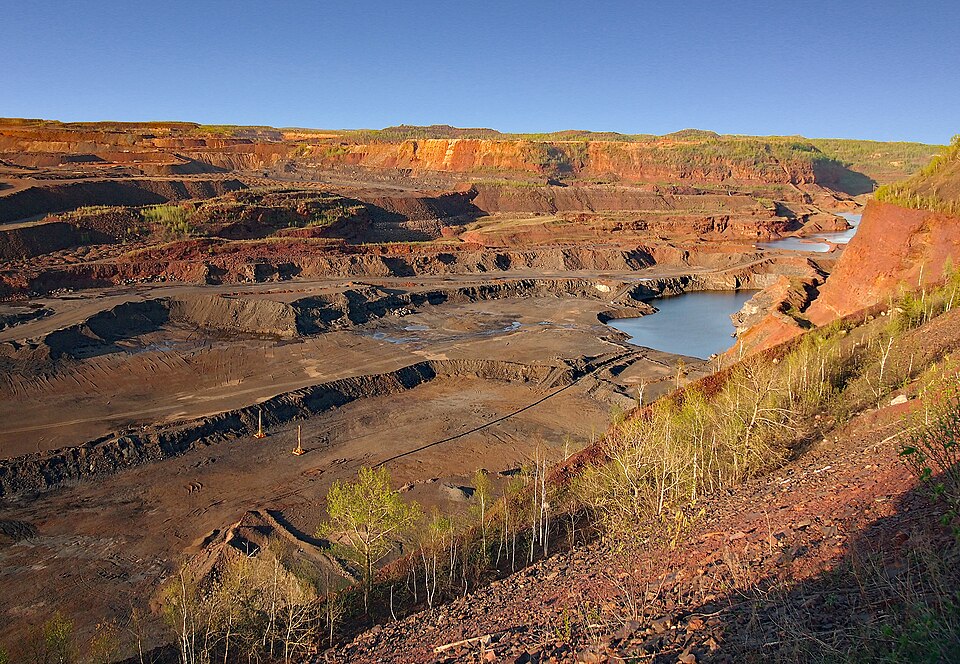
Mesabi Metallics plans an $18 billion mine-to-mill steelmaker
Announced at the White House on Monday, the plan would feed a $15 billion Iowa steel complex, put at 7.5 million tons a year in a first phase from 2030, with pellets from the Essar-owned company's Minnesota mine, which announced its first concentrate on Thursday 17 September and targets its first pellets in the fourth quarter; Iowa's legislature meets on Friday to rework a tax credit program for the project, and Cleveland-Cliffs, which holds state ore leases near the mine that Mesabi wants back, faces Mesabi's antitrust suit at a trial set for May 2027.
What Mesabi announced
Mesabi Metallics announced at the White House on Monday 28 September an $18 billion plan to build 'a fully integrated steel company': $15 billion for a new steel complex in Iowa, on top of the $3 billion it says is being spent to complete its iron ore mine at Nashwauk, on Minnesota's Mesabi Iron Range. The company calls it 'the largest single investment in a steel complex in American history'. It promises more than 6,000 jobs during construction in Iowa and at least 1,750 permanent ones once the plant runs. At the mine it counts more than 1,500 construction workers and over 200 full-time employees today, building toward 350 full-time jobs. [1]
The White House put the mill at '7.5 million tons of steel per year in its first phase, rising to about ten million tons', and Iowa Capital Dispatch reported that the White House expects it to be operational by 2030. The company's own release gives none of that: it names no site, no tonnage, no start date and no lender. Iowa Capital Dispatch reported that the state's planned incentives are for a steel mill project in Lee County. [2, 3, 1]
How mine to mill works
A pellet plant turns mined rock into furnace feed. The prospectus of The Metals Royalty Company (TMCR), which owns part of the mine's royalty, describes Nashwauk's line: the ore is crushed and ground, the iron mineral is drawn out with magnets, leftover silica is floated off, and the concentrate is formed into pellets and hardened by heat in an 'indurating furnace'. As KAXE put it, concentrate 'must still be made into pellets, fired and reduced' before it is a final product. Nashwauk's pellets are to be direct reduction grade, which the prospectus calls 'a specialized feedstock used principally as the input to direct-reduced iron', made 'principally in Brazil and Sweden, with very limited domestic U.S. production'. [4, 5]
The Iowa complex would take the pellets two steps further, the release says. Direct reduction removes the oxygen from the ore 'at temperatures below its melting point', leaving solid metallic iron. That iron, fed in while still hot and mixed with scrap steel, would be melted in electric arc furnaces, which run mainly on electricity, as Nucor's annual report says of its own. Most arc furnace mills melt chiefly scrap: Steel Dynamics' annual report says recycled scrap typically makes up more than 80 percent of the mix. Integrated mills melt iron ore 'in a blast furnace', in Nucor's words. Mesabi says its plan 'builds on the strengths of both', and 'mine-to-mill' means one owner from the ore in the ground to the finished steel, which Cleveland-Cliffs' annual report says it already is, 'from the mining of iron ore' through steelmaking. [1, 6, 7, 8]
Against the industry, the United States Geological Survey counts 82 million metric tons of raw steel made in the country in 2025, from about 105 million tons a year of capacity; 47 companies made steel in arc furnaces at 102 mills, and integrated mills made about 28 percent of the total. By the desk's arithmetic, the first phase's 7.5 million tons would equal about 9 percent of 2025's output and the full 10 million about 12 percent, if the White House's tons are metric, which its release does not say. [9, 2]
What is built, what is promised
At Nashwauk, construction of the plant began in 2010, stopped after the previous owner, Essar Steel Minnesota, filed for Chapter 11 bankruptcy in 2016, and restarted in April 2023, says TMCR's prospectus, which gives the operator's figure of about 85.5 percent complete on 1 January. KAXE reported that on Thursday 17 September the company announced its first iron concentrate, though Mesabi had once planned to make pellets by September. The prospectus, filed on Thursday 24 September, says the property is in 'the construction and commissioning phase', with first pellets targeted in the fourth quarter of 2026 and commercial production after an 8 to 12 month ramp-up. The White House release, by contrast, calls the mine 'newly opened'. [4, 5, 2]
The mine holds its main permits, the prospectus says, from a permit to mine to air, water and wetland permits, but its air permit caps output at 7.00 million long tons of pellets a year (about 7.11 million metric tons) until an amendment Mesabi expects by the end of the third quarter of 2027, which would lift the cap to about 7.38 million long tons, the pellet plant's maximum. The mine's money is on record too. The prospectus says the federal Export-Import Bank announced 'support of up to $10 billion' in March; the loan it is providing is $770 million, which, KAXE reported, Mesabi's chief executive, Joe Broking, confirmed completes Mesabi's $2.5 billion of project funding. The company's newest release puts the mine at 'close to $3 billion invested', a different figure from the $2.5 billion KAXE reported. [4, 5, 1]
Iowa's side rests on a memorandum. Commerce Secretary Howard Lutnick said 'I think this deal is done', Iowa Capital Dispatch reported, while the governor's office said the state and Mesabi 'have executed a memorandum of understanding' that needs the legislature to act. Governor Kim Reynolds' proclamation calls lawmakers back on Friday 2 October to amend the Major Economic Growth Attraction (MEGA) program, the state's incentive program for projects of more than $1 billion. Its tax credits now reach up to 5 percent of qualifying investment for each of two businesses; the change, which the proclamation says keeps the same total, would let a single business in a 'rural county', one of 50,000 people or fewer, take a certificate worth up to 10 percent, spread over ten years and transferable under certain conditions. [3, 10]
On the mill's money, the release names Essar Group as 'project sponsor' and no lender for the $15 billion. Mesabi Metallics is privately held and not subject to public company reporting rules, TMCR's prospectus says, and KAXE reported that Essar is based in India. The same prospectus notes that the Essar group's parent and certain affiliates 'have previously been involved in restructuring, refinancing and insolvency proceedings'. Broking told Itasca County commissioners on Tuesday 15 September that the company sets 'aggressive targets from time to time'. [1, 4, 5]
Cleveland-Cliffs and the ore
Cleveland-Cliffs, which mines iron ore on the same range, is already in court with Mesabi. Its 10-K says Mesabi sued it on 7 September 2017 in the bankruptcy court, alleging interference with its contractors and breaches of antitrust law, the law against monopolizing a market; a 2018 ruling found Mesabi's leases had terminated and upheld Cliffs' purchase and lease of the contested land, and on 3 June 2025 the federal court in Delaware set the case for trial in May 2027. Cliffs says the claims are 'without merit'. TMCR's prospectus, drawing on Mesabi's information, reports a second front: in October 2023 Mesabi ended Cliffs' leases on parcels it had bought from Glacier Park Iron Ore Properties, an arbitration panel upheld that in June 2024 and an Itasca County court confirmed it in January 2025, yet Cliffs still claims half of some parcels, which the mine's reserve estimate leaves out. [8, 4]
The state's leases are a separate fight. KAXE reported that Minnesota's Department of Natural Resources revoked Mesabi's leases on 2,600 acres in 2021 after missed deadlines and handed them to Cliffs in 2023. On Tuesday 15 September Broking told Itasca County commissioners that getting them back was a top priority: 'These leases set the stage for this $5 billion in incremental investment', a Minnesota expansion that would lift pellet capacity from 7 million to 18 million tons a year and add a direct reduced iron plant. Cliffs' 10-K counts five iron ore mines in Minnesota and Michigan, with Minorca and part of Hibbing idled at the end of 2025, and says its integrated mills run on domestic, mostly in-house ore while most competitors rely on imported iron made from ore. Neither Cliffs nor the United Steelworkers union is quoted on the Iowa plan in the reports cited here. [5, 8, 3]
What settles it next
Friday 2 October, when Iowa's legislature meets at 8:30 a.m. on the MEGA amendments; the fourth quarter of 2026, when Nashwauk's first pellets are targeted, followed by 8 to 12 months of ramp-up; the end of 2026, when Broking said Mesabi would file permits for the Minnesota expansion, while allowing that it could slip into January; the end of the third quarter of 2027, when Mesabi expects its air permit amendment; May 2027, the trial of its suit against Cliffs in Delaware; and 2030, when the White House expects the Iowa mill to be operational. Mesabi's release names no site, builder or lender for the Iowa complex. [10, 4, 5, 8, 3, 1]
Who it reaches
Cleveland-Cliffs directly: by its own 10-K it is the defendant in Mesabi's antitrust suit, which reaches the leases on the Nashwauk ore and is set for trial in May 2027; by TMCR's account it claims half of some parcels inside the mine's resource estimate; and it holds the state leases that Broking says 'set the stage' for a further $5 billion. The Metals Royalty Company as the holder of a royalty of 2 percent of the gross revenue from up to 8.5 million metric tons a year of Nashwauk pellets, reckoned from a published price index; its prospectus says it has received no royalty revenue yet and that the royalty depends on Mesabi completing the mine and starting commercial production. [8, 4, 5]
Nucor and Steel Dynamics as arc furnace steelmakers, the kind of mill Mesabi plans. Nucor's 10-K counts 'other domestic EAF steel mills', meaning arc furnace mills, among its competition, and says the pellets for its two direct reduced iron plants, in Trinidad and Louisiana, are bought 'from various international suppliers'. Steel Dynamics' 10-K warns that 'the introduction of additional domestic steel capacity could increase this global overcapacity' and lift scrap prices. Mesabi's release lists the industries its steel would serve, from national defense and cars to household appliances and infrastructure, but names no products, so how directly it would meet theirs is not yet on the record. [6, 7, 1]
Sources
- Mesabi Metallics, release: investing $18 billion to create a fully integrated American steel company, uniting Minnesota mine and Iowa steel complex (Des Moines,, 2026-09-28
- The White House, release: Mined, Melted, and Poured in America (28 September 2026; the mill's tonnage and jobs), 2026-09-28
- Iowa Capital Dispatch (Robin Opsahl), Iowa lawmakers to convene Friday for special session on tax incentives for steel mill, 2026-09-29
- The Metals Royalty Company, registration statement on Form F-1 (resale prospectus; the Mesabi royalty, the property's construction, permits and disputes with Cl, 2026-09-24
- KAXE (Emma Krab), Mesabi Metallics eyes $5 billion expansion as production, federal assistance ramp up, 2026-09-18
- Nucor, annual report on Form 10-K for 2025 (competition, direct reduced iron plants, raw materials), 2026-02-25
- Steel Dynamics, annual report on Form 10-K for 2025 (scrap in the melt mix, domestic capacity and overcapacity), 2026-02-27
- Cleveland-Cliffs, annual report on Form 10-K for 2025 (the Mesabi Metallics adversary proceeding, iron ore mines, competition), 2026-02-09
- U.S. Geological Survey, Mineral Commodity Summaries 2026: Iron and Steel (February 2026), 2026-02-05
- State of Iowa, Proclamation of Special Session, signed by Governor Kim Reynolds on 29 September 2026 (amendments to the MEGA program), 2026-09-29
Every stock is a company; the desk grades the company behind the stock. This article describes; it does not recommend. Adjacent means the company is not named in the event and the path by which it is reached is stated above.