Iowa doubles the tax credit it can offer Mesabi's steel mill
In a one-day special session on Friday 2 October, Iowa's legislature passed House File 2801, 75 to 17 in the House and 28 to 19 in the Senate, and Governor Kim Reynolds signed it that night: one business in a county of 50,000 people or fewer may now get a refundable, transferable investment tax credit of up to 10 percent, paid over ten years, twice the old limit for a single business; the state's fiscal analysts' table puts that credit at $1.15 billion for Mesabi Metallics' planned Lee County mill, by the desk's sum, and the contract still needs the state economic development board.
What changed since the plan was announced
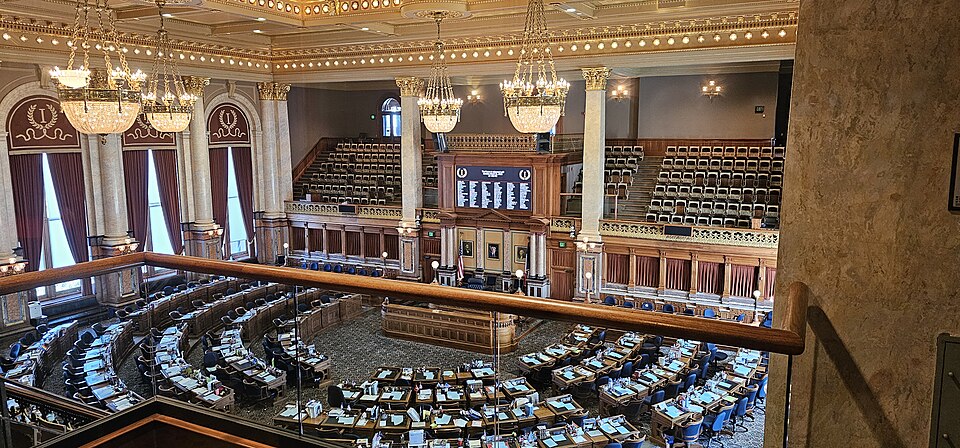
The previous piece closed on a date still to come: Friday 2 October, when Iowa's legislature was due back to amend the Major Economic Growth Attraction (MEGA) program, the state's incentive program for projects of more than $1 billion, for Mesabi Metallics' planned steel complex in Lee County. It took one day. The House passed House File 2801 by 75 votes to 17, with eight members absent or not voting; the Senate took it up in place of its own bill, Senate File 2508, and passed it by 28 votes to 19, with two absent. Governor Kim Reynolds signed it that night at a ceremony in her statehouse office, Radio Iowa reported, and the act took effect on enactment. [3, 4, 5, 6, 8, 1]
What changed is the size of the credit the state may offer. As first enacted, the program allowed incentives of up to 5 percent of qualifying investment for each of two businesses, 10 percent in all; it now allows up to 10 percent for 'a single eligible business located in a rural county, spread evenly over ten years and with transferability', in the words of the governor's office, which says the act 'makes it possible for Mesabi Metallics' to invest $15 billion in an Iowa steel plant. Reynolds said the special session 'advances the most consequential economic development ever' to come to the state. The act itself names no company. Asked at the White House on Monday 28 September whether the project depended on state or local tax breaks, Commerce Secretary Howard Lutnick had said 'I think this deal is done'; Debi Durham, director of the Iowa Economic Development Authority, told lawmakers 'this is not a done deal' and that it 'still has to go through the final negotiation'. [5, 1, 6]
What the act allows
The old law let the authority's board award an investment tax credit of up to 5 percent of a business's qualifying investment to each of up to two businesses, paid in equal parts over five tax years. The act keeps that route and adds a second, 'either, but not both': a credit of up to 10 percent for one business whose project is in a 'rural county', meaning a county of 50,000 people or fewer at the latest census, paid in equal parts over ten tax years. A board that takes the new route may give the program's incentives to that one business only, and, as before, to no one on or after 1 January 2030. Qualifying investment, in the Iowa Code's definition, is money spent on the land, site preparation, infrastructure and buildings, and on depreciable assets, things like machinery whose cost is written off over their working life. [1, 2, 9]
No certificate is issued until the project, or a 'designated portion' of it, has been placed in service and at least half the jobs created for it, or for that portion, are on the payroll, paying at least 140 percent of the 'qualifying wage threshold', an average wage for the area around the plant that the authority computes from state wage data. The portion rule is new; the old text waited for the whole project. The fiscal note of the Legislative Services Agency, the legislature's nonpartisan staff, assumes credits will be issued 'as portions of the project become operational', with the plant at 8.7 percent of capacity in the state's 2029 fiscal year, 33.9 percent in 2030, 81.7 percent in 2031 and full capacity in 2032. Durham told a House panel: 'Before they get one tax credit issued to them, it has to be an operational plant.' State and business officials have said the plant's 1,750 permanent jobs would pay an average of $48 an hour, Iowa Capital Dispatch reported. [1, 9, 2, 6, 8]
The larger credit is refundable, meaning the state pays out whatever exceeds the company's tax bill unless the company chooses to carry it forward for up to ten years, and transferable: with the authority's approval, and after it checks that the buyer has no tie to a 'foreign adversary', the company may transfer its certificates to another person or company, though only under agreements signed by 31 December 2027, and what it receives for them is not counted as Iowa income. The clawbacks sit in the same section. If within ten years the company sells, razes or otherwise puts out of use the land or buildings the credit was claimed for, its own tax bill rises by all of the credit in the first year, by 90 percent in the second and by ten points less each year after, down to 10 percent in the tenth. If a certificate was obtained through a 'prohibited activity', which includes a breach of the agreement, misrepresentation and fraud, the company and any buyer owe the credit back with interest, penalties and legal costs, a buyer only up to what it acquired, while a buyer that paid in good faith without notice and has no tie to the company owes nothing. A repayment can also fall on the company's affiliates. [1, 2]
What the state expects to pay
The fiscal note works from a total investment of $15.000 billion, of which $11.150 billion counts as qualifying, and assumes every credit is refunded in the year it is claimed. Under the old terms it puts the investment credit at $115 million a year from fiscal 2032 through 2036, $575 million in all. Under the act the credit begins in fiscal 2029, runs at $115 million a year from 2032 through 2038 and ends in 2041, for $1.15 billion by the desk's sum: $575 million more, all of it revenue the state's general fund does not collect. Ten percent of $11.150 billion would be $1.115 billion, so the note's table and its stated qualifying investment differ by $35 million, a gap the note does not explain. No MEGA incentive had been awarded as of 1 October, the note says. [2]
The program's two other incentives, which the act leaves as they were, come on top: refunds of the sales and use tax paid on utilities, materials and services that went into building and equipping the plant, and a credit against the income tax the company withholds from its workers' pay, worth up to 3 percent of their wages. The note puts Mesabi's claims on those at $215 million from fiscal 2028 to 2041, by the desk's sum, which brings the whole to about $1.365 billion. That is close to the $1.36 billion of a preliminary agreement shared with lawmakers, as the Des Moines Register reported and Iowa Public Radio relayed: $1.1 billion in investment credits, $154 million in sales tax refunds and $60.5 million in withholding credits. Iowa Capital Dispatch reported nearly $1.4 billion in all; KWQC put the ceiling at up to $1.5 billion, 10 percent of the whole $15 billion, where the note counts $11.150 billion as qualifying; and Sen. Dan Dawson, who opposed the bill, put the income tax credits at $1.2 billion. [2, 7, 6, 13, 8]
The case for and against
Supporters said the change keeps the program's cost ceiling. Rep. Carter Nordman, who managed the bill in the House, said lawmakers were 'combining two existing incentive programs into one'; the governor's proclamation calling the session had said the amendment would maintain the program's fiscal impact of up to 10 percent of qualifying investments. Durham told lawmakers that a 10 percent credit is a national average for businesses of this kind, that Arkansas and Kentucky had also competed for the plant, Arkansas being 'our biggest competitor', and that the bill is written so the state pays no incentives if the project is not completed. House Speaker Pat Grassley said in the governor's release that 'not a single dollar in performance incentives is earned until real facilities are built and high-paying manufacturing jobs are delivered to Iowa families'. [6, 3, 5]
Opponents in both parties argued about cost and haste. Dawson, the Republican who chairs the Senate's Ways and Means Committee and says he helped negotiate the program in 2024, called the bill the 'largest corporate giveaway in the state of Iowa's history' and warned that in future negotiations 'the ceiling now becomes the floor'. Sen. Jason Schultz, also a Republican, said he was worried about the budget and 'the situation we'll find ourselves in in January'. Sen. Tony Bisignano, a Democrat, said many legislators had not known of the project a week before the session, and Rep. Elinor Levin, a Democrat, said she had not come 'to sign off on a campaign ad for Rep. Miller-Meeks', the Republican congresswoman who, Iowa Public Radio noted, is in a tight race in the district where the plant would be built. The session fell just under a month before the general election on 3 November. [6, 7, 4]
The votes crossed party lines. In the House, two Republicans voted against the bill and 16 Democrats for it, Iowa Public Radio reported; in the Senate, six Republicans voted against it, Dawson among them, Radio Iowa reported. The Senate's Ways and Means Committee had passed its version 10 to 8 after the majority leader, Mike Klimesh, announced that Senators Tim Kraayenbrink and Dan Zumbach would replace Senators Dawn Driscoll and Jeff Taylor, both Republicans, on the committee for 2 October only; Taylor voted no on the floor. Two Democratic amendments to write protections for labor unions into the bill failed, by 16 votes to 29 each. The House committee had backed the bill 20 to 5. [7, 8, 4, 5, 6, 3]
What settles it next
The act sets the terms; a contract will fix the award. The memorandum of understanding Reynolds signed gives Iowa an exclusive 60 days to negotiate with Mesabi, Radio Iowa reported, and the authority has brought in outside lawyers with a tax department to make sure the clawbacks are in it. The authority's board must approve any contract, and Durham said a proposal could reach the board as soon as November, Iowa Public Radio reported. Under the act, the transfer option is closed to agreements signed after 31 December 2027, and the board may award nothing on or after 1 January 2030; on the fiscal note's schedule, the first credits come in fiscal 2029 and the last in 2041. [8, 7, 1, 2]
Much of the plant is still to be arranged. A Mesabi executive told lawmakers the company is still working out the financing, and it has obtained neither construction permits nor the two thousand acres in Lee County envisioned for the complex, Radio Iowa reported. On land, the act lets a business qualify by documenting a site evaluation 'commensurate with a certified site', a site the authority has certified as ready, and lets the board approve a foreign business's purchase of farmland on the same basis; the fiscal note does not say whether Mesabi, which is owned by India's Essar Group, would need that. Durham cited the company's 'capital stack' and its financing from the Export-Import Bank of the United States; the bank's own release of 17 March lists, among 'potential transactions', its support of up to $10 billion for an iron ore mining and processing facility on Minnesota's Mesabi Iron Range, and names no steel mill. In Minnesota, first pellets at Nashwauk are targeted for the fourth quarter of 2026, and Mesabi's antitrust suit against Cleveland-Cliffs is set for trial in May 2027. [8, 1, 2, 9, 6, 10, 12, 11]
Who it reaches
Cleveland-Cliffs (CLF), which mines iron ore on the same range, came up in the hearings. Mesabi's chief executive, Joe Broking, told lawmakers the Minnesota mine's delays were due in part to 'certain activities by a competitor to try and stop development on the Iron Range', which Iowa Capital Dispatch tied to Mesabi's antitrust allegations against Cliffs and dated to a suit in 2025. Cliffs' annual report says Mesabi filed the suit on 7 September 2017 in the bankruptcy court in Delaware, that it moved to the federal district court there in February 2025 and that it is set for trial in May 2027; Cliffs calls the claims 'without merit'. The act sets no condition tied to Cliffs or to the Minnesota mine. [6, 11, 1]
The Metals Royalty Company (TMCR) holds a royalty of 2 percent of the gross revenue from up to 8.5 million metric tons a year of Nashwauk's pellets, reckoned by a published index price; those are the pellets the Iowa plant is meant to turn into steel. Its prospectus says demand for such pellets is concentrated among a limited number of steelmakers that use arc furnaces or direct reduction, that losing a major customer of Mesabi's could hurt the royalty, and that it has received no royalty revenue yet. [12, 7]
Sources
- Iowa General Assembly, House File 2801 as enrolled, an act modifying the Major Economic Growth Attraction program (passed and signed 2 October 2026), 2026-10-02
- Iowa Legislative Services Agency, Fiscal Services Division, Fiscal Note on HF 2801, MEGA Program, Project Eligibility, 2026-10-02
- Journal of the Iowa House, Friday 2 October 2026, extraordinary session (proof copy: the governor's proclamation, the House roll call, the Ways and Means report, 2026-10-02
- Journal of the Iowa Senate, Friday 2 October 2026, extraordinary session (proof copy: the amendments, the Senate roll call, the committee change and report), 2026-10-02
- Office of the Governor of Iowa, release: Gov. Reynolds signs legislative amendments to MEGA program paving way for historic $15 billion steel mill, 2026-10-02
- Iowa Capital Dispatch (Robin Opsahl), Gov. Kim Reynolds signs law allowing $1.4B in tax incentives for steel mill project, 2026-10-02
- Iowa Public Radio (Grant Gerlock), State lawmakers are expanding tax breaks to draw a steel plant to southeast Iowa, 2026-10-02
- Radio Iowa (O. Kay Henderson), What's next for southeast Iowa steel complex?, 2026-10-05
- Iowa Code 2026, section 15.491, definitions for the MEGA program (qualifying investment, qualifying wage threshold, certified site), 2025-12-10
- Export-Import Bank of the United States, release: EXIM Powers America's Energy Dominance Agenda Unlocking Nearly $30 Billion in Indo-Pacific Financing (the Mesa, 2026-03-17
- Cleveland-Cliffs, annual report on Form 10-K for 2025 (the Mesabi Metallics adversary proceeding; its Minnesota mines), 2026-02-09
- The Metals Royalty Company, registration statement on Form F-1 (the Mesabi royalty, demand for direct reduction pellets, first pellets targeted), 2026-09-24
- KWQC, Iowa lawmakers give steel company more than $1B in incentives, 2026-10-02
Every stock is a company; the desk grades the company behind the stock. This article describes; it does not recommend. Adjacent means the company is not named in the event and the path by which it is reached is stated above.