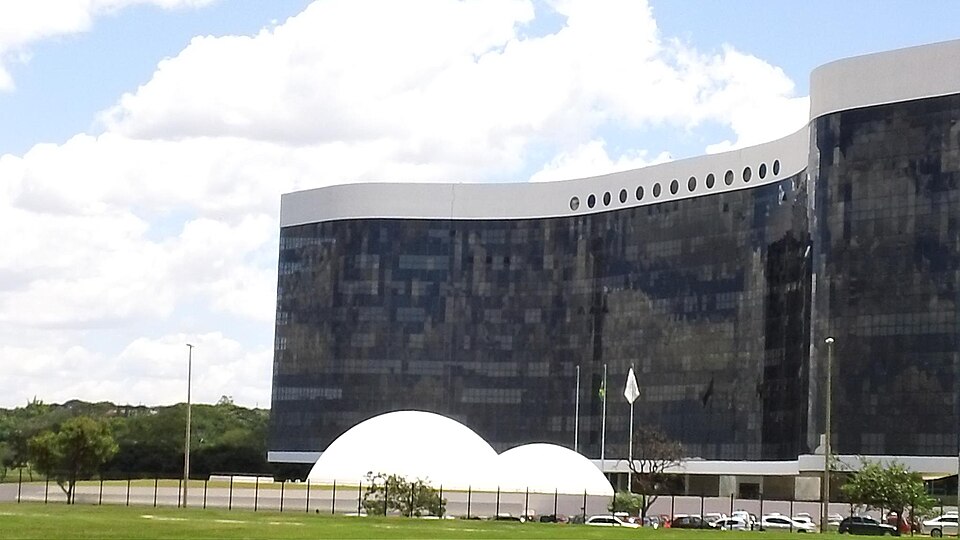
Brazil heads to a runoff with Flávio Bolsonaro ahead of Lula
Senator Flávio Bolsonaro won 47.03 percent of valid votes to President Lula's 45.16 percent on Sunday 4 October, by the electoral court's complete count, and the two meet again on Sunday 25 October; his Liberal Party won 121 of the 513 lower-house seats and 19 of the 54 Senate seats at stake, and the outcome reaches Petrobras, whose controlling shareholder is the federal government, and the banks and card issuers whose filings tie them to Brasília's fiscal and credit policy.
What the count says
Senator Flávio Bolsonaro of the Liberal Party (PL) finished first in Brazil's presidential vote of Sunday 4 October with 56,104,503 votes, or 47.03 percent of valid votes, and President Luiz Inácio Lula da Silva of the Workers' Party (PT) second with 53,879,538, or 45.16 percent, according to the results file of the Superior Electoral Court (TSE), the national electoral court, which shows all 499,248 polling sections counted. Valid votes are those cast for a candidate: blank and spoiled ballots are left out. The Constitution elects a president in the first round only with an absolute majority of those votes and otherwise sends the two leaders to a second round on the last Sunday of October, which the TSE's calendar sets for Sunday 25 October. By the desk's arithmetic the gap is 2,224,965 votes, or 1.87 percentage points. Figures printed on election night differ slightly: at 22:55 Brasília time on 4 October, with 99.96 percent of sections counted, The Rio Times reported 47.04 percent for Flávio Bolsonaro and 45.15 percent for Lula. [1, 6, 5, 20]
Turnout was 78.92 percent, 125,275,835 of 158,745,502 registered voters, the TSE's file shows; the 21.08 percent who stayed away made the highest abstention since 1998, Americas Quarterly reported. Augusto Cury of Avante came third with 2.89 percent, Renan Santos of Missão fourth with 2.24 percent and Ronaldo Caiado of the Social Democratic Party (PSD) fifth with 2.18 percent. Brazil is divided into 26 states and the Federal District, the Republic's annual report to the SEC notes, and by the desk's count of the TSE's 28 regional files, which add voters abroad, Flávio Bolsonaro led in 14 states and in the Federal District, and Lula in the other 12 states and among voters abroad; the 15 states The Rio Times credited to Flávio on election night count the Federal District as one. In São Paulo, whose 34,122,892 registered voters are the most of any state, Flávio Bolsonaro had 51.93 percent to Lula's 38.20 percent; Lula's largest share was 70.99 percent, in Piauí, and Flávio's 71.06 percent, in Roraima. [1, 2, 19, 8, 20]
The next Congress
The same court's files fill the next Congress. In the Chamber of Deputies, all 513 seats were at stake, and the PL won 121, more than any other party, followed by the PT with 70, União Brasil with 46, the PSD with 43, the Progressistas (PP) and Republicanos with 41 each and the MDB with 36, by the desk's tally of the TSE's state files; the seven parties of Lula's first-round coalition, the PT, PSB, PDT, PCdoB, PV, PSOL and Rede, won 124 seats between them. In the Senate, where each state and the Federal District has three senators serving eight-year terms and two of the three seats were renewed this time, 54 in all, the PL won 19, the MDB 7 and the PT 6. Americas Quarterly reported that from next year the PL will hold 28 of the Senate's 81 seats, more than any other party, and AP that the party 'won more than one-third of the Senate on Sunday', which it said is 'unusual in Brazil's fractured political system'. NPR wrote on election night that early results showed 'the right also made significant gains in Congress, particularly in the Senate'. [3, 4, 1, 6, 19, 17, 18]
Who backs whom in that Congress is the next count. The Progressistas signalled on Monday 5 October that they lean towards Flávio Bolsonaro and were to decide on Tuesday 6 October together with União Brasil, their partner in a formal alliance of parties called a federation, The Rio Times reported. By the desk's arithmetic on the TSE's tally, the PL, the PP and União Brasil together hold 208 of the Chamber's 513 seats, short of the 257 that make a majority. [21, 3]
What the campaigns propose
Both campaigns have said what they would do with the fiscal framework, the federal spending rule enacted in August 2023. The Republic's annual report to the SEC, filed on Thursday 27 August, says the framework 'combines a spending limit that is more flexible than the spending cap with a primary result target', the primary result being the budget balance before interest on the debt, and that it holds spending growth to between 0.6 percent and 2.5 percent a year above inflation and to 70 percent of the growth in revenue over the previous 12 months; automatic restraints set off by the 2025 primary deficit 'will be applicable regardless of who wins the October 2026 election', it adds. Lula's government plan, finalized on Friday 7 August, promises to keep the framework and criticizes the current level of interest rates, Estadão reported. Flávio Bolsonaro's plan, 'Para o Brasil Vencer o Atraso', For Brazil to Beat Backwardness in the desk's translation, would recast the rules to stabilize and then reduce public debt relative to the size of the economy, with primary surpluses and limits on credit subsidized by the Treasury, but sets out no formula or numeric targets, Forbes Brasil reported on Monday 5 October. The central bank's series puts gross general government debt at 82.86 percent of gross domestic product in August. [8, 22, 23, 9]
Oil is in the same contest. Provisional Measure 1,340, which the government enacted on Thursday 12 March and which took effect on publication, set a 12 percent tax on crude oil exports and a 50 percent tax on diesel exports, Petrobras's annual report says, and when the measure expired in July the authority in charge of foreign-trade policy kept the tax in effect, its quarterly report adds. That committee, Gecex, extended the 12 percent rate on Thursday 27 August for 60 days from 8 September, after a federal court in the Federal District had suspended its previous decision for the companies in the suit, and oil companies have been contesting the charges, CNN Brasil reported. Flávio Bolsonaro said on Thursday 6 August that, if elected, he would end the 12 percent rate, which he said had been invented because of the war, and compared it with Argentina's export tax on meat, Estadão Conteúdo reported. His plan would revive the national privatization program, assessing case by case where the state's presence no longer makes sense, without naming companies, and would fill the top posts of state companies that remain public through market-style recruitment, Forbes Brasil reported. [12, 13, 25, 24, 23]
On banks, Lula told the Flow podcast on Thursday 1 October that 'we are discussing with the Central Bank, we are going to prohibit banks from giving more than one credit card to people', SBT News reported (here and in the next sentence, the desk's translation from the Portuguese). The next day he wrote that 'each citizen has the right to have as many credit cards as they want' and that what he does not accept is banks sending cards to people's homes unrequested, and a person familiar with the discussions told Reuters that limiting consumers to a single card had never been under consideration, SBT News reported. A 2023 law and a National Monetary Council rule already cap the interest and charges on revolving card debt, the unpaid balance a cardholder carries forward, at no more than the original debt, Nu's annual report says, and a law of December 2025 raised the CSLL, a tax on profits, for certain financial companies to 17.5 percent from April 2026 through December 2027 and to 20 percent from January 2028. Flávio Bolsonaro's plan argues that 'lower interest rates are not decreed: they are won with accounts in order', Forbes Brasil reported (the desk's translation). [26, 27, 16, 23]
What the filings say
The annual report on Form 20-F that Petrobras filed on Thursday 9 April says 'Brazilian law requires that the Brazilian federal government owns the majority of our voting stock and, so long as it does, it will have the power to elect a majority of the members of our Board of Directors and, through them, the executive officers'. That shareholder 'has guided, and may continue to guide, certain macroeconomic and social policies through us', the report says; its actions 'could affect' fuel pricing decisions, and its representatives 'have at times expressed their views on the need for our prices to take into account domestic conditions'. Changes to the board and management 'may result in changes to our shareholder remuneration policy', the rules that set its dividends. The export tax already shows in the accounts of the company: its quarterly report, filed on Friday 7 August, records a US$1,087 million expense for the tax in the six months to 30 June, US$965 million of it in the second quarter, with US$579 million still to pay at 30 June. [12, 13]
The filings of the banks name the vote itself. The 20-F of Itaú Unibanco, filed on Thursday 30 April, says 'Brazil is expected to hold general elections in 2026' and that 'Political uncertainty and potential changes in federal government policies, including with respect to fiscal discipline and public spending, may materially adversely affect' the economy and 'the operations and financial performance of businesses operating in Brazil, including ours', that is, hurt them significantly, and that changes in inflation and interest rates 'may have a material effect on our net margins'. The 20-F of Banco Bradesco, filed on Wednesday 25 March, counts 'an ongoing fiscal crisis' among central concerns and says the situation 'is aggravated as the Brazilian government is shifting its focus to 2026 elections, further decreasing the likelihood of fiscal austerity measures'. That of Nu Holdings, filed on Wednesday 8 April, says 'The president of Brazil has the power to determine policies' and that through the National Monetary Council and the central bank the government 'introduces measures that affect liquidity, financing strategy, loan growth or even our profitability'; it called forecasts of the October 2026 outcome 'subject to a high degree of uncertainty'. [14, 15, 16]
What settles it next
The runoff campaign has its dates. Free campaign airtime on radio and television runs from Friday 9 October to Friday 23 October, which is also the last day for broadcast debates, under the TSE's calendar. Band and the newspaper Estadão have scheduled the first runoff debate for Sunday 11 October at 8 p.m. Brasília time, The Rio Times reported; both finalists skipped the first-round debates, and the PT's chairman, Edinho Silva, said debates would be key, AP reported, while Flávio Bolsonaro had not said whether he would attend, according to The Rio Times. Endorsements were still open on Monday 5 October: AP reported that three of the ten other first-round candidates had said they would back neither finalist, and The Rio Times that Augusto Cury and Renan Santos would back neither, that Ronaldo Caiado deferred to the PSD, which declared itself neutral, and that Romeu Zema of the Novo party said he would stand against the PT without naming Flávio Bolsonaro. The vote is on Sunday 25 October, for president and, where no candidate won a majority, for governor. [5, 21, 17]
After the vote, the central bank's monetary policy committee, Copom, meets on Tuesday 3 and Wednesday 4 November and announces its decision from 18:30 on the second day, under the calendar the bank published in June 2025. At its last meeting, on Wednesday 16 September, it cut the Selic, its benchmark interest rate, to 13.75 percent a year and said it 'continues to monitor how developments in domestic fiscal policy affect monetary policy and financial assets' (the desk's translation). By the desk's arithmetic, the crude export tax's 60-day extension from 8 September ends in early November, after the runoff. The electoral courts must certify the winners by Friday 18 December under the TSE's calendar, and the president elected on 25 October takes office on Tuesday 5 January 2027: Constitutional Amendment 111 of 2021 moved the start of the presidential term from 1 January to 5 January from this election on and set the current term to end that day. [11, 10, 25, 5, 6, 7]
Who it reaches
Petrobras (PBR) most directly: the Constitution vests the executive power in the president, and the federal government is the controlling shareholder that, the company's 20-F says, elects most of its board and, through it, its executives, and whose actions can reach its fuel prices and its dividends; the crude export tax Flávio Bolsonaro has pledged to end cost it US$1,087 million in the first half of 2026. Itaú Unibanco (ITUB) names the 2026 elections and federal fiscal policy as risks in its 20-F and says it led Brazil's credit card market with 24 percent of purchase volume in the fourth quarter of 2025, according to ABECS, the card companies' association. Banco Bradesco (BBDO) ties the election-year turn in fiscal policy to its risks in its 20-F. Nu Holdings (NU), whose first product, launched in Brazil in 2014, was a credit card, says the president's policies through the National Monetary Council and the central bank reach its loan growth and profitability. Itaú and Nu also say interest rates move their margins and the demand for credit, and the Copom next sets that rate on 4 November. [6, 12, 13, 24, 14, 15, 16, 11]
Sources
- Superior Electoral Court (TSE), presidential first-round results file for Brazil, all 499,248 sections counted, generated 5 October 2026, 2026-10-05
- TSE, presidential first-round results files for each state, the Federal District and voters abroad (28 files; the link is São Paulo's), 5 October 2026, 2026-10-05
- TSE, Chamber of Deputies results files for the 26 states and the Federal District (27 files; the link is São Paulo's), 5 October 2026, 2026-10-05
- TSE, Senate results files for the 26 states and the Federal District (27 files; the link is São Paulo's), 5 October 2026, 2026-10-05
- TSE, Resolution No. 23,760 of 2 March 2026, the 2026 electoral calendar (the court's compiled page as printed 18 August 2026; copy hosted by Poder360), 2026-03-02
- Constitution of the Federative Republic of Brazil, articles 46, 76, 77 and 82, on the Presidency's legislation site (read 6 October 2026), 2026-10-06
- Constitutional Amendment No. 111 of 28 September 2021, articles 4 and 5 (inauguration dates), on the Presidency's legislation site, 2021-09-28
- Federative Republic of Brazil, annual report on Form 18-K, exhibit 99.D (description of the Republic; fiscal framework), filed 27 August 2026, 2026-08-27
- Central Bank of Brazil, time series 13762, general government gross debt as a percent of GDP, monthly (read 6 October 2026), 2026-10-06
- Central Bank of Brazil, Copom statement of the 281st meeting, 16 September 2026 (Selic cut to 13.75 percent a year), 2026-09-16
- Central Bank of Brazil, Comunicado No. 43,383 of 24 June 2025, calendar of the 2026 Copom meetings, 2025-06-24
- Petrobras, Annual Report and Form 20-F 2025 (risk factors 2.a and 2.b; pricing; Provisional Measure 1,340), filed 9 April 2026, 2026-04-09
- Petrobras, Form 6-K, interim financial statements to 30 June 2026 in US dollars (note 13.4, export tax), filed 7 August 2026, 2026-08-07
- Itaú Unibanco Holding S.A., annual report on Form 20-F for 2025 (risk factors; credit cards; ABECS), filed 30 April 2026, 2026-04-30
- Banco Bradesco S.A., Form 20-F 2025 (risk factor 3.D.20.03-03), filed 25 March 2026, 2026-03-25
- Nu Holdings Ltd., annual report on Form 20-F for 2025 (risk factors; revolving credit rules; taxation; history), filed 8 April 2026, 2026-04-08
- AP, Lula shake-ups campaign as Flávio Bolsonaro reaches for more support ahead of Brazil's runoff, by Mauricio Savarese and Anna-Catherine Brigida, 5 October 20, 2026-10-05
- NPR, Brazil's presidential race heads to Lula-Bolsonaro runoff as right gains ground, by Carrie Kahn and Catherine Osborn, 4 October 2026, 2026-10-04
- Americas Quarterly, REACTION: Flávio Bolsonaro and Lula Advance to Brazil's Presidential Runoff, AQ Editors, 5 October 2026, 2026-10-05
- The Rio Times, election-night results report (Flávio and Lula head to a runoff), by Iolanda Fonseca, 4 October 2026, updated 5 October, 2026-10-04
- The Rio Times, Brazil Runoff on October 25, Flávio Bolsonaro vs Lula, by Arkady Petrov, 5 October 2026, 2026-10-05
- Estadão, Plano de governo de Lula promete manter arcabouço fiscal e enfrentar emendas parlamentares, by Daniel Weterman, 7 August 2026 (as carried by Terra), 2026-08-07
- Forbes Brasil, Tesouraço: o Que Prevê a Cartilha de Flávio Bolsonaro para a Economia, 5 October 2026, 2026-10-05
- Estadão Conteúdo, Flávio Bolsonaro's pledge to end the 12 percent crude export tax, by Naomi Matsui, 7 August 2026 (as carried by CNN Brasil), 2026-08-07
- CNN Brasil, Governo anuncia imposto de exportação do petróleo a partir de 8 de setembro, by Fabricio Julião, 27 August 2026, 2026-08-27
- SBT News, Lula avalia limitar cartões de crédito a um por pessoa, 2 October 2026, 2026-10-02
- SBT News, Brasileiros têm direito a quantos cartões quiserem, diz Lula, 2 October 2026, 2026-10-02
Every stock is a company; the desk grades the company behind the stock. This article describes; it does not recommend. Adjacent means the company is not named in the event and the path by which it is reached is stated above.