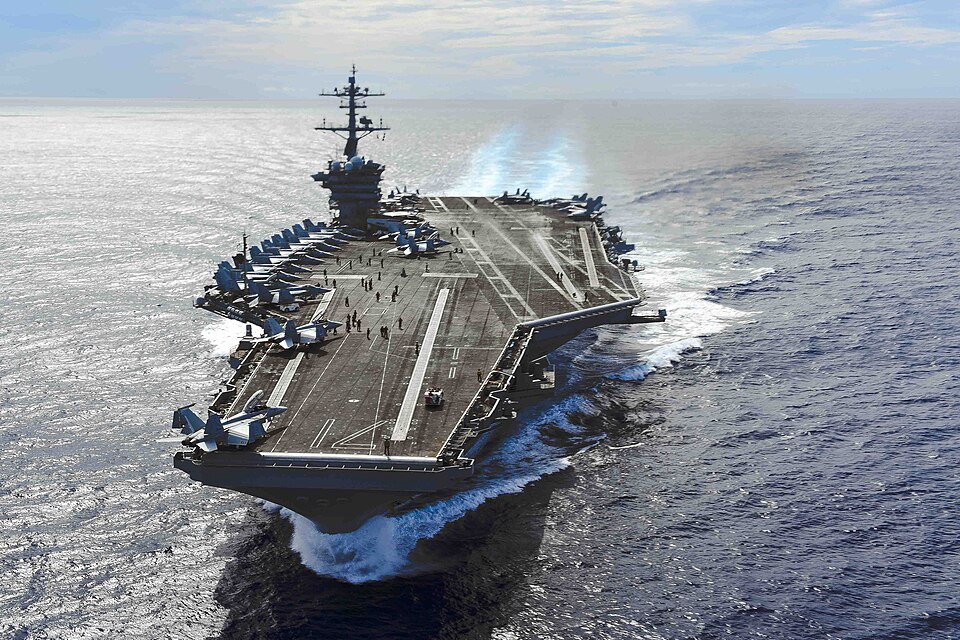
The Roosevelt heads for the Mideast, a third carrier or a replacement
Unnamed U.S. officials say the carrier Theodore Roosevelt and the Makin Island amphibious group, 9,000 to 10,000 sailors and Marines, are bound for the Middle East and could make three carriers there by the end of October or of November, though one told Bloomberg that keeping three is undecided and Task & Purpose reported the Roosevelt will replace the George Washington; Trump told TIME more bombing after the 3 November midterms is 'Possible', and Britain's naval trade office logged five reports of vessels struck from 28 September to 1 October.
What the officials disclosed
On Thursday 1 October a U.S. official told the Associated Press that the military is sending roughly 9,000 troops to the Middle East aboard a group of ships that together carry over 7,000 sailors and 2,000 Marines; the official spoke on condition of anonymity to discuss sensitive military operations. The group is the carrier strike group of the USS Theodore Roosevelt, a carrier sailing with its air wing and escorts, which recently deployed with the cruiser USS Chosin, and the amphibious group of the USS Makin Island, ships that carry Marines and the craft to land them, including the USS John P. Murtha and the USS Anchorage. The move could mean three carriers in the region as early as the end of October, the official said. [1]
The Roosevelt left San Diego on Sunday 27 September, Task & Purpose reported. The Navy has not said where it is going: on Monday 28 September its Pacific Fleet said only that the 'Theodore Roosevelt Carrier Strike Group is underway conducting routine operations in the U.S. 3rd Fleet area of operations', and the magazine noted that the Navy does not typically comment on where units will head next. The Navy's news pages carried no release on the deployment from 24 September to 1 October. The destination, the numbers and the timing in this piece are therefore the unnamed officials' and the reporters', not the Navy's. [2, 3]
The official who spoke to Al Jazeera said the Makin Island group, carrying more than 2,000 Marines, followed the Roosevelt a day later. Two carriers, the USS George H.W. Bush and the USS George Washington, are in the region now with the amphibious group of the USS Boxer, the AP reported; the Washington, typically deployed in the Pacific, was moved there to relieve the USS Abraham Lincoln, whose crew was at sea for more than 260 days straight. With the personnel already in place, the AP reported, the move would bring the U.S. naval presence to more than 20,000 sailors and Marines and hundreds of aircraft. The Navy previously had three carrier strike groups in the Middle East in April, for the first time since 2003. [4, 1]
Three carriers, or a swap
The accounts agree on the ships and differ on the count and the calendar. The AP's official put three carriers in the region as early as the end of October. The official who spoke to Al Jazeera said three carriers and two amphibious landing groups will be positioned near Iran by the end of November, a concentration of force that would hand President Trump 'a wider menu of options if he decides to act'. The official who spoke to Bloomberg said that when the Roosevelt arrives the United States 'could again have three carrier strike groups in the region, the same number as in late April, although a decision on maintaining that level hasn't been made'. [1, 4, 5]
The other reading is a swap. Task & Purpose reported on 28 September, before any of the officials spoke, that the Roosevelt 'is expected to head to U.S. Central Command's area of responsibility, where it will relieve the USS George Washington', and that its sailors and their families were told to prepare for about eight months away, with the possibility of an extension; with the Roosevelt, it counted five of the Navy's 11 carriers committed to operations connected to the war since the war began on 28 February. The head count differs too: roughly 9,000 by the AP's official, 10,000 sailors and Marines by Bloomberg's, and an additional 9,000 to 10,000 troops by the Wall Street Journal's report as Al Jazeera relayed it. Al Jazeera's Tanya Noury, citing sources in the Pentagon and the White House, reported that the Pentagon is not currently planning to withdraw any assets even if an agreement with Iran is reached. [2, 1, 5, 4]
Trump's words, and Tehran's
Trump told TIME, in an interview at the White House on Monday 28 September that the magazine published on Thursday, why he turned down Iran's latest ceasefire proposal: 'Because things that I wouldn't have approved a year ago I wouldn't have today.' Iran, he said, 'made an offer to open up the Strait', and 'it's not good enough. Nearly.' Asked whether he would ramp up bombing after the midterm elections, he answered 'Possible', and pressed on whether he was considering it, he said: 'I can't tell you that because look, you know, you're asking, where are you going to bomb?' The elections are on Tuesday 3 November. [6, 1]
At the White House on Thursday, asked whether Iran was linked to the FlyDubai co-pilot who stabbed his captain and tried to crash an Israel-bound flight on Wednesday, Trump said that 'based on what I'm hearing' the answer was yes, 'but we're working on it right now', and that if the link was established, 'they'll be hit very hard'. Asked whether the war could hurt Republicans in November, he said 'It's possible', then 'It should help, because Iran will not have a nuclear weapon.' That night in Denton, Texas, he said Iran 'is ready to fold up' and that he believes the United States will win the war 'right after the election', or 'maybe before the election', CBS News reported. [1, 7]
The talks run through Qatar, and Iran's plan, as the desk reported on 27 September from NBC News, asks the United States to accept a transit route agreed by Iran and Oman. On Wednesday 30 September Iran's government spokeswoman, Fatemeh Mohajerani, told the official IRNA agency that the American side's proposal had been presented to President Masoud Pezeshkian at that day's cabinet meeting, which Agence France-Presse reported as the formal U.S. response; an official quoted by Reuters said the disagreement is over the sequencing of the plan. On Thursday Pezeshkian said, according to IRNA, that Iran has 'never run away from dialogue and will not do so, although the United States has targeted our country three times despite having signed the agreement'. No Iranian statement answering the deployment itself appears in the reports read here; Reuters reported on Thursday, citing sources, that Iran is preparing a broader and more forceful response if the United States resumes large-scale military attacks. [11, 7, 8, 1, 4]
The oil and shipping record
Eight days ago the desk's YANBU study recorded the International Energy Agency's estimate of Gulf oil exports in August at around 13 million barrels a day, nearly half their pre-war level, and the restart at a low rate, on 22 September, of Saudi Arabia's East-West pipeline to Yanbu on the Red Sea, built to avoid the strait. The counts since are higher. The ship-tracking firm Kpler said on Tuesday that about 21.8 million barrels a day of crude and fuels are being shipped from the Gulf on a weekly average, against a pre-war baseline of 23.3 million, by way of the Red Sea and the Suez Canal, a pipeline to Fujairah and a U.S.-protected route through the strait that guides tankers at night, the AP reported. Goldman Sachs put Gulf exports, including 'dark exports' from ships with their location transponders turned off, at 23.3 million barrels a day over the last week, in line with their 2025 average, and Reuters reported on Thursday that Saudi Arabia had resumed tanker loadings at Yanbu. The measures differ: the agency's is a monthly estimate for August, the firms' are weekly figures from the end of September. [9, 7, 8]
The strait is still being fired on. The incident log of the U.K. navy's Maritime Trade Operations centre, as CBS News describes it, carries a report dated 1 October of a tanker struck by an unknown projectile while transiting the Strait of Hormuz, 'resulting in a fire', with the crew reported safe; three reports dated 30 September of tankers struck there, one of them a crude oil tanker hit on the port side; and a vessel set on fire by a suspected projectile on the evening of 28 September. The log names no attacker. An adviser to Iran's Revolutionary Guards, Brigadier General Ali Belali, told the Fars agency that Iran had hit a moving target with a long-range ballistic missile 'in the past few days', without saying what it hit, CBS News reported. The desk's piece of 27 September recorded a U.S. official counting nearly 40 million barrels through the strait under escort in 48 hours. [10, 7, 11]
In Reuters' reports the price of oil moved on other news. On Thursday, Reuters reported, Brent, the international benchmark, rose by about 3 dollars after Chinese refiners suspended exports of oil products, with the new front-month December contract at 101.06 dollars a barrel at 1452 GMT. On Friday, Reuters reported, Brent fell 2.57 dollars, or 2.51 percent, to 99.74 dollars at 1035 GMT, and West Texas Intermediate fell 3.53 dollars to 89.34, after reports that European governments were discussing a French proposal to release 50 million barrels of diesel and for members of the International Energy Agency to release 50 million barrels of crude. Neither report ties a move in the price to the deployment; Friday's brings in the carrier after a 'Meanwhile', as the Wall Street Journal's account of a third carrier and up to 10,000 more troops. Ole Hansen of Saxo Bank said that 'the main stress in the energy market is no longer crude availability, with Middle East flows recovering, but rather refined product supply'. [8, 12]
What settles it next
The dated records to read next. Sunday 4 October, when OPEC+ meets; two sources told Reuters the group is likely to keep its November production targets steady. Iran's answer to the American response it received on 30 September, for which none of the reports read here gives a date. The Roosevelt's arrival, which the officials put as early as the end of October or by the end of November, and the decision that Bloomberg's official said has not been made on keeping three carriers in the region. Each new entry in the UKMTO log. And Tuesday 3 November, the midterm elections, after which Trump called more bombing 'Possible'. [8, 7, 1, 4, 5, 10, 6]
Who it reaches
Huntington Ingalls Industries is reached by the ships themselves. Its Newport News yard built all ten Nimitz-class carriers in active service, the Roosevelt among them, and is the exclusive contractor for the refueling and complex overhaul each needs at the midpoint of its 50-year life, work that takes nearly four years, by its annual report for 2025; the George Washington came out of that overhaul in May 2023. Aircraft carriers brought the company 3,390 million dollars of its 12,484 million in revenue in 2025, about 27 percent by the desk's arithmetic. On Wednesday 30 September the Navy sent another carrier, the USS Harry S. Truman, from Norfolk to Newport News Shipbuilding for the next major phase of that overhaul. [13, 2, 3]
Two filings name the strait itself. Frontline, which owns crude tankers, says in its report for the six months to 30 June, filed on 16 September: 'Risk levels across the Strait of Hormuz, the Red Sea and the Black Sea are rapidly changing with little warning, leading to more waiting time, disrupted flows and a greater need for fleet repositioning'; it adds that a significant number of vessels have remained committed to Arabian Gulf trades. Occidental Petroleum says in its quarterly report of 5 August that commodity prices in the second quarter 'benefited in part from risk premiums associated with the conflict involving Iran', that shipping through the strait improved in parts of the quarter but 'recent developments have underscored the continued fragility of those conditions', and that its international sales volumes were lower because of disruptions from the conflict in the Middle East. Neither filing mentions the carriers. [14, 15]
Sources
- Associated Press (Konstantin Toropin and Michelle L. Price) via WSLS, Third aircraft carrier and thousands of troops head to Mideast as Trump weighs new Iran st, 2026-10-01
- Task & Purpose (Austin Campbell), USS Theodore Roosevelt arrives in Pacific ahead of anticipated Middle East deployment, 2026-09-28
- U.S. Navy, Press Office, News Stories, the list from 24 September to 1 October (no release on the Roosevelt; the Truman's move to Newport News), 2026-10-01
- Al Jazeera (Priyanka Shankar), New aircraft carrier, 10,000 US troops: Is the Iran war about to escalate? (a US official to Al Jazeera), 2026-10-02
- Bloomberg (Tony Capaccio) via The Japan Times, U.S. may add carrier and 10,000 troops to Middle East, official says (three paragraphs read; the rest paywalled), 2026-10-02
- TIME, transcript of the interview with President Trump of 28 September (What Trump Has Built), Eric Cortellessa and Sam Jacobs, 2026-10-01
- CBS News live updates, Trump says Iran 'ready to fold up' (entries of 30 September to 2 October, with AP, AFP and Reuters items), 2026-10-02
- Reuters via Business Recorder, Oil prices rise $3 as China suspends fuel exports (Thursday 1 October), 2026-10-01
- CrossAssetData, YANBU study, chapter two: Missiles over Yanbu as Riyadh sells Asia 100 million barrels, 2026-09-24
- UK Maritime Trade Operations (UKMTO), Recent Incidents log, entries 143 to 147, 28 September to 1 October, 2026-10-01
- CrossAssetData, Trump rejects Iran's seven-day plan to reopen Hormuz, 2026-09-27
- Reuters via Business Recorder, Oil price drops more than 2 percent on talks over diesel, crude stock releases (Friday 2 October), 2026-10-02
- Huntington Ingalls Industries, annual report on Form 10-K for 2025 (Newport News: carriers built, refueling and complex overhaul, revenue by program), 2026-02-05
- Frontline plc, report on Form 6-K for the six months ended 30 June 2026 (management's discussion and analysis), 2026-09-16
- Occidental Petroleum Corporation, quarterly report on Form 10-Q for the quarter ended 30 June 2026, 2026-08-05
Every stock is a company; the desk grades the company behind the stock. This article describes; it does not recommend. Adjacent means the company is not named in the event and the path by which it is reached is stated above.