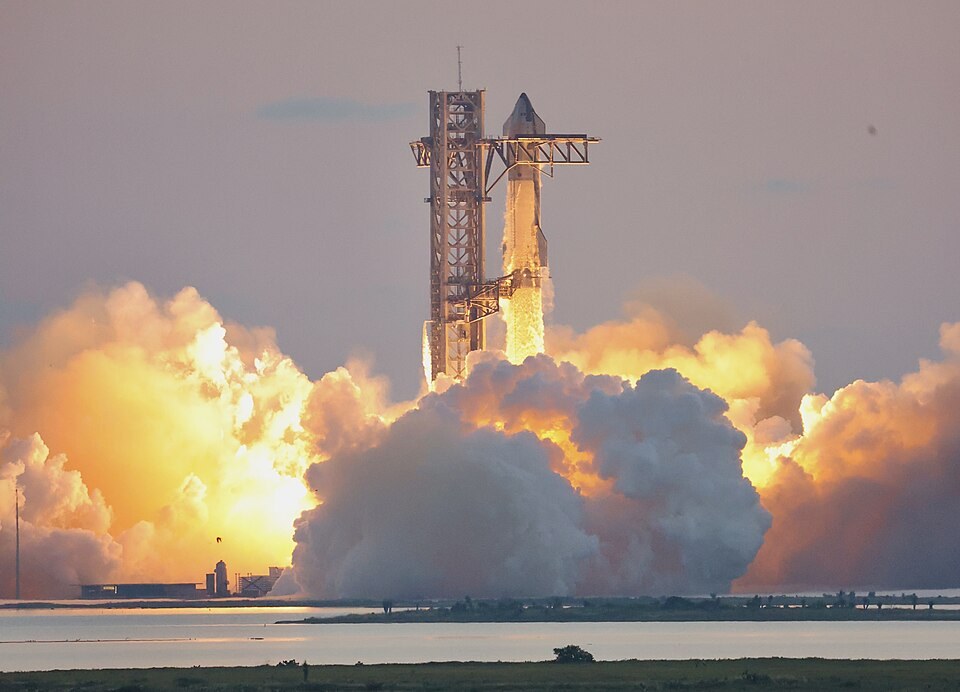
Starship reaches orbit and releases 26 V3 Starlinks
Flight 14 lost one of six upper-stage engines, reached orbit about 25 minutes in, released every satellite it carried and came down after about three hours of a planned nine or ten; SpaceX's June prospectus had put the first V3 deployments on Starship in the second half of 2026 and called its growth strategy 'highly dependent on Starship', and Tesla, EchoStar and Cannae carry SpaceX in their own reports.
What happened on Monday
SpaceX's Starship lifted off from Starbase in South Texas on Monday 28 September on its fourteenth flight, at 8:49 a.m. Eastern by Satellite Today's account. During the climb one of the six engines on the Ship upper stage shut down early; a SpaceX spokesperson, Dan Huot, announced the orbital attempt was called off, then flight controllers reversed course, Space.com reported, and about 25 minutes after liftoff the Ship fired a single Raptor engine and entered orbit for the first time. [1, 2, 4]
The Ship released all 26 of the next-generation V3 Starlink satellites it carried, and TechCrunch reported that SpaceX was able to connect to all of them and that they are meant to start serving customers in the next few weeks. Rather than orbit for the nine or ten hours planned, SpaceX brought the Ship down early: Satellite Today reported a splashdown in the North Pacific after a flight of 3 hours and 9 minutes. The Super Heavy booster was never meant to return to the launch site; Fortune reported it dropped into the Gulf of Mexico, after what TechCrunch called a simulated landing over the water. [3, 1, 4]
NASA's administrator, Jared Isaacman, congratulated SpaceX on 'managing every step in a safe, responsible and especially inspirational way', Fortune reported, and Elon Musk had said at a business summit this month that SpaceX is being 'extremely cautious' about bringing the Ship back over land. [4]
What SpaceX told investors in June
SpaceX's final prospectus of 12 June describes Starship as 'designed to be a fully reusable, super heavy-lift launch vehicle' and its third version as designed to deliver 100 metric tons to orbit. It defines the V3 satellites as 'our next-generation Starlink broadband satellites, which are designed to offer one Tbps of downlink capacity per satellite and which we expect to begin deploying on Starship in the second half of 2026', and says a single Starship launch should be able to carry up to 60 of them, a potential twenty-fold increase in downlink capacity over a Falcon 9 launch. [5]
The same document names the dependence plainly: 'Our ability to execute our growth strategy is highly dependent on Starship.' It says the space segment spent $930 million on research and development in the three months to 31 March 2026, and $3,004 million in 2025, for the Starship program, and counts about 9,600 Starlink satellites in low Earth orbit at 31 March. [5]
What the June quarter showed
SpaceX's first quarterly report as a listed company, filed on 4 August, counts one Starship launch in the three months to 30 June and one in the first half, against three in the first half of 2025, and says every Starship launch so far has been for its own purposes. It reported 485 metric tons put into orbit in the quarter, against 652 a year earlier, and said space research spending rose by $383 million, or 55.3 percent, driven by production, engineering, launch and test costs 'to support continued development of the Starship vehicle'. [6]
Who else carries SpaceX on the record
Tesla's quarterly report says it invested $2.00 billion in SpaceX common stock in March 2026, formerly a preferred investment in xAI, an interest of less than 1 percent, that it is presumed to have significant influence over the stake because its chief executive also runs SpaceX, and that it has elected to carry the stake at fair value; it recorded a $1.00 billion net gain on it in the June quarter, and says sales restrictions tied to SpaceX's public offering expire in December 2026. The same report shows SpaceX buying Tesla's Megapack batteries, $318 million of Tesla revenue in the quarter. [7]
EchoStar's quarterly report lists this among its risks: 'Investor expectations regarding our potential investment in SpaceX may be currently influencing our stock price', adding that adverse developments at SpaceX could weigh on its own shares. Cannae Holdings reported that it remeasured its investment in SpaceX to a fair value of $110.9 million at 30 June, a gain of $83.4 million. [8, 9]
Where the sources disagree
On the plan: TechCrunch reported the Ship was to orbit for about nine hours, while Satellite Today and Fortune reported a ten-hour mission of six orbits. On the constellation: SpaceX's prospectus counted about 9,600 Starlink satellites at 31 March, TechCrunch called it 10,000-strong and Fortune put the older satellites at 11,000; the counts come from different dates and are not reconciled in any of the documents. [3, 1, 4, 5]
What settles it next
Fortune reported that, depending on what Monday's flight shows, the next Ship could return to the launch site to be caught by the tower's arms, and that if the catch works SpaceX will fly the Ship again by the end of the year or early next year. SpaceX's quarterly reports count Starship launches and the mass put into orbit, and the next covers the quarter to 30 September; Tesla's restrictions end in December by its own account, and NASA's Artemis III, which Fortune says could come as soon as next summer, includes Starship docking with Orion in Earth orbit. [4, 6, 7]
Sources
- Via Satellite (Satellite Today), SpaceX's Starship Reaches Orbit, Cuts 10-Hour Mission Short After Engine Issue, 2026-09-28
- Space.com, SpaceX launches Starship into orbit for 1st time on Flight 14, 2026-09-28
- TechCrunch, SpaceX's Starship rocket reaches orbit for the first time, by Sean O'Kane, 2026-09-28
- Fortune (Associated Press), Starship reaches orbit for first time, but SpaceX cut its planned 10-hour trip after 3 hours, 2026-09-28
- Space Exploration Technologies Corp., final prospectus (Form 424B4), 2026-06-12
- Space Exploration Technologies Corp., quarterly report on Form 10-Q for the quarter ended 30 June 2026, 2026-08-04
- Tesla, quarterly report on Form 10-Q for the quarter ended 30 June 2026 (the SpaceX equity investment and related-party transactions), 2026-07-23
- EchoStar, quarterly report on Form 10-Q for the quarter ended 30 June 2026 (risk factors), 2026-08-03
- Cannae Holdings, quarterly report on Form 10-Q for the quarter ended 30 June 2026 (the investment in SpaceX), 2026-08-10
Every stock is a company; the desk grades the company behind the stock. This article describes; it does not recommend. Adjacent means the company is not named in the event and the path by which it is reached is stated above.