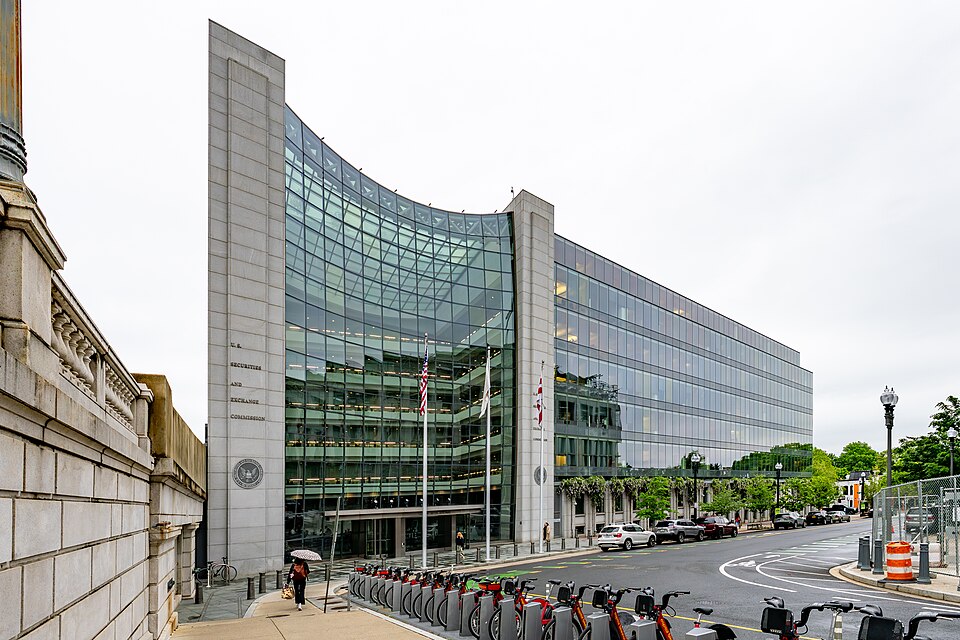
The SEC opens a five-year door to stocks on public blockchains
The order excuses a new kind of venue from registering as a stock exchange, and the firms that stock its pools from registering as dealers, on conditions: the token must carry the real share with its dividends and votes, the company can veto it, the code must be public, and the venue may list only a capped number of stocks.
What the Commission did
The Securities and Exchange Commission issued an order on Thursday that lets certain trading venues offer American stocks as tokens on a public blockchain without registering as a stock exchange. The relief runs for five years from publication and the Commission calls it the Innovation Exemption. The order is release 34-106402 and sits in the Commission's files as number 4-927, open for public comment on what should follow. [1, 3, 2]
There are two exemptions in the order. The first covers what the Commission calls a tokenized securities venue: an organization that brings buyers and sellers of tokenized stock together by running automated market maker liquidity pools, which are pools of assets that a program prices and trades against instead of matching one buyer to one seller, and by setting the standards for who may trade there. That venue is exempted from the legal definition of an exchange in the Securities Exchange Act of 1934, the law Nasdaq and the New York Stock Exchange are registered under. The second exemption covers the firms that supply those pools with stock using their own money, which would otherwise make them dealers in the eyes of the same law. [2, 1, 7]
The Commission lists the benefits it says the technology can offer: investors holding their own shares directly, trading around the clock, owning fractions of a share and settlement that is close to instant, meaning the buyer's money and the seller's stock change hands almost at once rather than the next business day. It says it is granting the relief while it considers what permanent rules should apply. [2]
What counts as a token, and what does not
The order draws a hard line. A tokenized stock qualifies when the token is created by the company that issued the stock, or on its behalf, or by an unrelated third party, and when the holder gets the same rights and privileges as someone holding the ordinary share, dividends and votes included. A venue has to verify that before it lists one. What does not qualify is a token that merely tracks a share price without carrying the share behind it, which the order names as a tokenized linked security or a tokenized security-based swap. [2, 7]
That line runs straight through what some firms already sell. Reuters reported that Robinhood and Kraken already offer tokenized stocks outside the United States, and CoinDesk reported that Robinhood's product gives price exposure without shareholder rights, the kind the order excludes. Reuters also reported that Coinbase has signaled it plans to offer tokenized stocks in the United States once the rules allow it. [7, 8]
Companies keep a veto over their own shares. Before a venue can list a token that somebody else created from a company's stock, it has to give that company written notice and a chance to object, and the fact sheet sets the notice at 30 days. Joris Delanoue, the chief executive of the onchain transfer agent Fairmint, told CoinDesk the issuer veto is the key safeguard. [2, 9, 8]
The conditions the relief hangs on
The exemption is narrow by design. The order caps how many stocks a venue may list and how much of each it may trade; the law firm Jones Day, reading the order for clients, puts the first tier at 75 symbols and a quarter of one percent of the previous month's average daily volume, and the second at 250 symbols and 2.5 percent, with a three-month pause for breaking the volume cap and loss of the exemption altogether for breaking the symbol cap. Commissioner Mark Uyeda's statement describes the volume caps as calibrated to the tiers the market already uses to pause a runaway stock. [9, 5]
The rest of the conditions are about being visible. The programs that run the pools, known as smart contracts, must be auditable, public and deployed on a public blockchain that anyone can join. Trading in a token has to stop when trading in the underlying stock stops. A venue must publish what it does and what it and its affiliates trade, say plainly that it is not registered with the Commission, keep its records in the United States, be a United States person and follow sanctions law, publish a notice 30 days before it opens and tell the Commission in writing within one business day of that notice. Firms supplying the pools must trade only for their own account and hold no customer assets. [2, 9, 1]
What the order does not touch is as important. The rules against fraud and manipulation apply in full, the chairman wrote. The relief does not cover selling new shares, and it does not reach any other business a firm does. [4, 9]
Why now: the bill that did not pass
Two days before the order, the Senate refused to open debate on the crypto market bill. Its record for Tuesday 15 September reads that by a vote of 49 to 50 the Senate did not agree to the motion to invoke cloture on the motion to proceed to H.R. 3633, the Digital Asset Market Clarity Act. Cloture is the vote that ends a filibuster, and it needs 60. Senator Coons did not vote; Senators Collins, Hawley, Moran and Tillis voted no, Tillis so that the vote could be reconsidered later. [6]
The chairman's own statement makes the connection. Paul Atkins wrote that Congress had failed to advance the CLARITY Act despite the tireless efforts of many, and that the Commission was acting within the authority it already has. He described the order as a bridge rather than a destination, said it was not cementing today's technology as the standard for tomorrow, and wrote that the interim measure must be followed by durable rulemaking. Jamie Selway, who runs the division that wrote it, called the approval a milestone. Uyeda, supporting it, asked for detailed, data-supported comments to shape what comes next. [4, 1, 5]
Whether venues actually use it is a separate question. Jim Petrila, the chief legal officer at Dromos Labs, told CoinDesk that the gating requirements may mean that uptake is slow. [8]
Who it reaches
The order names no company, so every path here is adjacent. Nasdaq and Intercontinental Exchange, which owns the New York Stock Exchange, run the registered exchanges whose rulebook a tokenized venue is being excused from. Coinbase has signaled it will offer tokenized stocks here when it can, and Robinhood sells abroad the kind of price-tracking token this order shuts out, both as Reuters reported. Bullish is expanding into tokenization through its Equiniti deal, as CoinDesk reported. Charles Schwab and Morgan Stanley, which owns E-Trade, are the established brokers Reuters named as facing the competition. The company files on this site carry each one's record. [7, 8, 2]
Sources
- U.S. Securities and Exchange Commission, press release 2026-90, SEC Issues Innovation Exemption to Facilitate the Trading of Tokenized NMS Stock and Request for, 2026-09-17
- U.S. Securities and Exchange Commission, fact sheet for the order granting temporary conditional exemptive relief for trading of tokenized NMS stock on tokenize, 2026-09-17
- U.S. Securities and Exchange Commission, the order itself and its comment file (release 34-106402, file 4-927), 2026-09-17
- Paul S. Atkins, chairman of the SEC, Statement on the Innovation Exemption: A Bridge Toward Durable Rulemaking, 17 September 2026, 2026-09-17
- Mark T. Uyeda, commissioner of the SEC, Statement on the Innovation Exemption, 17 September 2026, 2026-09-17
- United States Senate, Daily Digest for Tuesday 15 September 2026 (the cloture vote on the motion to proceed to H.R. 3633), 2026-09-15
- Reuters via Investing.com, US securities regulator rolls out five-year exemption for tokenized stock trading, 17 September 2026, 2026-09-17
- CoinDesk, SEC opens door to tokenized U.S. stock trading: here's who could benefit, 17 September 2026, 2026-09-17
- Jones Day, The SEC's New Innovation Exemption: Five-Year Relief for Trading on Tokenized Securities Venues, September 2026, 2026-09-17
Every stock is a company; the desk grades the company behind the stock. This article describes; it does not recommend. Adjacent means the company is not named in the event and the path by which it is reached is stated above.