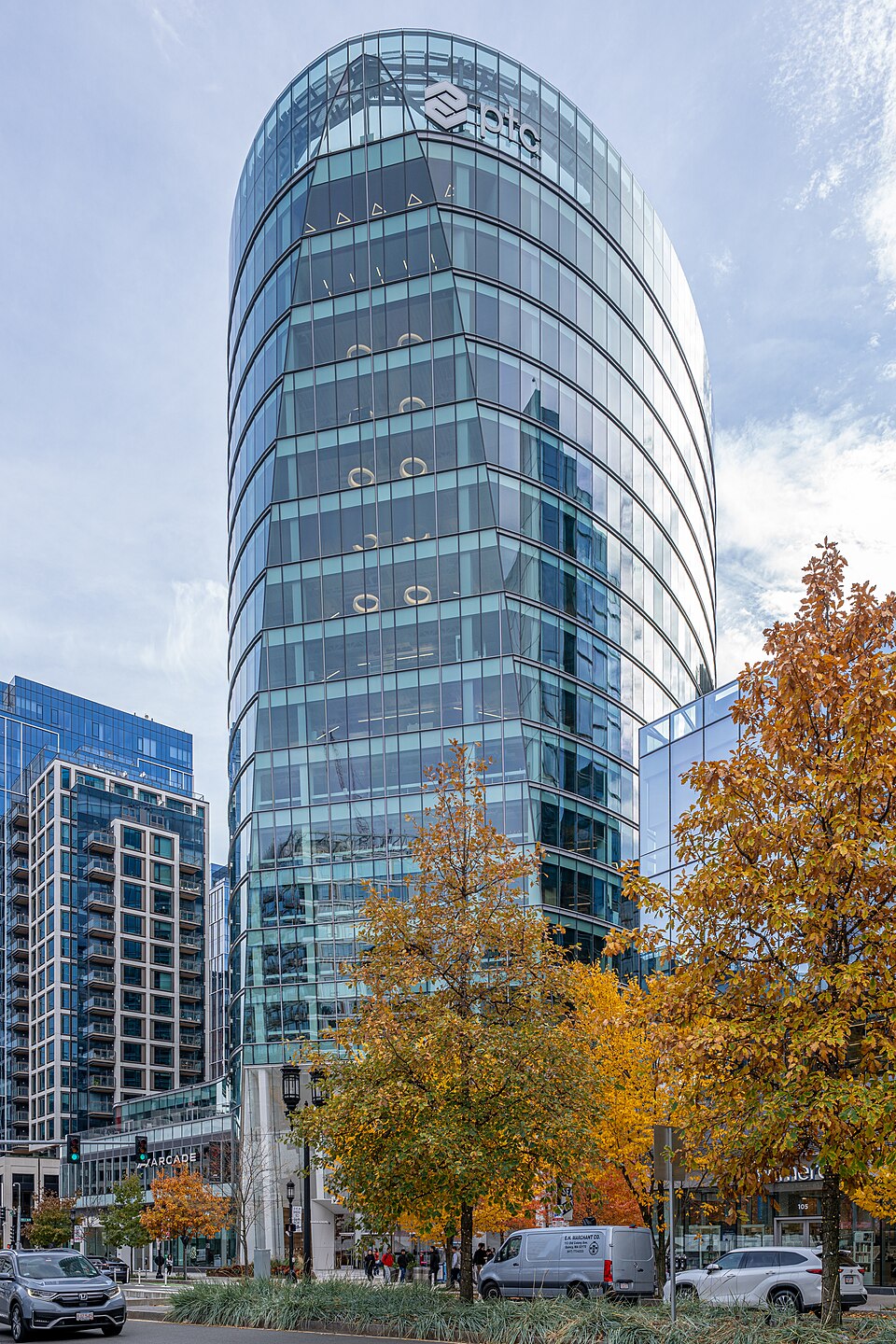
Schneider Electric agrees to buy PTC for $22.6 billion in cash
PTC, the Boston maker of design and product-data software, agreed on Sunday 4 October to be bought for cash by Schneider Electric at a value of about $22.6 billion for its shares and $23.7 billion with its debt; a $25 billion bridge loan carries Schneider until about €5 billion to €6 billion of new shares and €16 billion to €17 billion of new debt replace it, and closing, expected by the third quarter of 2027, needs PTC's shareholders, US antitrust clearance and a national-security review.
What the companies signed
On Sunday 4 October PTC, a Boston company that sells manufacturers software for designing products and managing their data, signed an agreement and plan of merger with Schneider Electric SE, a European company organized under French law, and Grand Slam Merger Sub, a Massachusetts subsidiary that Schneider owns outright. The subsidiary is to merge into PTC, leaving PTC a wholly owned part of Schneider; each PTC share is to be converted into a fixed sum in cash, and PTC's stock would then be delisted from the Nasdaq Global Market, meaning it would no longer trade there. The joint release of Monday 5 October says the deal values PTC's equity, all of its shares together, at approximately $22.6 billion (€20.1 billion) and implies an enterprise value, a measure that counts debt as well, of $23.7 billion (€21.1 billion). The boards of both companies approved it unanimously, and PTC's board resolved to recommend that its shareholders approve it. [1, 3, 8]
Schneider, once known mainly for fuses and circuit breakers and now a builder of the backbone of data centers, from cooling units and server racks to power distribution equipment, in Reuters' description, already runs an industrial software business, AVEVA, which its chief executive, Olivier Blum, named in the release; in June it agreed to buy Cognite, a privately held provider of AI software and industrial data, a purchase still awaiting regulatory approvals. The release says PTC adds 'the critical product and engineering data fabric', the record of how products are designed and built, to the process and energy data Schneider already handles, and that with PTC and Cognite, software and services would make up an estimated 24 percent of Schneider's revenue on a pro forma basis, counted as if the companies were already combined. Blum called the purchase 'an important step forward'; on the conference call he said 'Data is becoming a very critical layer' for getting value from AI, Reuters reported. PTC's chief executive, Neil Barua, called the all-cash deal 'the culmination of the PTC Board's commitment to maximize shareholder value'. [3, 6, 8]
Reuters, Axios and The Next Web all describe it as Schneider's largest acquisition; Reuters, citing LSEG data, calls it one of the biggest in Europe this year. Axios says it tops Schneider's purchase of AVEVA in 2023, which it puts at $11 billion, and is Schneider's third deal of more than a billion dollars this year. The Next Web says the buyout of AVEVA, completed in 2023, valued that company at about £9.5 billion, and lists the $3.1 billion agreement for Cognite in June and a €1.2 billion takeover offer in September for Shelly Group, a Bulgarian maker of smart-home devices. It also notes that the Financial Times reported a day before the announcement that the two companies were close to agreement at about $20 billion. Axios adds that software mergers this large have been rare in 2026, with dealmaking in the sector held back by uncertainty over AI. [6, 7, 8]
What PTC makes and earns
PTC sells two families of software, by its annual report for the year to 30 September 2025. Its computer-aided design products, Creo and the cloud-based Onshape, are used to design, test and change products in three dimensions on a computer. Its product lifecycle management products keep a product's data in order from first concept to service and retirement: chiefly Windchill, with Codebeamer for products that contain software, ServiceMax for field service, Servigistics for service parts and the cloud-based Arena. It serves mainly five industries, in its own words: industrials; federal, aerospace and defense; electronics and high tech; automotive; and medical technology and life sciences. It employs over 7,000 people, 7,642 full-time at that year end, and supports more than 30,000 customers; 95 percent of the year's revenue was recurring, from subscriptions, support, cloud software and hosting. On Friday 13 March 2026 PTC sold its Kepware and ThingWorx businesses to an entity controlled by funds affiliated with TPG, for total consideration of $530.8 million and up to $125 million more in certain circumstances after a later sale by the buyer, by its latest quarterly report. [4, 5]
In the fiscal year to 30 September 2025, PTC's revenue was $2,739.2 million, 19 percent more than the $2,298.5 million of the year before; its net income was $734.0 million, and its operating activities brought in $868 million of cash. The company leads with another yardstick, ARR, for annual run rate: the yearly value of the subscription, cloud, hosting and support contracts active at a date. ARR was $2,478.5 million at that year end, 10 percent more than a year earlier. PTC's filings say 'the timing of revenue recognition for on-premises subscription revenue can vary significantly': for software installed on the customer's own computers, a substantial part of a subscription contract's total value is recorded as revenue at one point, when the software is made available or the term begins, so revenue moves with when large contracts start and how long they run, while ARR does not. [4, 5]
In the quarter to 30 June 2026, the latest it has reported, PTC's revenue was $600.0 million, 7 percent less than the $643.9 million of a year earlier: the businesses sold in March had brought in $46 million in that earlier quarter, and license revenue was lower, mainly because a single large contract renewal and expansion ran for a shorter term, the company said. ARR was $2,412.4 million, flat on the year, and 7 percent higher than the $2,255.6 million of a year earlier once the businesses sold are left out of both. PTC paid for a $375 million accelerated share repurchase, in which a bank delivers most of the shares at once, with the proceeds of the sale, bought back a further $975 million of its shares in the market over the nine months to June, and borrowed a net $225 million under its credit facility in the quarter; at 30 June its debt was $1,425.1 million and its cash $351.5 million. That debt less that cash comes to about $1.1 billion by the desk's arithmetic, close to the gap between the release's $22.6 billion and $23.7 billion; the release does not show its calculation. [5, 3]
How Schneider pays
Schneider pays in cash and has the money promised before it raises it. On Sunday 4 October it signed a mandate letter with two banks, Morgan Stanley Europe SE and Société Générale, which committed to lend up to $25 billion under a bridge term loan, a loan meant to carry a buyer until longer-term money replaces it. The banks' funding is subject to conditions that include signing the final loan documents and completing the merger, and the merger itself does not depend on Schneider obtaining financing. The release puts the total cash consideration at approximately €22 billion and says Schneider expects to fund it with about €5 billion to €6 billion of new shares, sold through an accelerated bookbuild, a quick placement with large investors, under an authorization its shareholders already gave the board at their annual meeting, and about €16 billion to €17 billion of new debt raised in several currencies; the two ranges add up to €21 billion to €23 billion, by the desk's arithmetic. The release does not break the €22 billion down. The agreement lists what the money must cover: the cash for PTC's shares and stock awards, the deal's costs, and any repayment or refinancing of debt that the banks' letter contemplates. [1, 2, 3, 6]
Schneider says it expects to keep credit ratings in category A, the band the agencies give borrowers they judge strong, subject to the agencies' formal confirmation. It expects to continue the policy that has given it a progressive dividend, one meant to rise over time, for the last 16 years; to complete €600 million of share buybacks in 2026 under its €2.5 billion to €3.5 billion program to 2030, pause them in 2027 and 2028 and then speed them up to finish by the end of 2030; and to continue selling businesses with €1.0 billion to €1.5 billion of revenue by 2030. From the combination it expects €250 million a year of cost savings, at their full annual pace, by the third year, and about €800 million of revenue synergies, extra sales from offering each company's products to the other's customers and markets. It says the deal would add to its revenue growth, its share of recurring revenue, its margins and the share of its profit that turns into free cash, and it expects the return on the capital employed in the deal to exceed its cost of capital, the return its investors require, by the fifth year after closing, counting the synergies at their full pace. [3]
What walking away costs
Only PTC owes a termination fee, a sum fixed in advance that one side pays the other if the deal ends in particular ways: $700 million, about 3.1 percent of the equity value by the desk's arithmetic. PTC pays it if it ends the agreement to accept a superior offer, if Schneider ends it after PTC's board withdraws or weakens its recommendation or in a few similar cases, and if a rival proposal has been made and not withdrawn, the deal then fails at the vote or runs out of time before it, and within 12 months PTC agrees to or completes a sale of at least half of itself. From the signing PTC may not seek other offers, but until the vote it may talk with a bidder who comes unasked, in writing, if its board judges, after advice, that the proposal is or may lead to a superior offer: one for at least half of PTC that is better for its shareholders, counting how likely and how soon it would close. Before changing its recommendation for a rival, PTC must give Schneider 120 hours' notice naming the bidder and the terms, and negotiate if Schneider asks; each change in the rival's terms brings a new notice of 72 hours. [1, 2]
No fee runs the other way: the agreement sets none for Schneider to pay PTC, whether regulators refuse the deal or time runs out. PTC's protection lies in Schneider's promises. Schneider must use its reasonable best efforts to win the approvals, including offering to sell businesses or accept limits on how it runs them and signing mitigation or security agreements with the national-security reviewers, and both sides must contest on the merits any proceeding brought to stop the merger on antitrust or foreign-investment grounds; either side may also ask a court for specific performance, an order compelling the other to do what it promised. Schneider's duty stops at what the agreement calls a burdensome condition: a remedy with more than an immaterial effect on Schneider's own business, or a material adverse effect on the combined group measured as if the group were the size of PTC, or a demand in the national-security review that all or a significant part of PTC, or one of its lines of business, be held or run separately from Schneider, for example through a proxy agreement or a voting trust. [2]
What settles it next
The deal needs the votes of holders of a majority of all PTC shares outstanding on the record date, not just of those who vote. PTC must file its proxy statement, the document that asks for those votes, within 30 days of signing, by Tuesday 3 November unless Schneider agrees to a later date, and must hold the meeting no later than 45 days after the statement is first mailed. [1, 2]
In the United States the companies must file under the Hart-Scott-Rodino Act, the antitrust law that makes large mergers wait while the Federal Trade Commission and the Justice Department look at them, within 25 business days of signing. They also need the approval of the Committee on Foreign Investment in the United States, which looks for unresolved national-security concerns in foreign purchases; they will send it a draft notice first and then a formal one, and Schneider pays the filing fee. Because PTC holds facility and personnel security clearances for classified work, they must also notify the Defense Counterintelligence and Security Agency of the Defense Department, which may require mitigation measures. Antitrust and foreign-investment clearances are needed in other countries too, listed in Schneider's disclosure letter, which was not made public; the agreement's definition of foreign-investment law names one rule by its number, the European Union's 2022 regulation on foreign subsidies. [1, 2]
Schneider will publish its third-quarter revenue early, on Friday 16 October, because of the deal. The companies expect to close by the third quarter of 2027. Either side may walk away if the merger has not closed by 11:59 p.m. Eastern time on Sunday 4 April 2027, the outside date; if any of the antitrust, national-security or foreign-investment conditions is still unmet then, the date moves back by three months automatically, up to three times, to Tuesday 4 January 2028 at the latest. Holders who do not vote for the merger and properly claim appraisal, a court's valuation of their shares in place of the cash, keep that route only to the extent a court finds the right available under Massachusetts law, PTC's report says. [1, 2, 3]
Who it reaches
PTC (PTC) is the company being bought: its holders vote on the merger and, if it closes, receive cash while the stock leaves Nasdaq. Autodesk (ADSK) is reached as a rival: PTC's annual report names it, with Dassault Systèmes and Siemens, among the large established companies it competes with, and on Wednesday 9 July 2025 Bloomberg News reported that Autodesk was weighing a cash-and-stock bid for PTC, which was 'also drawing interest from other industry players', before reporting on Monday 14 July 2025 that Autodesk had shelved the work; no record read for this piece says whether other bidders took part in this year's talks. Morgan Stanley (MS) is reached through its affiliates: Morgan Stanley Europe SE is one of the two banks behind the $25 billion bridge loan, and Morgan Stanley & Co. International is Schneider's lead financial adviser. Schneider Electric, the buyer, and Société Générale, the other bank, have no US listing in the desk's universe and are named here in the text only. [1, 3, 4, 9, 10]
Sources
- PTC Inc., current report on Form 8-K, Items 1.01 and 7.01: the merger agreement with Schneider Electric, its conditions, the termination fee and the bridge fina, 2026-10-05
- Agreement and Plan of Merger among PTC Inc., Schneider Electric SE and Grand Slam Merger Sub, Inc., dated 4 October 2026 (exhibit 2.1), 2026-10-05
- Schneider Electric and PTC, joint press release, Schneider Electric to acquire PTC (exhibit 99.1; the same text Schneider published as a financial release), 2026-10-05
- PTC Inc., annual report on Form 10-K for the fiscal year ended 30 September 2025, 2025-11-21
- PTC Inc., quarterly report on Form 10-Q for the quarter ended 30 June 2026, 2026-07-31
- Reuters, via Euronext, Schneider Electric to buy US software firm PTC in $22.6 billion deal (Sabrina Valle, Lucie Barbier and Dimitri Rhodes), 2026-10-05
- Axios, Schneider Electric buying PTC for $22.6 billion (Dan Primack), 2026-10-05
- The Next Web, Schneider Electric to buy US software maker PTC for $22.6bn in cash (Cristian Dina), 2026-10-05
- Bloomberg News, via Bloomberg Law, Autodesk Is Said to Weigh Takeover of Software Firm PTC (opening paragraphs; the rest is behind a paywall), 2025-07-10
- Bloomberg News, via Bloomberg Law, Autodesk Is Said to Drop Pursuit of Software Firm PTC (opening paragraphs; the rest is behind a paywall), 2025-07-14
Every stock is a company; the desk grades the company behind the stock. This article describes; it does not recommend. Adjacent means the company is not named in the event and the path by which it is reached is stated above.