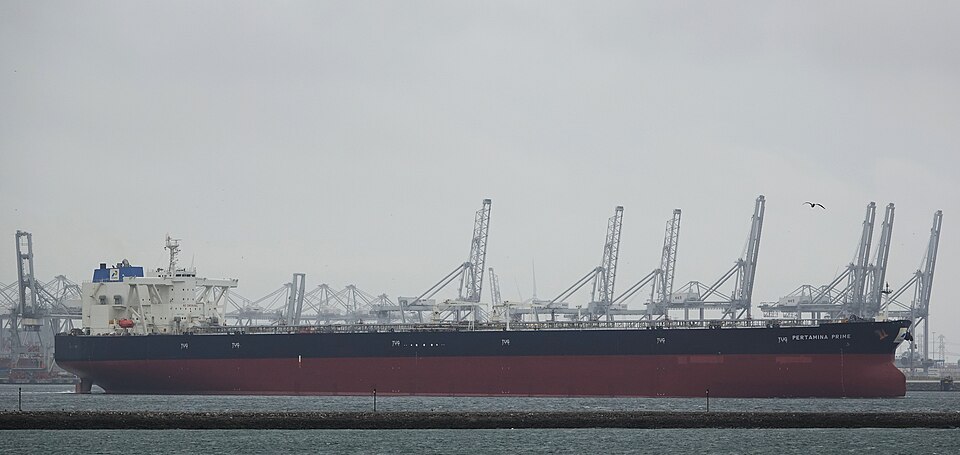
Pipeline down, Saudi Arabia doubles its Gulf loadings
A week after drones stopped the East-West line, Reuters and Bloomberg report Aramco running crude through Hormuz to ship-to-ship transfers off Sohar, about 20 million barrels sold to Asian refiners, and oil easing from the week's four-month highs; the sources' repair estimates run from three to six weeks.
What happened
Saudi Aramco is offering more crude to its Asian term buyers, the refiners that buy on long-term contracts, for loading by ship-to-ship transfer off Sohar in Oman, just outside the Strait of Hormuz. Reuters reported the offers on Wednesday evening, citing people familiar with the matter. The grades on offer are Arab Light, the company's flagship, together with Arab Medium and Arab Heavy, and Aramco had made at least two similar offers of the heavier grades in recent weeks. Aramco declined to comment. [1]
The ships tell the same story. Over the past week Saudi Arabia doubled its daily crude loadings at Ras Tanura and Juaymah, its terminals inside the Gulf, to about two very large crude carriers a day, roughly 4 million barrels, according to satellite tracking by the consultancy Energy Aspects, Reuters reported. Kpler's ship-tracking data showed four such tankers, able to carry 8 million barrels between them, loading at Ras Tanura on Wednesday. Other Gulf producers are offering crude for loading outside the strait after securing vessels to shuttle it through, often with their tracking signals switched off, the agency said. [1]
Bloomberg reported the same pivot from the buyers' side. Aramco sold about 20 million barrels of spot crude this week, cargoes sold for prompt loading rather than under long-term contracts, to Asian refiners, among them Chinese state-owned and independent processors and other importers in East Asia. The buyers load from the Gulf of Oman by ship-to-ship transfer over September and October. Deliveries from Yanbu to some European customers and to at least one East Asian refiner have been delayed, with the length of the delays not immediately clear, and there was no official word on when the pipeline would resume. Poland's Orlen has bought replacement cargoes elsewhere, Bloomberg reported. Aramco declined to comment to Bloomberg as well. [2, 3, 15]
Reuters' sources added that Aramco had told at least one Asian buyer with September cargoes that its Yanbu shipments would be delayed and rescheduled, without saying for how long, and that European customers had been told some September-loading cargoes would be canceled while loadings at Yanbu stay suspended. [1]
Why the oil goes the long way round
The East-West pipeline runs 1,200 kilometers from the Abqaiq oilfield in the east to the port of Yanbu on the Red Sea, and it became the kingdom's way of exporting without passing Hormuz after Iran began blockading the strait in late February. Drones hit it on 10 September, and Saudi Arabia shut it as a precaution while teams assessed its safety. Al Jazeera's route tracker, published on Thursday, puts Saudi crude loadings at about 7.5 million barrels a day in January and February, 2.3 million in August and 2.1 million in early September, a fall of more than 70 percent. It counts exports by the Hormuz route at more than 2 million barrels a day in the first two weeks of September, much of it by ship-to-ship transfer off Sohar from tankers with their transponders switched off. [12, 4, 6]
The shuttle works like this: a tanker loads inside the Gulf, runs the strait, and pumps its cargo across to a supertanker waiting in the Gulf of Oman, off Sohar or Fujairah, which then sails on to Asia. Lloyd's List reported that these cross-Hormuz transfers grew from 603,000 barrels a day in April to 4.6 million in August, four fifths of all the crude leaving through the strait. Kpler's analysis, published on Thursday, says the transfer capacity at Fujairah and Sohar is running at or near its maximum. Richard Matthews of Gibson Shipbrokers told Al Jazeera that transiting Hormuz will add further to freight costs, and Saxo Bank's analysts told Reuters that the higher flows through the strait only partly offset the export barrels lost to the attack. [9, 7, 6, 4]
The repair clock, and what the record says
Bloomberg reported on Wednesday, citing a person familiar with the matter, that Aramco is working to bypass the damaged section of the line, aims to restore roughly half of its 7 million barrel-a-day capacity within days, and expects its full capability back in about six weeks. Aramco and the energy ministry did not respond to its requests for comment. Kpler expects the bypass to bring back about 2 to 2.5 million barrels a day within a month and full repairs to take four to six weeks, and it notes reports that the kingdom is giving its own refineries first call on crude while the line is out. Al Jazeera puts the repair at three to five weeks, and Rahul Choudhary of Rystad Energy told it he expects a restart within weeks at 40 to 60 percent of capacity, around 2.5 to 3 million barrels a day. Each of these is the source's own estimate. [3, 7, 6]
The record is thinner than the reporting. The energy ministry's statement of 11 September gave the attacks, the two regions and the precautionary shutdown, and no restart date, and nothing official has followed on the bypass or the weeks. On who sent the drones, the foreign ministry said on 12 September that they were launched from Iraq, and Al Jazeera reported the office of Iraq's prime minister tracing the launch to Maysan province in the southeast; Kpler's note attributes the attack to Houthi forces. This article keeps the ministries' account. The precedent for the repair is April: after the strikes of early April cut about 700,000 barrels a day of the line's pumping capacity, the ministry announced on 12 April that the full capacity of about seven million barrels a day had been restored within a short period. [14, 11, 12, 7, 10]
The prices and the stocks, as the sources report them
Reuters reported Brent, the international benchmark, settling at $105.83 a barrel on Wednesday, down $2.92 or 2.7 percent, and West Texas Intermediate, the U.S. benchmark, at $102.43, down 3.2 percent, after the Oman offers and the weekly inventory report. Giovanni Staunovo of UBS said the news of exports from the Gulf suggests that concerns the disruption could be larger are easing. On Thursday morning Reuters reported Brent little changed at $105.64 at 06:47 Saudi time, after four-month highs earlier in the week, with Hiroyuki Kikukawa of Nissan Securities saying concerns over supply tightness eased slightly on the news that Saudi Arabia would ship cargo via Oman. These are the agency's figures on the named days; this site prints no price of its own. [5, 4]
The U.S. Energy Information Administration's weekly report, released on Wednesday for the week to 11 September, counted commercial crude stocks down 0.6 million barrels to 423.4 million, 1 percent above the five-year average, while gasoline stocks rose by 0.8 million barrels and distillate stocks, mainly diesel and heating oil, by 1.6 million, the latter still 13 percent below the five-year average. Refineries ran at 96.8 percent of capacity, crude imports rose to 7.1 million barrels a day, and total product supplied, the agency's measure of demand, averaged 20.5 million barrels a day over four weeks, 0.6 percent below a year earlier, the agency reported. The next report is scheduled for 23 September. [8]
Freight is where the detour is priced. Kpler puts the cost of a supertanker from the Gulf to Asia at about $30 a barrel, against about $20 from the Gulf of Oman, a premium of roughly $10 a barrel for the Hormuz leg. Lloyd's List reported the Middle East Gulf to China benchmark at $759,969 a day on 8 September, 26 percent above the March peak, and the Gulf of Oman to China route at $358,201 a day, the highest ever, with the broker BRS calling tonnage availability very tight. Kpler also traces the ripple into gas: European gas prices up 50 percent since early August and Asian spot LNG at $27 to $28 per million British thermal units, as it counts them. [7, 9]
Who it reaches
None of the companies in the event is listed in the United States: Aramco, the Asian refiners, the Omani port. The reach on this site is adjacent, through the prices and rates the sources report. Exxon Mobil is Aramco's partner in the refinery at Yanbu, near where the line ends, and with Chevron, Occidental and ConocoPhillips it sells crude at prices that move with the benchmarks Reuters reports. Valero, Marathon Petroleum and Phillips 66 sell the gasoline and diesel whose stocks the EIA counts. Frontline, DHT, International Seaways and Scorpio Tankers own the ships the freight rates are paid for. Cheniere sells liquefied natural gas into the European and Asian prices Kpler describes. The company files on this site carry each one's record. [13, 1, 5, 8, 7, 9]
Sources
- Reuters via Khaleej Times, Saudi offers more crude via Oman loading after pipeline attacks, sources say, 16 September 2026, 2026-09-16
- Bloomberg via gCaptain, Saudis pivot to send more oil via Hormuz after pipeline shut, 16 September 2026, 2026-09-16
- Bloomberg via Transport Topics, Saudis seek to resume half of key oil pipeline within days, 16 September 2026, 2026-09-16
- Reuters via Arab News, Oil prices extend losses as fears of Middle East supply disruptions ease, 17 September 2026, 2026-09-17
- Reuters via Investing.com, Oil slips as Saudi Arabia offers more crude via Oman, 16 September 2026, 2026-09-16
- Al Jazeera, From Yanbu to Sohar: tracking Saudi Arabia's alternative oil routes, 17 September 2026, 2026-09-17
- Kpler, Yanbu pipeline attack ripples across crude, freight and gas markets, by Reid I'Anson, 17 September 2026, 2026-09-17
- U.S. Energy Information Administration, Weekly Petroleum Status Report, summary for the week ending 11 September 2026, released 16 September 2026, 2026-09-16
- Lloyd's List, VLCC market hits historic high in latest phase of Hormuz crisis, 9 September 2026, 2026-09-09
- Saudi Ministry of Energy statement of 12 April 2026 on the East-West pipeline's restored pumping capacity, as carried by the Saudi Press Agency and copied by Gl, 2026-04-12
- Saudi Ministry of Foreign Affairs statement of 12 September 2026 on the drone attack on the East-West pipeline, as copied by GlobalSecurity, 2026-09-12
- Al Jazeera, Saudi Arabia shuts critical oil pipeline after drone attack: what it means, 12 September 2026, 2026-09-12
- Al Jazeera, Why Saudi Arabia's East-West pipeline matters for global oil, 14 September 2026, 2026-09-14
- Saudi Press Agency, Ministry of Energy statement: East-West Pipeline shut down as a precaution following multiple attacks, 11 September 2026, 2026-09-11
- OilPrice.com, Saudi Arabia pivots to spot oil sales after key pipeline goes offline, by Tsvetana Paraskova, 16 September 2026, 2026-09-16
Every stock is a company; the desk grades the company behind the stock. This article describes; it does not recommend. Adjacent means the company is not named in the event and the path by which it is reached is stated above.