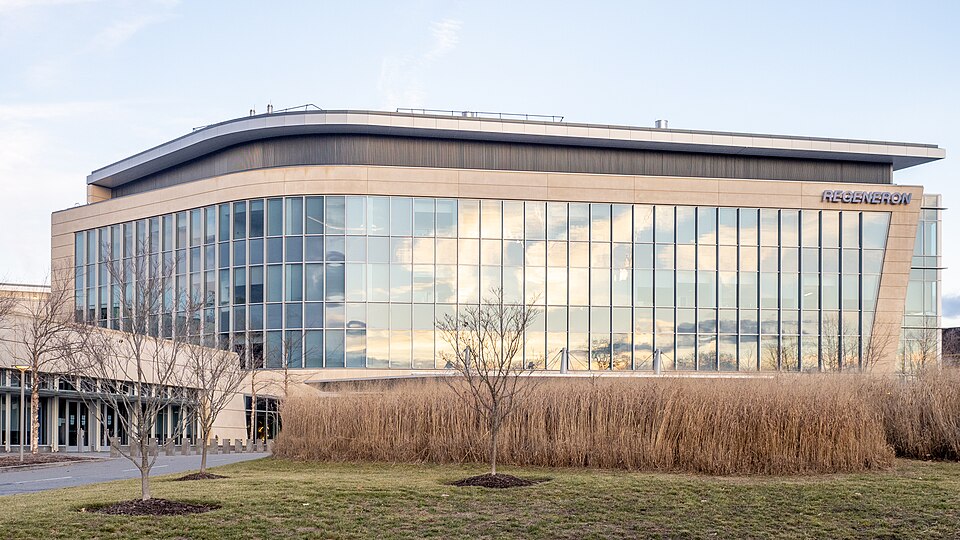
Regeneron and Sanofi widen their Dupixent alliance by four drugs
On Thursday 1 October Regeneron and Sanofi signed the sixth amendment to their 2009 antibody agreement, adding four long-acting Regeneron antibodies aimed at the IL-4 and IL-13 pathways that Dupixent blocks; Sanofi pays $1.0 billion up front and up to $7.0 billion more on milestones, the two split costs and profits equally, Regeneron drops its lawsuit over Dupixent information, and Regeneron's report of Tuesday 6 October adds a cost cap and a second option the joint release did not mention.
What the companies signed
On Thursday 1 October Regeneron Pharmaceuticals and Sanofi signed the Sixth Amendment to their Amended and Restated License and Collaboration Agreement of Tuesday 10 November 2009, the contract under which the two developed Dupixent, Regeneron reported to the Securities and Exchange Commission on Tuesday 6 October. Under it the companies will 'co-develop and co-commercialize four new long-acting, Regeneron-invented antibodies': one aimed at interleukin-13 (IL-13), one at interleukin-4 (IL-4), one at the IL-4 receptor alpha (IL-4Rα, the same target as Dupixent), and a bispecific antibody, a single molecule that binds two targets, aimed at IL-4 and IL-13 together. The companies announced the deal in a joint release on Thursday 1 October, which Sanofi filed with the SEC the same day. [1, 2, 3]
Sanofi pays Regeneron $1.0 billion up front, and Regeneron may receive up to $7.0 billion more 'upon the achievement of certain development, regulatory, and commercial milestones', the 8-K says; global profits on the new products are shared equally, as are development costs. The companies' investor presentation breaks the milestones down: a $1.0 billion development milestone, up to $2.5 billion on regulatory steps and up to $3.5 billion on commercial ones, for up to $8.0 billion in all. Reuters reported that Regeneron becomes eligible for the first $1 billion milestone when REGN20423, the IL-13 antibody, enters late-stage testing, according to the company. Regeneron leads development and is the lead regulatory party in the United States; Sanofi is the lead regulatory party outside the United States and leads commercialization everywhere. [1, 3, 7]
The amendment also gives Regeneron an option on Sanofi's lunsekimig, an experimental 'bispecific Nanobody VHH therapy' aimed at TSLP and IL-13, two signals of the immune system. The joint release says the option can be exercised upon completion of lunsekimig's phase 3 studies in chronic obstructive pulmonary disease (COPD), a long-term lung disease. Regeneron's 8-K goes further: the option runs 'on an asset-by-asset basis after completion of certain ongoing clinical trials', covers 'another Sanofi early development product' as well, and if Regeneron takes either one it 'will reimburse Sanofi for certain development costs related to such product'. [1, 2]
What the filing adds
The 8-K carries a term the joint release does not. All development costs under the agreement are shared equally, 'In addition, development costs in excess of a budget cap for all New Licensed Products will be the responsibility of Regeneron, subject to certain rights to recoup such excess costs in future years.' The filing does not state the size of the cap. The full text of the amendment is to be filed as an exhibit to Regeneron's quarterly report for the period ended Wednesday 30 September, the 8-K says. [1]
Item 8.01 of the 8-K settles a dispute. Alongside the amendment, the two companies signed a settlement under which Regeneron agreed to dismiss its lawsuit over 'Sanofi's obligation to provide Regeneron with full access to material information relating to the commercialization of Dupixent' and over Regeneron's audit rights under the agreement. Regeneron filed that suit on Monday 18 November 2024 in the federal court in Manhattan, seeking a declaratory judgment, an injunction and damages, by its annual report, and the court denied Sanofi's motion to dismiss it on Tuesday 17 March 2026, by its quarterly report. PharmExec reported that the suit alleged Sanofi withheld full access to pharmacy benefit manager contracts and other records tied to Dupixent sales, and that Sanofi maintained it was in full compliance. Sanofi's chief executive, Belén Garijo, said on the companies' call that the agreement brings 'clearer governance, greater transparency' and the resolution of the litigation between the two. [1, 5, 6, 8, 4]
Item 2.02, the item for results, gives one preliminary figure: Regeneron 'currently expects' its third-quarter results to include an acquired in-process research and development charge, a cost booked when a company pays for research not yet turned into a product, of approximately $22 million before tax. The 8-K does not say which transaction the charge comes from, and the quarter's results are not final. The companies' presentation says the Sanofi transaction itself is 'to be recorded as a Q4 2026 event for both companies', which Sanofi's finance chief, Francois-Xavier Roger, repeated on the call. [1, 3, 4]
What an interleukin is, and why long-acting matters
An interleukin is 'one of a group of related proteins made by leukocytes (white blood cells) and other cells in the body', and interleukins 'regulate immune responses', by the National Cancer Institute's dictionary. Dupixent is an antibody that blocks two of them: by its FDA label, it 'inhibits interleukin-4 (IL-4) and interleukin-13 (IL-13) signaling by specifically binding to the IL-4Rα subunit', the part of the cell's receptor the two signals share, and inflammation driven by IL-4 and IL-13 is 'an important component' of atopic dermatitis (eczema), asthma, COPD and the other diseases it treats. The joint release says more than 1.5 million people currently receive Dupixent across nine approved uses. [10, 9, 2]
Dupixent is injected under the skin; for adults with atopic dermatitis the label's dose is 300 mg 'every 2 weeks' after a first double dose, and some children take it every four weeks. The four new antibodies are 'designed to extend dosing intervals for Type 2 diseases', the companies' presentation says, meaning longer gaps between injections; for REGN20423 it describes a 'prolonged half-life', meaning the drug stays in the body longer, with 'potential dosing intervals well beyond currently approved agents', and a target of 'Q3M-Q6M dosing', one injection every three to six months. Regeneron's chief scientific officer, George Yancopoulos, put the comparison on the call as 'a twice a year subcutaneous injection or having to remember to take a daily pill'. REGN20423 differs from Dupixent in its target: it blocks the IL-13 signal itself, a 'ligand blocker', rather than the receptor. [9, 3, 4]
Only one of the four has reached patients. REGN20423 is in a phase 1 study in atopic dermatitis, the first stage of human testing, and the other three 'are expected to enter clinical studies in 2027', the joint release says. None has yet been shown to work in a patient trial. [2, 3]
How the Dupixent arrangement works
Dupixent's own terms do not change, both companies said. Under the existing agreement Sanofi records the product's sales, and the two 'equally share profits from sales within the United States'; outside the United States profits are shared on a sliding scale that starts at 65 percent for Sanofi and 35 percent for Regeneron and ends at 55 percent and 45 percent as sales grow, by Regeneron's annual report for 2025. Sanofi first funded most development, and Regeneron owed back part of it from its profits, a 'development balance' of approximately $595 million at Wednesday 31 December 2025; by Regeneron's quarterly report, that balance was fully repaid as of Tuesday 30 June 2026. The new products carry no such balance, Sanofi's finance chief said on the call, because development costs are paid equally as they are incurred. [2, 5, 6, 4]
As Regeneron filed it, Dupixent's net sales, which Sanofi records, were $17,806.7 million in 2025: $13,187.0 million in the United States and $4,619.7 million elsewhere. Regeneron's share of profits on Dupixent and Kevzara, a second antibody from the alliance, was $5,241.6 million that year, and Sanofi collaboration revenue was 48 percent of Regeneron's total revenues in the first half of 2026, mostly its share of Dupixent's profits, the company reported. On Sanofi's side, Reuters reported that Dupixent accounted for 36 percent of Sanofi's nearly 44 billion euros of sales in 2025. Sanofi's finance chief said on the call that Dupixent's loss of exclusivity, the end of patent protection that lets copies in, 'is coming in March 2031' in the United States, and that Sanofi is working to extend it, with 'no certainty at this stage'. [5, 6, 7, 4]
What settles it next
The next record is Regeneron's quarterly report for the period ended Wednesday 30 September, which is to carry the Sixth Amendment's full text, including the budget cap's terms if the exhibit states them; a large accelerated filer such as Regeneron has 40 days after the quarter to file, which by the desk's arithmetic is Monday 9 November. The quarter's final figures will show the acquired research charge the 8-K previewed. After that, the presentation sets out the programs' own dates: registration-enabling studies of REGN20423, the larger trials meant to support an approval, 'expected to begin by late 2027/early 2028' (Reuters reported that the first $1 billion milestone comes when REGN20423 enters late-stage testing), and first studies in people of the other three antibodies in 2027. Regeneron's lunsekimig option waits on that drug's phase 3 results in COPD. [1, 5, 11, 3, 7]
Who it reaches
Regeneron (REGN) is direct: it receives the $1.0 billion and is eligible for up to $7.0 billion in milestones, leads development of the four antibodies, bears development costs above the cap, and drops its suit. Sanofi (SNY) is direct: it pays, leads sales of the new products worldwide and records them, as it records Dupixent's. Reuters reported that analysts saw the deal as a reset of a strained partnership and an early step for Ms. Garijo, who took over as chief executive in May; BMO Capital Markets' Evan Seigerman called it 'an important step in repairing their relationship'. [1, 2, 7]
Sources
- Regeneron Pharmaceuticals, Form 8-K (items 1.01, 2.02, 8.01), filed Tuesday 6 October 2026, event of 1 October 2026, 2026-10-06
- Sanofi and Regeneron, joint press release 'Sanofi and Regeneron expand global Alliance with multiple next-generation, long-acting immunology antibodies', 1 Octo, 2026-10-01
- Regeneron and Sanofi, investor presentation 'A New Chapter for the Regeneron-Sanofi Alliance', 1 October 2026 (PDF on sanofi.com), 2026-10-01
- Sanofi and Regeneron investor event, call transcript (LSEG StreetEvents), 1 October 2026 (PDF on sanofi.com), 2026-10-01
- Regeneron Pharmaceuticals, annual report on Form 10-K for 2025, filed 4 February 2026, 2026-02-04
- Regeneron Pharmaceuticals, quarterly report on Form 10-Q for the period ended 30 June 2026, filed 30 July 2026, 2026-07-30
- Reuters (Bhanvi Satija and Mariam Sunny), 'Sanofi, Regeneron expand tie-up with $8 billion drug-development deal, settle legal dispute', 1 October 2026, as carr, 2026-10-01
- PharmExec (Nicholas Jacobus), 'Regeneron and Sanofi Expand Antibody Alliance with Four New Drugs', 1 October 2026, 2026-10-01
- U.S. Food and Drug Administration, Dupixent (dupilumab) prescribing information, label effective 22 April 2026, read through openFDA, 2026-04-22
- National Cancer Institute, Dictionary of Cancer Terms, 'interleukin', read through the dictionary's web service, 2026-10-07
- Securities and Exchange Commission, Form 10-Q general instructions (filing deadlines), 2026-10-07
Every stock is a company; the desk grades the company behind the stock. This article describes; it does not recommend. Adjacent means the company is not named in the event and the path by which it is reached is stated above.