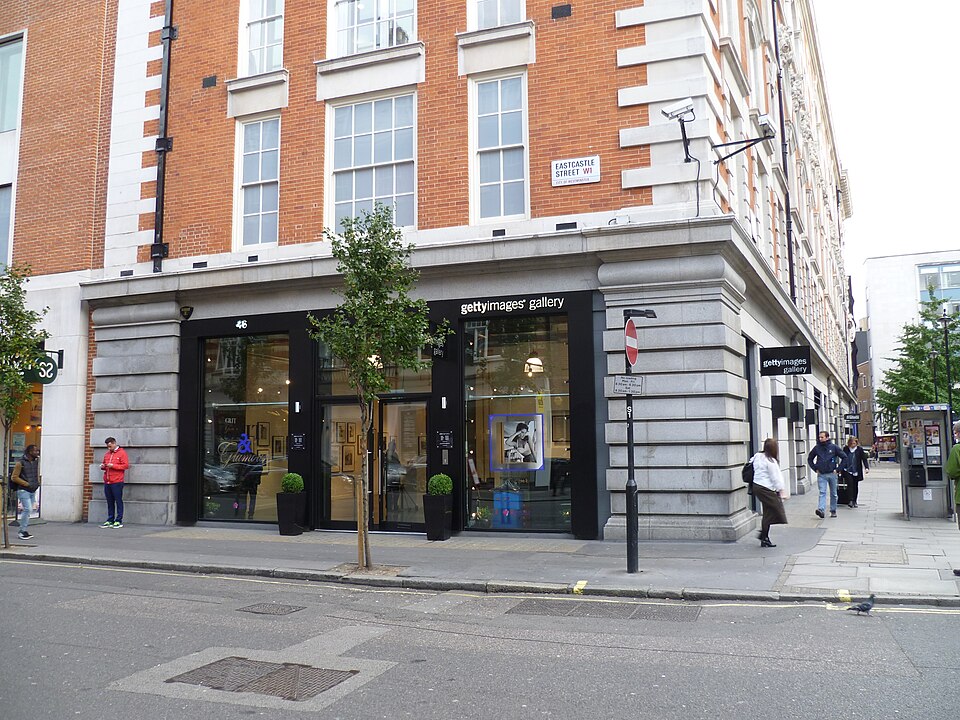
Getty Images is suspended by the NYSE and plans no appeal
The New York Stock Exchange suspended Getty Images Holdings' shares on Tuesday 29 September and began proceedings to delist them over 'abnormally low selling price' levels; the company does not intend to appeal and its 8 October annual meeting is postponed, and on 30 September its shares moved to the over-the-counter market and it paid the interest due 1 September on its 9.750 and 14.000 percent notes inside a 30-day grace period, while it pursues what it calls an 'active and progressing dialogue' with its key debt and equity holders.
What the exchange did
On Tuesday 29 September the New York Stock Exchange suspended trading in the Class A shares of Getty Images Holdings, the visual content company behind the Getty Images, iStock and Unsplash brands, and its regulation staff began proceedings to remove the shares from the exchange. The staff found them 'no longer suitable for listing', citing 'abnormally low selling price' levels under Section 802.01D of the Listed Company Manual, the exchange's rule book for the companies it lists. In a report to the Securities and Exchange Commission on Thursday 1 October, the company said it does not intend to appeal and expects the shares to be delisted, and that they began trading on Wednesday 30 September on the over-the-counter market, in what it calls the OTC Pink Limited Market, under the same symbol, GETY. [2, 1, 5]
Section 802.01D holds the standards the exchange applies by judgment rather than by formula, standards that an SEC order of 17 March calls qualitative. The order, on a proposed rule change, sums up the exchange's position: the section gives it 'general authority' to suspend trading 'in the event of any condition that makes further dealings on the Exchange unwarranted', and the exchange proposed to spell out that it may suspend or delist a security whose trading price, in its opinion, 'has experienced a precipitous decline and is at an abnormally low level from which it is unlikely to recover'. The fixed price test is a separate section, 802.01C, which allows a cure period, time to put a shortfall right. Getty Images had already failed that test: its annual report says the 30-day average closing price of its shares stopped meeting the exchange's minimum on 9 March, opening a cure period of 180 days. [8, 6]
The same report of 1 October says the board has postponed the annual meeting of stockholders that was set for Thursday 8 October, in light of the delisting proceedings and of the company's evaluation of 'strategic financing alternatives and balance sheet management initiatives, which include an active and progressing dialogue with its key debt and equity holders'. The proxy statement for that meeting had asked stockholders to let the board carry out a reverse stock split, combining every 5 to 20 shares into one, with the 'primary goal' of meeting the exchange's minimum price for continued listing. [1, 7]
The company says the move to the over-the-counter market 'will not impact' its business operations, but that it 'can provide no assurance' the shares will keep trading there, that broker-dealers will keep quoting them or that there will be enough trading for an efficient market. Its proxy statement describes that market: trades go through market makers, dealers who carry an inventory of shares, so investors 'may be required to take additional steps and/or pay additional fees'; some institutional investors and retail brokers stay away; and such shares 'have less liquidity', meaning they are harder to trade, than shares on a national exchange. Its annual report adds that a delisting 'is likely to inhibit or preclude our ability to effect strategic acquisitions and raise additional financing'. [1, 7, 6]
The interest and the grace period
A month before the exchange acted, the company put off a bond payment. On Monday 31 August it said it would use 30-day grace periods on the interest due on Tuesday 1 September on two series of senior unsecured notes, bonds backed by no specific assets: its 9.750 percent notes due 2027 and its 14.000 percent notes due 2028. The grace periods are written into the indentures, the contracts that govern each bond issue: time in which interest not paid on its due date can still be paid before the miss counts as a default. The company said it had 'sufficient cash on hand to make the payments and meet its day-to-day obligations' and was using the grace periods 'to maximize financial flexibility' while it weighed its financing options. [4]
It paid on Wednesday 30 September, the company told the SEC that day, and because the payments were made inside the grace periods, no event of default occurred under the indentures. By the desk's count, 30 days from 1 September ran to Thursday 1 October. A default would have mattered: the annual report says that if an event of default occurs, creditors could declare all borrowings, with unpaid interest, 'immediately due and payable'. The ratings agencies, which grade how likely a borrower is to repay, had already moved: Bloomberg News reported that S&P Global Ratings cut Getty Images to CCC in September, and that Moody's lowered its corporate family rating two notches to Caa3 after it entered the grace period, saying it expected liquidity to weaken further without a cash infusion or a debt restructuring. [3, 6, 9]
How the cash ran short
The strain was already on the record. The company's quarterly report for April to June, filed on Monday 10 August, says management concluded there is 'substantial doubt' about its ability to continue as a going concern, the accounting test of whether a company can meet its obligations as they fall due over the next year. If it cannot obtain enough liquidity or complete a transaction, the report says, the company 'may be forced to seek relief under applicable bankruptcy laws or to pursue a restructuring, wind-down, or liquidation', and holders of its common stock 'could experience a significant or complete loss of their investment'. [5]
The same report sets out how the cash ran short. At 30 June the company had $51.6 million of cash and $30.0 million left on its $150.0 million revolving credit line, a facility it can draw on and repay; it drew that last $30.0 million in July. The report names three drains. One is litigation by former holders of its public warrants, contracts that gave the right to acquire shares at a set price, which it redeemed in October 2022: it paid $110.9 million of judgment and interest in the second quarter and kept a remaining litigation reserve of $99.5 million, and on 27 July a New York state court directed judgment against it for $67.8 million in other cases, plus interest at 9 percent from 22 August 2022 until judgment, which the company has appealed. The others, counted through 30 June, are about $60.4 million of legal, accounting and other costs for its merger with Shutterstock, and about $30.1 million of interest, net of what the escrowed money earned, plus $13.5 million of fees, on the financing raised for that merger. [5]
The merger is over. The two companies agreed it on 6 January 2025. On 15 May 2026 the UK Competition and Markets Authority concluded that it could proceed if Shutterstock's entire editorial business were sold, a condition the merger agreement did not require Getty Images to accept; its board resolved on 30 June not to go ahead with that sale, and on Tuesday 7 July the company delivered notice ending the agreement. The $628.4 million of 10.500 percent secured notes raised for the deal were then repaid with the money held in escrow. In the periods on file the business earned less than its interest bill: in the second quarter it made $32.4 million from operations against $57.3 million of interest expense, and in 2025 it made $83.9 million against $156.2 million, on revenue of $981.3 million. [5, 6]
The debt and the talks
How much it owes depends on when the count is taken. The quarterly report's table lists at 30 June $539.9 million of 11.250 percent senior secured notes due 2030, which the annual report says are backed by a first claim on substantially all of the company's assets; term loans of $40.1 million in dollars and the equivalent of $470.5 million in euros; $120.0 million drawn on the credit line; $264.7 million of the 14.000 percent notes; $5.3 million of the 9.750 percent notes; and the $628.4 million of escrow notes since repaid. By the desk's arithmetic that is about $2.07 billion at face value, the amount to be repaid, and about $1.47 billion once the escrow notes are taken out and July's $30.0 million draw is added, with the euro loans at the 30 June exchange rate. Bloomberg News, counting another way, put the company's debt at 'more than US$1.3 billion' at 30 June. [5, 6, 9]
The company has pointed to its largest owners for new money. On 31 August it said its alternatives include 'a potential capital solution' to be provided by its 'majority equity holders', who have formed a group under the securities laws 'to advance discussions with the Company on such a solution'. A filing by Koch's KED Icon Holdings on 26 August names the group, formed with effect from 25 August: KED Icon, owned through a chain of companies by Koch, Inc., and the Getty Family Stockholders, which the proxy statement says include Getty Investments and the co-founder and chairman, Mark Getty. Together they own 306.6 million shares, about 73 percent of those outstanding by the desk's arithmetic; the proxy statement puts the family's holding at 45.5 percent and Koch's at 27.4 percent. [4, 11, 7]
Two reports go further, each citing people familiar with the matter. Debtwire reported on 11 September that the company was preparing for a possible Chapter 11 bankruptcy filing, the court process in which a company keeps operating while it reorganizes its debts, and that Alvarez & Marsal was advising it. Bloomberg News reported on 29 September that the company is in confidential talks with lenders about new money, possibly through a debtor-in-possession loan, a loan to a company in bankruptcy; that the negotiations also centre on lenders taking control of the company through a potential bankruptcy; that the Getty family is also considering putting in money; and that no final decision has been made. The secured lenders and a group of unsecured creditors have hired their own advisers, Bloomberg reported. Neither outlet obtained a comment from the company. [10, 9]
What settles it next
The exchange will apply to the SEC to delist the shares once its procedures are complete, including any appeal; the company has the right to a review by a committee of the exchange's board but does not intend to appeal, and the delisting takes effect 10 days after the exchange files its application, a Form 25. The report gives no new date for the annual meeting. The debt runs on the calendar in the annual report: interest on the 11.250 percent secured notes falls due on 1 November, about $30.4 million by the desk's arithmetic, half of the $60.7 million a year in the report's table of payments; the next mandatory redemption of $30.0 million of the 14.000 percent notes, at face value, falls on Wednesday 30 December; and on Monday 1 March 2027 interest on both unsecured series falls due and the $5.3 million of 9.750 percent notes mature. The 14.000 percent notes mature on 1 March 2028; the credit line on 4 May 2028, unless a clause moves it to 180 days before certain earlier maturities of more than $100.0 million; and the secured notes and term loans on 21 February 2030. The chief executive, Craig Peters, said in August that he expected the review of the capital structure to run through the third quarter and into the fourth, Debtwire reported. [2, 1, 6, 5, 10]
Who it reaches
Getty Images Holdings directly: its shares are leaving the exchange, its notes' September interest is paid and its annual meeting waits. Shutterstock is reached through the merger agreement Getty Images ended on 7 July: the quarterly report counts that merger's costs and the interest on the money raised for it among the reasons for the company's going-concern doubt. The two holders that formed the group, the Getty Family Stockholders and Koch's KED Icon Holdings, are not in the desk's universe of companies; Koch, Inc. is privately held, its filing says. [1, 3, 5, 11]
Sources
- Getty Images Holdings, current report on Form 8-K, Items 3.01 and 8.01 (the exchange's delisting notice, the move to the OTC Pink Limited Market, the postponed , 2026-10-01
- New York Stock Exchange, NYSE to Commence Delisting Proceedings Against Getty Images Holdings, Inc. (GETY), Business Wire release of 29 September 2026, read on , 2026-09-29
- Getty Images Holdings, current report on Form 8-K, Item 7.01 (interest paid on the 9.750 and 14.000 percent notes within the grace periods), filed 30 September , 2026-09-30
- Getty Images Holdings, current report on Form 8-K, Item 8.01 (the 30-day grace periods; the majority equity holders' group), filed 31 August 2026, 2026-08-31
- Getty Images Holdings, quarterly report on Form 10-Q for the quarter ended 30 June 2026 (going concern, liquidity, debt, the terminated merger, the warrant liti, 2026-08-10
- Getty Images Holdings, annual report on Form 10-K for 2025 (the debt's terms and payment schedule, risk factors on default and delisting), filed 16 March 2026, 2026-03-16
- Getty Images Holdings, proxy statement on Form DEF 14A for the 2026 annual meeting (the reverse stock split proposal, over-the-counter trading, holders of more , 2026-08-28
- U.S. Securities and Exchange Commission, Release No. 34-105035, order instituting proceedings on the NYSE's proposed change to Section 802.01C of its Listed Com, 2026-03-17
- Bloomberg News, via The Edge Malaysia, Getty Images in talks with lenders for potential bankruptcy loan, 29 September 2026, 2026-09-29
- Debtwire (ION Analytics), Getty Images mulls potential bankruptcy filing, working with A&M, by Lavanya Nair, Danielle Saba and Jay Antenen, 11 September 2026, 2026-09-11
- KED Icon Holdings and Koch, Inc., Schedule 13D/A (Amendment No. 5) on Getty Images Holdings, disclosing the group formed with the Getty Family Stockholders, fil, 2026-08-26
Every stock is a company; the desk grades the company behind the stock. This article describes; it does not recommend. Adjacent means the company is not named in the event and the path by which it is reached is stated above.