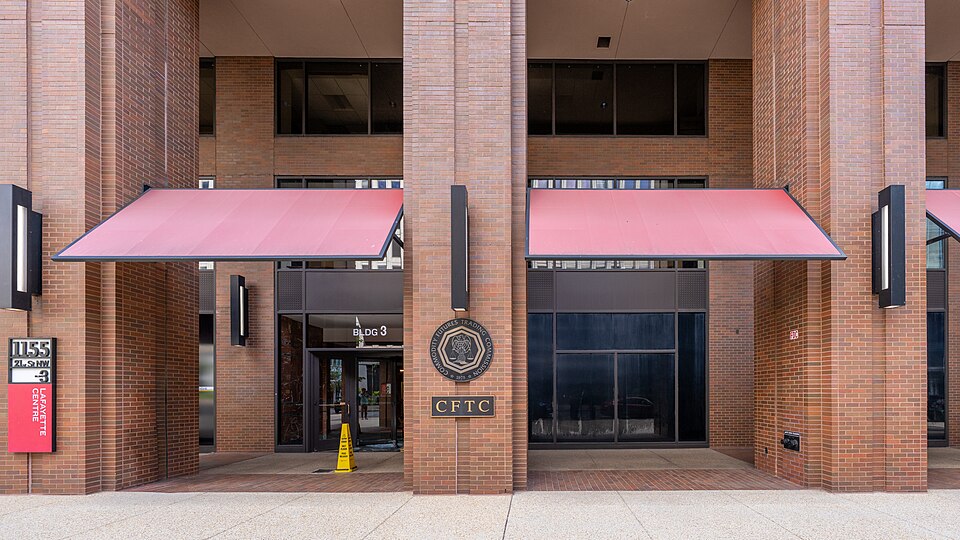
CFTC opens comment on federal rules for leveraged crypto trading
The Commodity Futures Trading Commission's advance notice of Monday 5 October sketches Regulation CTX, which would say when a retail crypto trade falls under futures law, and Regulation CAM, a tailored exchange registration with every such trade routed through a futures commission merchant; it is not yet a proposed rule, the Federal Register prints it on Tuesday 13 October, and comments are due by Monday 14 December.
What the CFTC published
The Commodity Futures Trading Commission on Monday 5 October published an advance notice of proposed rulemaking, release 9307-26, seeking public comment on its intent to write rules for retail crypto trades under section 2(c)(2)(D) of the Commodity Exchange Act. That section covers commodity trades with ordinary retail customers that are offered with leverage, on margin or with financing; the agency calls the crypto versions 'CTXs'. The notice previews two frameworks: Regulation Crypto Asset Transactions, or Regulation CTX, and Regulation Crypto Asset Markets, or Regulation CAM. Chairman Michael S. Selig said in the release that the agency would 'take every necessary step to establish regulations that are designed to prevent, rather than only prosecute after the fact, fraudulent schemes such as FTX.' [1, 2]
An advance notice is the step before a proposal. The release says the Commission 'intends to use the information and comments received to inform potential future agency action, such as a rulemaking'. WilmerHale's client alert of Thursday 8 October noted that the notice 'does not include actual rule text', which would follow in a proposed rulemaking, and Lowenstein Sandler's alert of Wednesday 7 October wrote that any Regulation CTX or Regulation CAM would require a further proposed rule and then a final rule. [1, 8, 9]
No other commissioner's statement accompanies the notice. The CFTC's own page of current commissioners lists one member, Chairman Selig, sworn in on 22 December 2025, out of the five seats the agency's statute provides. The copy the agency posted leaves its signing date blank and names Christopher J. Kirkpatrick, Secretary of the Commission, as the officer who issues it for the Commission. [2, 7]
Where Regulation CTX draws the line
The first framework is an interpretation of when a crypto trade falls under futures law. The statute reaches trades 'offered (even if not entered into)' with leverage, and the notice says the agency 'preliminarily believes' such a covered offer can be made in standard customer documents, such as onboarding papers, exchange terms and conditions, or credit and margin documents, and can attach to every transaction on an exchange or in an account. In plain words, an exchange that offers leverage at all would bring its fully paid trades under the agency's rules too, as WilmerHale and Lowenstein Sandler both read it. [2, 8, 9]
The way out is 'actual delivery', which the statute sets at 28 days. Chairman Selig said in remarks at Fordham Law's blockchain symposium in New York on Monday 5 October that the agency proposes to treat 'delivery of a crypto asset to a user's external, non-custodial digital wallet within 28 days' as generally meeting that exception. A fully paid trade that sits only as an entry on the exchange's own books, the notice says, stays under the futures framework until delivery; once delivered, the agency keeps only its anti-fraud and anti-manipulation authority over it. [2, 5]
How a crypto asset market would work
Regulation CAM would create 'a subcategory of designated contract market registration, known as a crypto asset market', the release says. A designated contract market is the CFTC's license for a futures exchange. Chairman Selig said at Fordham that a crypto asset market would follow the statutory core principles for such exchanges 'but with the benefit of a tailored set of regulations', that it is meant for exchanges offering only these trades, and that an exchange offering futures, options or swaps would stay under the current framework. He also said the plan contemplates a 'proof-of-reserves' duty for exchanges holding customer property in pooled accounts. [1, 5]
Every such trade would pass through a futures commission merchant, the CFTC-registered broker that holds customer money apart from its own. The notice's appendix says the agency 'preliminarily believes that CTXs must be intermediated by an FCM and cleared and settled by a DCO', a derivatives clearing organization. WilmerHale reported that only futures commission merchants, and banks they sponsor, would be eligible to lend to retail customers on such a market. The notice would let one firm register as the market, the merchant and the clearing house at once, or affiliate with them, and asks for comment on the conflicts that raises and on an exemption for venues with very small volume. [2, 8, 9]
Why now, and the SEC's part
The notice follows the Senate's failure to advance the Digital Asset Market Clarity Act. Chief Investment Officer reported on Tuesday 15 September that 50 senators voted to end debate and 49 voted against, short of the 60 needed. Chairman Selig wrote in an opinion piece the CFTC posted on Monday 5 October that, unlike that bill, the new rules 'wouldn't require crypto assets to trade on CFTC-registered platforms', because the agency lacks that authority without Congress; at Fordham he called the plan 'a federal option', likening it to a bank choosing a federal or a state charter. [10, 6, 5]
The notice is written to sit beside the Securities and Exchange Commission's proposed Regulation Crypto Assets of 18 August, which includes a conditional safe harbor describing when a crypto asset sold in an investment contract becomes free to trade outside the securities laws. The CFTC says its framework would be 'complementary' for assets in that safe harbor. Lowenstein Sandler described the result as a division of labor: the SEC handles fundraising and whether an asset is part of a security, the CFTC handles leveraged retail trading afterward. The notice also asks for comment on what happens when an asset behind a trade is said to be a security, since CFTC-registered venues generally may not list derivatives on securities. [2, 9]
What settles it next
The Federal Register's public inspection copy says the notice is scheduled for publication on Tuesday 13 October as document 2026-20888, and the Federal Register's record of the document gives the comment deadline: comments must be received on or before Monday 14 December 2026. The CFTC's release says comments received will be posted on Regulations.gov. After the window closes, any rule would come first as a proposed rule with its own comment period and then as a final rule, as Lowenstein Sandler wrote. [3, 4, 1, 9]
Who it reaches
Coinbase (COIN) is adjacent: the notice cites its letter of 18 August 2025 urging the agency to consider how futures law applies to crypto spot markets on a designated contract market, and cites the same letter in proposing to let crypto exchanges keep their integrated structures. Robinhood (HOOD) is adjacent: the notice cites the 2023 House testimony of its chief legal officer among the sources for its view that state regimes have not adequately protected retail crypto customers. [2]
CME Group (CME) is adjacent: the notice recounts that CME self-certified cash-settled bitcoin futures in December 2017, and its appendix says an existing designated contract market could offer these crypto trades under its current registration, a point Lowenstein Sandler called a significant benefit for existing exchanges. [2, 9]
Sources
- CFTC, release 9307-26, 'CFTC Seeks Public Comment on Advanced Notice of Proposed Rulemaking Relating to Regulation Crypto Asset Transactions and Regulation Cryp, 2026-10-05
- CFTC, advance notice of proposed rulemaking, Regulation Crypto Asset Transactions and Regulation Crypto Asset Markets, RIN 3038-AF80, as approved, 5 October 202, 2026-10-05
- Federal Register, document 2026-20888, 91 FR 64811, the document record: publication 13 October 2026, comments close 14 December 2026, 2026-10-12
- Federal Register, public inspection copy of document 2026-20888, scheduled for publication on 13 October 2026, 2026-10-12
- CFTC, Chairman Michael S. Selig, remarks at the Fordham Law Blockchain Regulatory Symposium, New York, 5 October 2026, 2026-10-05
- CFTC, Chairman Michael S. Selig, 'WSJ Op-Ed: CFTC's New Rules for Crypto', posted 5 October 2026, 2026-10-05
- CFTC, Chairman and Commissioners page, read 12 October 2026, 2026-10-12
- WilmerHale, client alert, 'CFTC Seeks Input on Crypto Asset Regulatory Framework', 8 October 2026, 2026-10-08
- Lowenstein Sandler, client alert, 'CFTC Issues Advance Notice of Proposed Rulemaking on Regulation Crypto Asset Transactions and Regulation Crypto Asset Markets, 2026-10-07
- Chief Investment Officer, 'Digital Asset Bill Stalls in Senate After Failed Cloture Vote', 15 September 2026, 2026-09-15
Every stock is a company; the desk grades the company behind the stock. This article describes; it does not recommend. Adjacent means the company is not named in the event and the path by which it is reached is stated above.