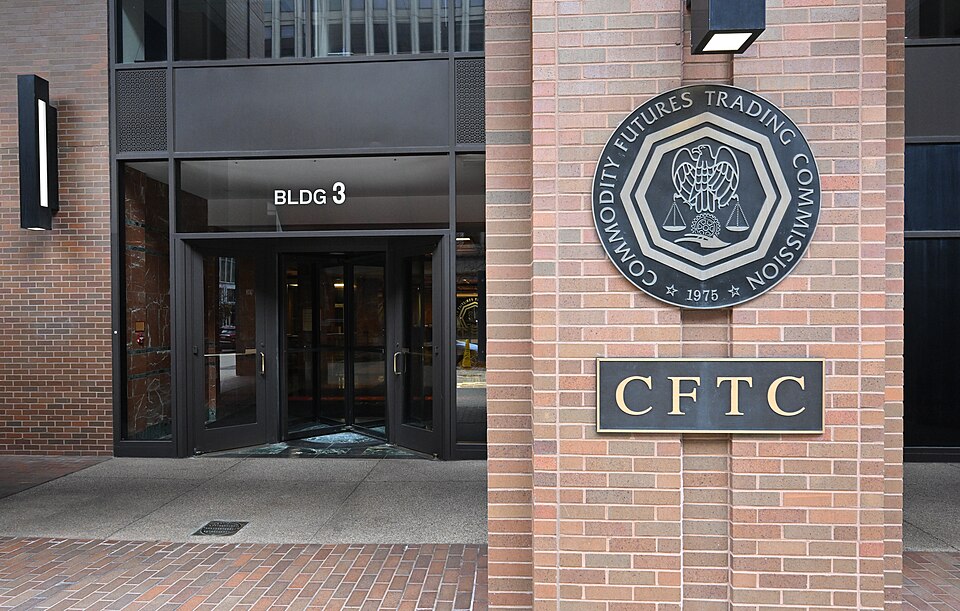
CFTC lets Coinbase clear derivatives, fully collateralized only
The order of Monday 28 September registers Coinbase Clearing LLC to clear futures, options on futures and swaps only when the most either side could lose is held in full from the start; Coinbase now owns an exchange, a broker and a clearing house, and says its margined futures, cleared by Nodal Clear, and its planned single stock perps stay with existing partners.
What the CFTC signed
The Commodity Futures Trading Commission registered Coinbase Clearing LLC on Monday 28 September as a derivatives clearing organization, a clearing house that stands between the buyer and seller of each contract. The order of registration permits it to clear 'fully collateralized futures, options on futures, and swaps', meaning contracts whose largest possible loss is paid in up front, and ties that term to the definition in the agency's Regulation 39.2. It was issued 'By the Commission' and signed by the commission's secretary, Christopher J. Kirkpatrick; it names no commissioner and records no vote. Nothing in it confines the clearing house to crypto contracts. [1, 11, 3, 4]
The order rests on what the company told the agency, and says so. It recites Coinbase Clearing's representations that it meets the requirements for registration and will comply with the core principles the law sets for clearing houses, that it will enforce its members' compliance with its rules, and that funds in any clearing member account will be treated as 'member property' as the Bankruptcy Code defines it and kept 'separate and distinct' from its own. Two conditions follow: any new or amended CFTC rule touching the order overrides its terms, and the commission may 'condition, modify, suspend, terminate, or otherwise restrict the terms of this order' on its own motion. [1]
Coinbase Clearing is not alone. The CFTC's list of clearing houses shows a second registration on the same terms the same day, for Quanta Clear, Inc., and three earlier this year: Gemini Olympus on 29 April, ICE Direct Clear on 15 May and ProphetX on 10 June. Twelve applications are pending on the list by the desk's count, Bullish Clearing & Settlement's among them, listed since 7 May. One registered clearing house, Cboe Clear US, may also clear digital asset futures 'on a margined basis', through brokers. And Bitnomial Clearinghouse now shares an owner with an exchange and a broker: Cointelegraph reported that Kraken's parent, Payward, completed its acquisition of Bitnomial in May, 'gaining a CFTC-regulated exchange, clearinghouse and futures brokerage'. [2, 11]
The order speaks for the commission as a body, and the body is small. The CFTC's own page describes a commission of five members and lists one sitting commissioner: the chairman, Michael S. Selig, sworn in on 22 December 2025. The SEC will have two from Friday: WealthManagement reported on Monday 28 September that Commissioner Hester Peirce would leave effective Friday, which leaves Chairman Paul Atkins and Commissioner Mark Uyeda as its only commissioners. The bill that would have divided oversight of digital assets between the two agencies is stalled: a Senate vote to end a filibuster on the CLARITY Act, known as cloture, failed on 15 September, short of the 60 votes needed. The National Law Review wrote that 'in the near term the CLARITY Act is effectively dead' and that both chairmen 'have promised to continue to advance crypto rulemaking even without congressional action.' [1, 12, 13, 14]
Exchange, broker, clearing house
Coinbase's announcement names the three registrations in its own terms: a futures commission merchant is its 'derivatives broker', a designated contract market its 'derivatives exchange', and Coinbase Clearing its 'own Derivatives Clearing Organization'. The exchange matches buyers and sellers. The broker takes customers' orders and, under the rulebook Coinbase Clearing filed, deposits their money with the clearing house. The clearing house, in Cointelegraph's words, 'stands between the buyer and seller in a derivatives trade, and helps manage settlement and counterparty risk, including if one party defaults'; through what Nodal Clear calls novation, it 'becomes the buyer to every seller and the seller to every buyer'. [5, 4, 11, 9]
Coinbase now holds all three. Its annual report says Coinbase Financial Markets, Inc. operates as a futures commission merchant and began offering event contracts, trades on the outcome of future events, in December 2025, and that in February 2022 Coinbase acquired LMX Labs, LLC, a designated contract market that now operates as the Coinbase Derivatives Exchange, with its purchase of FairXchange, Inc. When the report was filed the exchange listed more than 35 futures on crypto, commodities and equity indices: dated futures, which end on a set day, and perpetual-style futures, long-dated contracts with a funding rate calculated hourly. 'With an FCM (Coinbase Financial Markets, Inc.), a DCM (Coinbase Derivatives, LLC), and now a registered DCO (Coinbase Clearing LLC), Coinbase has the end-to-end infrastructure to directly bring regulated products to market,' the company wrote on Monday. [6, 5, 11, 8]
Paid in full, up front
Regulation 39.2 defines a fully collateralized position as a contract that requires the clearing house 'to hold, at all times, funds in the form of the required payment sufficient to cover the maximum possible loss that a party or counterparty could incur upon liquidation or expiration of the contract.' In plain words, each side pays in at the start the most it could ever lose. The rulebook filed with the application defines such contracts as ones on which each side's obligations are 'fully paid at the time the Contracts are entered into' and nothing more is due, for margin or anything else, and says: 'All trades must, at all times, be fully collateralized. The Company will not clear a position that is not fully collateralized.' A trade the member's account cannot cover in full is refused. [3, 4]
That is the opposite of trading on margin. On Coinbase's margined perpetual-style futures, its help page says, 'Initial margin is posted at trade initiation to cover potential future losses', and gains and losses are paid as variation margin twice a day: margin covers potential losses and is topped up as prices move, where full collateral covers the largest possible loss once, at the start. CME Group's quarterly report describes the machinery a margined clearing house runs: it revalues open positions at market prices at least once each business day, twice for futures and options, collects from firms whose positions lost value, pays those whose positions gained, and protects itself through 'initial and maintenance performance bond requirements and mandatory guaranty fund contributions', that is, margin from each firm and a pool all of them pay into; in the first half of 2026 it moved an average of about $8.7 billion a day between them. Coinbase Clearing's rulebook says it 'does not maintain a financial resource package to be used in the event of a Member Default because it clears only fully collateralized positions'. [8, 10, 4]
The limit decides what stays outside. Nodal Clear says it 'provides central counterparty clearing services to Nodal Exchange and Coinbase Derivatives Exchange', and it began clearing round-the-clock trading in some of the exchange's bitcoin and ether futures on 9 May 2025. Coinbase's help page for its perpetual-style futures says 'All trades are cleared through Nodal Clear' and that participants must come through an approved futures commission merchant. Nodal Clear's own entry on the CFTC's list permits it to clear futures and options on futures, with no fully collateralized condition. Coinbase says outside partners keep that work: 'We will continue to use existing partners to support certain products, including our margined derivatives business and our upcoming launch of single stock perps,' meaning contracts tied to one company's shares. [9, 8, 2, 5]
What changes for Coinbase
Coinbase's case for its own clearing house is in its announcement: 'For the first time, we can create and settle fully collateralized contracts directly. That means faster product development, more efficient operations, and the flexibility to bring new regulated products to market over time.' It calls Coinbase Clearing 'the first USDC-native clearinghouse', with USDC as collateral and settlement around the clock, and quotes its general counsel, Molly Abraham: 'Today's CFTC approval completes Coinbase's end-to-end derivatives infrastructure, enabling us to bring more regulated derivatives products to market with native USDC collateral and 24/7 settlement.' USDC is a stablecoin redeemable one for one for dollars, by Coinbase's annual report. The announcement names no first product and no date. [5, 6]
The rulebook shows two more things that change when Coinbase runs the clearing house rather than relying on another. It admits members directly, as self-clearing members, as well as futures commission merchants clearing for customers, where the margined perpetual-style futures are open only through a broker. And it lets the clearing house invest members' money under the CFTC's investment rules and keep the return: 'The Company will retain all profit from investment of Participant funds not paid to Members.' The rulebook does not name USDC; it accepts 'any form of collateral deemed acceptable by the Company and as communicated through Participant Notices and on the Website'. Neither the rulebook nor the announcement puts a figure on what clearing in house saves or earns. [4, 8, 5]
Coinbase's quarterly report does not give derivatives revenue a line of its own. It reported transaction revenue of $599.2 million for the three months to 30 June, 22 percent less than a year earlier, and wrote that the fall in consumer revenue was 'offset in part by growth in derivatives trading volume and the launch of prediction markets trading'. Institutional transaction revenue grew 65 percent, to $100.1 million, 'due mainly to the acquisition of Deribit in August 2025', the crypto derivatives exchange Coinbase bought on 14 August 2025 for $4.3 billion and which its annual report calls 'the global leader in crypto options trading by volume and open interest', open interest being the contracts still outstanding. Deribit is supervised by Dubai's Virtual Asset Regulatory Authority and sits outside this order. [7, 6]
What settles it next
The records still to come: the first contract Coinbase Clearing accepts, for which Coinbase has named neither product nor date; the launch of single stock perps, which Coinbase says will run through existing partners; Coinbase's report for the quarter to 30 September, its first since the registration, after a second-quarter report dated 30 July; and decisions on the twelve applications pending on the CFTC's list, Bullish Clearing & Settlement's among them. By the order's own terms, any new CFTC rule on the subject would override it, and the commission can change it on its own motion. [5, 7, 2, 1]
Who it reaches
Coinbase directly, as the owner of the new clearing house beside its exchange and its broker. CME Group as the operator of a margined clearing house for the bitcoin and ether futures and options its exchanges list, an average of 116,000 and 89,000 contracts a day in the second quarter by its report: the kind of clearing the order leaves outside Coinbase Clearing. Circle as the issuer of USDC, the collateral Coinbase says its clearing house is built on; Coinbase's annual report says that under their agreement 'the greater the proportion of USDC in circulation generally and on our platform, the greater our revenue'. [5, 10, 6]
Sources
- Commodity Futures Trading Commission, Order of Registration: Coinbase Clearing LLC as a derivatives clearing organization, issued 28 September 2026 (PDF), 2026-09-28
- Commodity Futures Trading Commission, Industry Filings: Derivatives Clearing Organizations, the list of registered and pending clearing houses (read 1 October 2, 2026-10-01
- Electronic Code of Federal Regulations, 17 CFR 39.2 Definitions: fully collateralized position (text in force on 28 September 2026), 2026-09-28
- Coinbase Clearing LLC, application for registration, Exhibit A-2: proposed rulebook, Version 1.0, as posted by the CFTC (PDF dated 18 September 2026), 2026-09-18
- Coinbase, Coinbase Receives CFTC Approval for Coinbase Clearing LLC (company blog), 28 September 2026, 2026-09-28
- Coinbase Global, Inc., annual report on Form 10-K for 2025 (derivatives subsidiaries, exchanges, Deribit, the Circle agreement), filed 12 February 2026, 2026-02-12
- Coinbase Global, Inc., quarterly report on Form 10-Q for the quarter ended 30 June 2026 (transaction revenue, the Deribit acquisition), dated 30 July 2026, 2026-07-30
- Coinbase Help, US Perpetual-Style Futures Margin & Clearing (read 1 October 2026), 2026-10-01
- Nodal Clear, Nodal Clear Announces Clearing Support for 24x7 Trading on Coinbase Derivatives Exchange, 9 May 2025, 2025-05-09
- CME Group Inc., quarterly report on Form 10-Q for the quarter ended 30 June 2026 (clearing house settlement, cryptocurrency contract volume), filed 24 July 2026, 2026-07-24
- Cointelegraph, Coinbase gets CFTC approval for US derivatives clearinghouse, 29 September 2026, 2026-09-29
- Commodity Futures Trading Commission, Chairman & Commissioners (read 1 October 2026), 2026-10-01
- WealthManagement, SEC Commissioner Hester Peirce To Resign This Week, by Patrick Donachie, 28 September 2026, 2026-09-28
- The National Law Review, Senate Fails to Advance CLARITY Act, 16 September 2026, 2026-09-16
Every stock is a company; the desk grades the company behind the stock. This article describes; it does not recommend. Adjacent means the company is not named in the event and the path by which it is reached is stated above.