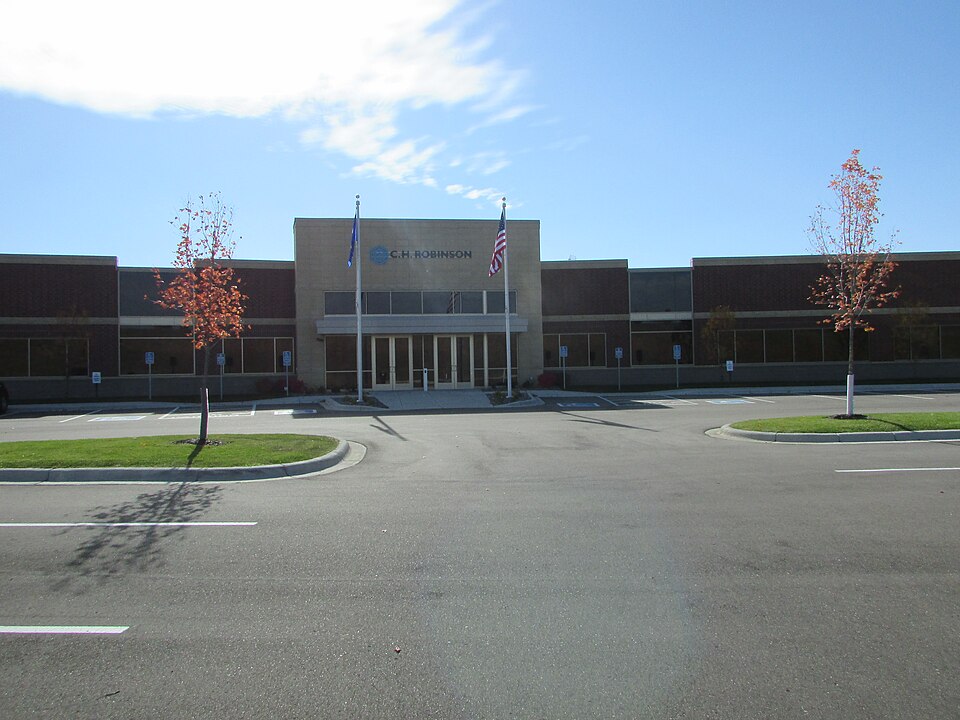
C.H. Robinson agrees to buy RXO, uniting two big truck brokers
On Sunday 4 October C.H. Robinson agreed to buy RXO, the truck broker XPO spun off in 2022, in a deal valued at $5.8 billion including RXO's net debt, about $5.3 billion of it for the shares, paid about 57 percent in cash and 43 percent in its own stock; it has a bridge loan commitment of up to $4.5 billion, will pause buybacks, and expects about $300 million a year of net cost savings within two years of a closing planned for the first half of 2027.
What the companies signed
On Sunday 4 October C.H. Robinson Worldwide of Eden Prairie, Minnesota, signed an agreement and plan of merger to buy RXO, a truck brokerage company based in Charlotte, North Carolina, and on Monday 5 October the two announced it and reported it to the Securities and Exchange Commission. Their joint release puts the deal's 'implied value' at $5.8 billion. C.H. Robinson's investor presentation splits that into approximately $5.3 billion for RXO's shares, the equity value, and $5.8 billion of enterprise value, a measure that adds the debt a buyer takes over and subtracts the cash; RXO owed $501 million of debt in principal and held $15 million in cash at the end of June, by its quarterly report. Both boards approved the agreement unanimously and RXO's board recommends it to its stockholders. The companies expect to close in the first half of 2027, after which RXO's shares would leave the New York Stock Exchange. [1, 2, 3, 6]
Each RXO share is to become a set mix of cash and a fraction of a C.H. Robinson share. A holder may ask for all cash or all shares instead, but those requests are scaled back where needed so that, across the whole deal, about 57 percent of the payment is cash and 43 percent is C.H. Robinson stock; shares whose holders make no choice receive the mix. RXO's holders would end up owning about 11 percent of the combined company. Applied to the presentation's equity value, that is roughly $3.0 billion of cash and $2.3 billion of stock, by the desk's arithmetic. The dollar values were measured on where C.H. Robinson's shares traded, on average, over the 16 days to Friday 2 October: the cash is a fixed sum, while the stock part is worth whatever C.H. Robinson's shares are worth at closing, a risk the release lists as 'fluctuations in the market value of the merger consideration'. [1, 2, 3]
One large holder is already committed. MFN Partners, which holds about 17 percent of RXO's shares, signed a voting and support agreement with C.H. Robinson on Sunday 4 October to vote them for the merger and not to sell them; it is released if RXO's board changes its recommendation, and the agreement ends if the terms are changed to cut or alter MFN's payment without its consent. Orbis Investments, which says it is RXO's largest shareholder and has owned RXO since it became independent, said in the release that it fully supports the deal; MFN's is the only voting agreement filed. In 2024 the two funds put $550 million into RXO, $300 million from MFN and $250 million from Orbis, to help pay for Coyote Logistics. RXO's stock awards are to be paid in the standard mix, with performance-based awards counted at the maximum for 2026 and at twice the target for 2027 and 2028. [1, 2, 4, 5, 8]
Two brokers, one network
RXO has been a separate company since Tuesday 1 November 2022, when XPO spun it off and its shares began trading on the New York Stock Exchange. It is a broker: shippers bring it loads and it places them with independent trucking companies it does not own, pricing the work under contracts or at the spot rate, the going price on the day. It also runs managed transportation, planning and buying freight transport for shippers who hand over the job, and last mile delivery, where it says it is the largest provider of outsourced deliveries of heavy goods in the United States. On Monday 16 September 2024 it bought Coyote Logistics, a truckload broker, from UPS for $1.038 billion in cash, having agreed in June to a price of $1.025 billion, and said the purchase would make it the third-largest provider of brokered transportation in North America. Its revenue was $5,742 million in 2025, up 26.2 percent mainly because of Coyote, and it reported net losses of $100 million in 2025 and $290 million in 2024, the 2024 figure including a one-time $216 million charge tied to the private share sale that helped pay for Coyote. In the first half of 2026 its revenue was $3,199 million and its net loss $45 million. Truck brokerage made up 71 percent of its gross revenue in 2025, last mile 20 percent and managed transportation 9 percent, by C.H. Robinson's presentation. [5, 6, 8, 3]
C.H. Robinson is much the larger. It arranges freight by truckload, less-than-truckload, ocean, air and more for 75,000 customers with 450,000 contract carriers, about 37 million shipments a year, and its North American Surface Transportation division, which arranges truckload and less-than-truckload freight across the United States, Canada and Mexico, brought in $6,541 million of its $8,947 million of revenue in the first half of 2026, a half in which it earned $334 million. RXO is to go mainly into that division. The presentation counts 18,000 shippers and 150,000 carriers at RXO and notes 'Limited Customer Overlap' with C.H. Robinson; Reuters reported that the deal would widen C.H. Robinson's last-mile delivery coverage in the US and help it win more large corporate customers. They are rivals today: RXO's annual report names C.H. Robinson among its primary competitors in what it calls a highly fragmented industry with thousands of companies, and Transport Topics ranks C.H. Robinson second and RXO eleventh on its list of the 100 largest logistics companies in North America. [2, 7, 3, 9, 5, 10]
How it is paid for
C.H. Robinson will pay the cash with new debt. On Sunday 4 October Morgan Stanley Senior Funding committed to lend it up to $4.5 billion as a 364-day senior unsecured bridge loan: a short-term loan promised in advance so a deal can close before the buyer has raised long-term money, and not secured on any particular assets. The bridge may cover part of the cash, the repayment of RXO's credit facility and fees, and it also stands behind amendments C.H. Robinson wants to its own $1 billion revolving credit facility and to the note purchase agreement under which it sold notes to institutional investors in 2013; the commitment shrinks as C.H. Robinson raises money from debt securities or term loans and as those amendments take effect. The company intends to pay through one or more capital markets transactions, meaning sales of securities to investors, new term loans and cash on hand, drawing on the bridge only to the extent necessary, and the merger does not depend on its getting the money. Morgan Stanley is both C.H. Robinson's financial adviser and one of the lenders. At C.H. Robinson's request RXO is to help redeem, buy back or exchange its $400 million of 6.375 percent notes due 2031. [1, 2, 4, 6, 7]
C.H. Robinson's debt has already grown this year: at the end of June it owed $1,685 million, against $1,089 million at the end of 2025, and held $154.6 million in cash, by its quarterly report. Its presentation estimates net debt, debt minus cash, at 2.9 times a year of adjusted earnings before interest, taxes, depreciation and amortization at closing, a common gauge of how heavily a company has borrowed, on a figure that counts the full savings it expects; its target is 1.75 to 2.25 times by the end of 2028. Until it is back in that range it plans to pause share repurchases, and it says it expects to keep solid investment-grade credit ratings and to keep growing its dividend. Its revolving credit agreement caps its leverage ratio, as that contract defines it, at 3.75 to 1, and its note purchase agreement at 3.50 to 1. [7, 3, 2]
What the savings rest on
The price rests on cost cuts. C.H. Robinson expects net cost savings running at about $300 million a year within two years after closing, by applying what it calls its Lean AI operating model to RXO: by its presentation, a management system of scorecards and continuous improvement plus more than 100 AI agents, software that carries out tasks from quoting a price to collecting payment. About 80 percent of the savings is to come from serving customers at lower cost and from merging shared services, and about 20 percent from dropping duplicate outside services and from real estate and insurance. On the presentation's own measure of adjusted gross profit per employee, which is not a standard accounting figure, C.H. Robinson went from $162,000 in 2023 to $214,000 in 2025, while RXO's 2025 figure, calculated slightly differently, was $164,000; the slide calls this an efficiency opportunity 'similar to C.H. Robinson pre-2023 before Lean operating model introduction'. Dave Bozeman, president and chief executive of C.H. Robinson, called the deal 'a natural next step in our transformation'. The agreement keeps continuing RXO employees' pay, target bonuses and comparable benefits for 12 months after closing and, for those outside RXO's severance plan, sets minimum severance for that period. [2, 3, 4]
The deal comes in a squeezed truckload market. C.H. Robinson's quarterly report says North American freight kept tightening in the second quarter as carrier capacity shrank, with regulatory enforcement affecting how many drivers are available and high operating costs straining carriers, while underlying demand stayed subdued: the Cass Freight Index, a measure of industry shipment volumes, was down 3.3 percent on a year earlier. Its own truckload cost per mile, before fuel surcharges, was up about 29.0 percent while the rate it charged customers was up about 25.5 percent, because costs climbed faster than contract rates could be repriced. RXO describes the same squeeze, with capacity 'continuing to exit, driven primarily by regulatory changes and enforcement', so that what it paid carriers went up faster than its contract rates; its cost of transportation was 83.0 percent of its revenue in the second quarter, against 78.8 percent a year earlier. One slide in C.H. Robinson's presentation is headed 'Combination Rationale Does Not Rely on Freight Market Recovery'. [7, 6, 3]
Brokers also carry more legal risk. C.H. Robinson's quarterly report says the Supreme Court's decision in Montgomery v. Caribe Transport II made clear that state-law negligence claims over a broker's choice of trucking company are, in certain circumstances, not preempted by federal law, so plaintiffs may increasingly claim that a broker failed to take reasonable care in picking a carrier; RXO's annual report in February said only that the court had agreed to hear such a case. On Thursday 23 July a jury in Dallas County, Texas, found that C.H. Robinson had negligently hired the carrier in a catastrophic accident in March 2021 and assigned it 23 percent of $604 million of damages; because the jury also found it vicariously liable, it may be held liable for the whole $604 million. C.H. Robinson has accrued only an immaterial amount, says it does not believe it probable that the full judgment will be sustained, and had $155 million of insurance per occurrence for that period. Bloomberg News, in a report carried by Transport Topics, noted that the merger comes shortly after the ruling, which it said opened brokers to lawsuits when a contracted carrier's driver is in a collision. [7, 5, 10]
What settles it next
The next records are regulatory filings and RXO's vote. The agreement requires both companies to file under the Hart-Scott-Rodino Act, the US law that makes large mergers wait while antitrust officials review them, within ten business days of signing, and to make the other competition and foreign-investment filings, in jurisdictions listed in a disclosure letter that is not public, within 20 business days. C.H. Robinson pays the filing fees and controls the strategy, and it must offer remedies such as sales of businesses, but not ones that would have a material adverse effect on RXO's business or more than an immaterial effect on its own; neither side may agree with a regulator to put off closing without the other's consent, or sign another deal that would hold up the approvals. C.H. Robinson is to file a registration statement on Form S-4 that will carry RXO's proxy statement, the document that asks holders for their votes, and the merger needs a majority of all RXO shares outstanding, not just of the votes cast; MFN's roughly 17 percent is pledged. [4, 1]
If the merger has not closed by Sunday 4 July 2027, nine months after signing, either side may end the agreement, though either may extend that date twice by three months if only the antitrust or foreign-investment approvals are missing, which would carry it to Tuesday 4 January 2028 by the desk's arithmetic. RXO would pay C.H. Robinson a $175 million termination fee, about 3.3 percent of the equity value by the desk's arithmetic, if it ends the agreement to sign a better offer, if C.H. Robinson ends it after RXO's board changes its recommendation or after a material and willful breach of RXO's promise not to seek other offers, or if a rival proposal was made and not withdrawn, the agreement then ends in certain ways such as a failed vote, and within 12 months RXO agrees to or completes another sale. The agreement sets no fee for C.H. Robinson to pay, including when antitrust approval fails: after a valid termination neither side owes anything else except for fraud or a willful breach. The companies expect to close in the first half of 2027. [1, 4, 2, 3]
Who it reaches
C.H. Robinson (CHRW) is the buyer: it takes on new debt backed by the bridge commitment, pauses share repurchases and folds RXO mainly into its North American Surface Transportation division. Neither the agreement nor the release gives RXO a seat on C.H. Robinson's board or names a role after closing for RXO's chairman and chief executive, Drew Wilkerson, who called the deal 'an exciting next chapter' for RXO; C.H. Robinson's president and chief executive is Dave Bozeman. RXO (RXO) is the company being bought: its holders vote, may ask for cash or shares within the limits, and would own about 11 percent of C.H. Robinson. Morgan Stanley (MS) is reached twice, through Morgan Stanley Senior Funding, which committed the bridge loan, and Morgan Stanley & Co., C.H. Robinson's financial adviser. [1, 2, 4]
UPS (UPS), which sold Coyote to RXO, was to keep its brokered freight with RXO under a contract running through January 2030, by RXO's release of June 2024; the merger makes RXO a C.H. Robinson subsidiary. J.B. Hunt (JBHT), Landstar (LSTR), Expeditors (EXPD) and Forward Air (FWRD) are named with C.H. Robinson among RXO's primary competitors in its annual report for 2025, along with Echo Global Logistics, Flexport, Total Quality Logistics and Uber Freight; the merger puts two companies from that list under one owner. [8, 1, 5]
Sources
- C.H. Robinson Worldwide, Inc., current report on Form 8-K, Items 1.01 and 7.01 (the merger agreement, the voting and support agreement and the debt commitment l, 2026-10-05
- C.H. Robinson and RXO, joint press release, C.H. Robinson to Acquire RXO (exhibit 99.1), 2026-10-05
- C.H. Robinson Worldwide, investor presentation, C.H. Robinson to Acquire RXO (exhibit 99.2; the slides were read as images), 2026-10-05
- Agreement and Plan of Merger among C.H. Robinson Worldwide, RXO, Rover Merger Sub and Viking Logistics (exhibit 2.1), 2026-10-04
- RXO, Inc., annual report on Form 10-K for the year ended 31 December 2025, 2026-02-09
- RXO, Inc., quarterly report on Form 10-Q for the quarter ended 30 June 2026, 2026-08-06
- C.H. Robinson Worldwide, Inc., quarterly report on Form 10-Q for the quarter ended 30 June 2026, 2026-07-31
- RXO, Inc., press release, RXO To Acquire Coyote Logistics From UPS (exhibit 99.1 to its Form 8-K of 24 June 2024), 2024-06-23
- Reuters, via BNN Bloomberg, C.H. Robinson to buy freight broker RXO for US$5.8B, 2026-10-05
- Bloomberg News, via Transport Topics, C.H. Robinson to acquire RXO for $5.8 billion, 2026-10-05
Every stock is a company; the desk grades the company behind the stock. This article describes; it does not recommend. Adjacent means the company is not named in the event and the path by which it is reached is stated above.