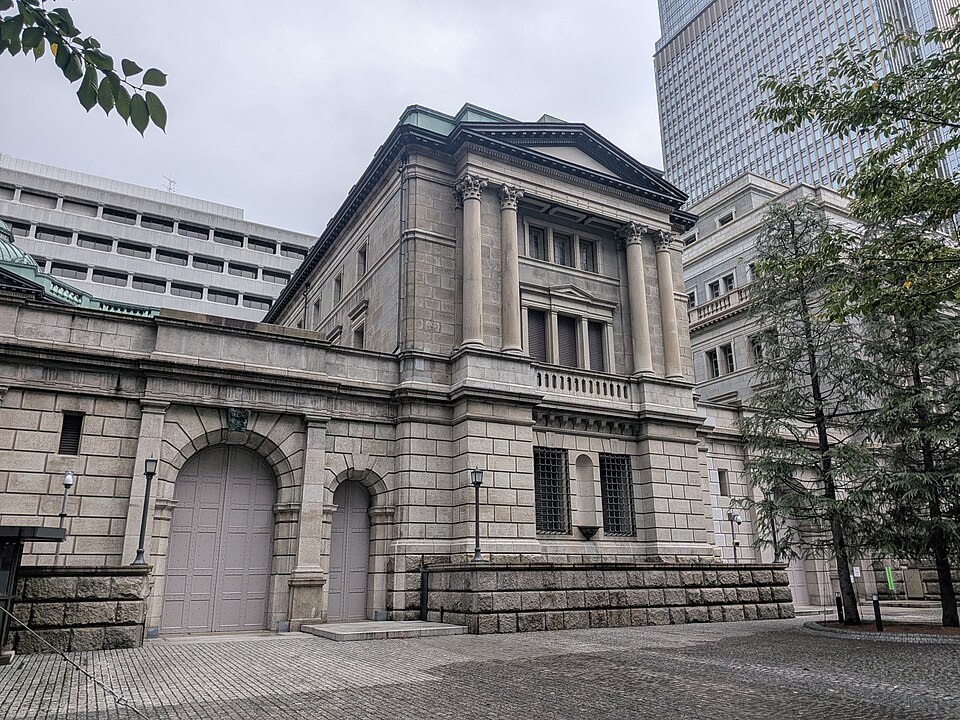
The Bank of Japan lifts rates to 1.25 percent, highest since 1995
Two days after the Fed's increase and a day after three Bank of England members voted for one, Japan's central bank moved for the second time in three months; its statement expects inflation clearly above 2 percent later this fiscal year, two members voted no, two others said the Bank's wording is already late, and the yen fell anyway, Reuters reported.
What the Bank decided
At the meeting that ended on Friday, the Bank of Japan's Policy Board decided by 7 votes to 2 to guide the overnight call rate, the rate banks charge each other for a day's money and the Bank's policy rate, to around 1.25 percent, up from 1 percent. The rate the Bank pays commercial banks on the balances they hold with it goes to 1.25 percent as well, and its basic loan rate to 1.5 percent. All three take effect on September 24. The statement came out at 11:54 in the morning, Tokyo time. [1, 2]
Reuters reported the move as widely expected, the highest policy rate in 31 years, and meant to forestall the risk of inflation overshooting the 2 percent target. Al Jazeera noted it is the first increase since June, and the Seoul Economic Daily that the pace has quickened to an increase every three months, from roughly one every six months since the Bank began raising in March 2024. Nikkei Asia reported Governor Kazuo Ueda saying monetary policy had entered a new phase. [3, 7, 8, 6]
The reasons, in the Bank's words
The statement describes an economy that has recovered moderately with some weakness, partly from the situation in the Middle East. Producer prices keep rising fast on three things it names: demand tied to artificial intelligence, high crude oil prices and a weaker yen. Consumer prices excluding fresh food have been rising by 1.5 to 2.0 percent a year as companies pass import costs and wage increases into their prices, inflation expectations keep rising, and underlying inflation is approaching 2 percent with a risk, the Bank says, of going above it. Real interest rates remain low. On what comes next the statement is plain: the Bank will continue to raise the policy rate, weighing the timing and the pace, and it expects consumer price inflation to move clearly above 2 percent from the second half of this fiscal year, which ends in March 2027, before easing back toward 2 percent. That is the Bank's own projection, as published. [1]
The board disagreed in both directions. Toichiro Asada voted against because consumer price inflation has recently been below 2 percent and, in his view, the economy cannot necessarily be called strong. Ayano Sato voted against because she did not see economic and price developments accelerating enough to raise the rate now. Hajime Takata and Naoki Tamura voted for the increase but opposed the statement's description of the price outlook from the other side, each holding that inflation has already reached a level consistent with the target. Two members thought the Bank was early, and two thought its wording was late. [1]
The morning's data sat between them. Reuters reported that core consumer prices, which leave out fresh food, rose 1.7 percent in August from a year earlier, after 1.8 percent in July and against a forecast of 1.8 percent, and that the measure that also leaves out fuel rose 1.9 percent. Core inflation has now been under 2 percent for eight straight months because government utility subsidies offset broader price increases, Reuters wrote, while fuel costs from the Middle East and a weak yen have raised the risks. [5]
What the governor said, and what the yen did
At his news conference Ueda would not commit to a pace. How fast and how far depends on how prices develop, he said, as Reuters reported it; the Bank needs to look at the data carefully, but "that doesn't mean we can move slowly." He said underlying inflation overshooting 2 percent could hurt the economy, that medium- and long-term inflation expectations have risen, and that recent wage data were strong and suggested wage pressure is broadening. On the currency he drew a line: the Bank looks at how currency swings could affect inflation at home and does not set policy to control the exchange rate. He added that it is hard to say where the neutral rate, the level that neither speeds nor slows the economy, lies. [4]
Reuters reported that the increase failed to prop up the yen, which fell as investors focused on the absence of explicitly hawkish guidance and on the two dissents. Asia Times, in a commentary by William Pesek, put the fall at about 1 percent after the governor spoke, noted that both dissenters were appointed under Prime Minister Sanae Takaichi, and recalled U.S. Treasury Secretary Scott Bessent's public claims of insight into the Bank's next move; its argument is that the Bank was answering inflation that is outrunning growth, not Washington. [4, 9]
The week the central banks turned
Tokyo's was the third decision in three days. On Wednesday the Federal Open Market Committee raised its target range to 3.75 to 4 percent by 12 votes to 0 and said inflation remains elevated. On Thursday the Bank of England held its rate at 3.75 percent by 6 votes to 3, with Megan Greene, Catherine Mann and Huw Pill voting for 4 percent; its summary put consumer price inflation at 3.1 percent in August and tied the rise in energy prices to the protracted conflict in the Middle East. The Bank of England and the Bank of Japan both name the conflict in the Middle East, and the Fed's statement points to geopolitical uncertainty. [10, 11, 1]
The line from Tokyo to an American borrower runs through the bond market. Japan is the largest foreign holder of U.S. Treasury securities, with 1,103.9 billion dollars in July against 1,155.4 billion a year earlier, the Treasury's table shows, with its own caution that custody data may not reflect who finally owns the bonds. Analysts cited by Reuters, as Al Jazeera carried them, watch the gap between American and Japanese rates, because a wider gap weakens the yen and lifts Japan's import costs. Reuters reported the ten-year Treasury yield hovering around 5 percent this week. [12, 7, 13]
Who it reaches
The decision names no company, so every path here is adjacent. Mitsubishi UFJ, Sumitomo Mitsui and Mizuho, Japan's three largest banks, each listed in New York, hold balances at the Bank that will earn 1.25 percent from September 24. Toyota, Honda and Sony report in yen and sell around the world, so the exchange rate the Bank names as a risk, and that Reuters reported falling on the day, moves their results. The company files on this site carry each one's record. [1, 4]
Sources
- Bank of Japan, Change in the Guideline for Money Market Operations (the decision, the votes and dissents, the outlook attachment), 18 September 2026, 2026-09-18
- Bank of Japan, Amendment to Principal Terms and Conditions of Complementary Deposit Facility, 18 September 2026, 2026-09-18
- Reuters via Investing.com, BOJ raises interest rates to 31-year high in widely expected move, 18 September 2026 Tokyo time, 2026-09-18
- Reuters via Investing.com, BOJ Governor Ueda's comments at news conference, 18 September 2026, 2026-09-18
- Reuters via Investing.com, Japan's core inflation holds near BOJ's target (the August consumer price index), 18 September 2026 Tokyo time, 2026-09-18
- Nikkei Asia, BOJ hikes rates to 1.25% as chief Ueda cites shift in policy phase, 18 September 2026, 2026-09-18
- Al Jazeera, Bank of Japan raises rates to 31-year high of 1.25% as inflation rises, 18 September 2026, 2026-09-18
- Seoul Economic Daily, Bank of Japan Raises Key Rate to 1.25%, Highest in 31 Years, 18 September 2026, 2026-09-18
- Asia Times, Bank of Japan rate hike exposes cracks in Bessent's facade, commentary by William Pesek, 18 September 2026, 2026-09-18
- Federal Reserve Board, FOMC statement, 16 September 2026, 2026-09-16
- Bank of England, Monetary Policy Summary and Minutes, September 2026 (decision of 17 September), 2026-09-17
- U.S. Department of the Treasury, Treasury International Capital data, Table 5: Major Foreign Holders of Treasury Securities (through July 2026), 2026-09-17
- Reuters via Investing.com, US single-family housing starts rebound in August; building permits fall (the ten-year Treasury yield around 5 percent), 17 September, 2026-09-17
Every stock is a company; the desk grades the company behind the stock. This article describes; it does not recommend. Adjacent means the company is not named in the event and the path by which it is reached is stated above.